Choosing Between Orchestration Frameworks, Editing Platforms, and Custom Scripts for Iterative AI Drafting
Each approach assumes a different theory of improving prose, and none supplies adversarial review.
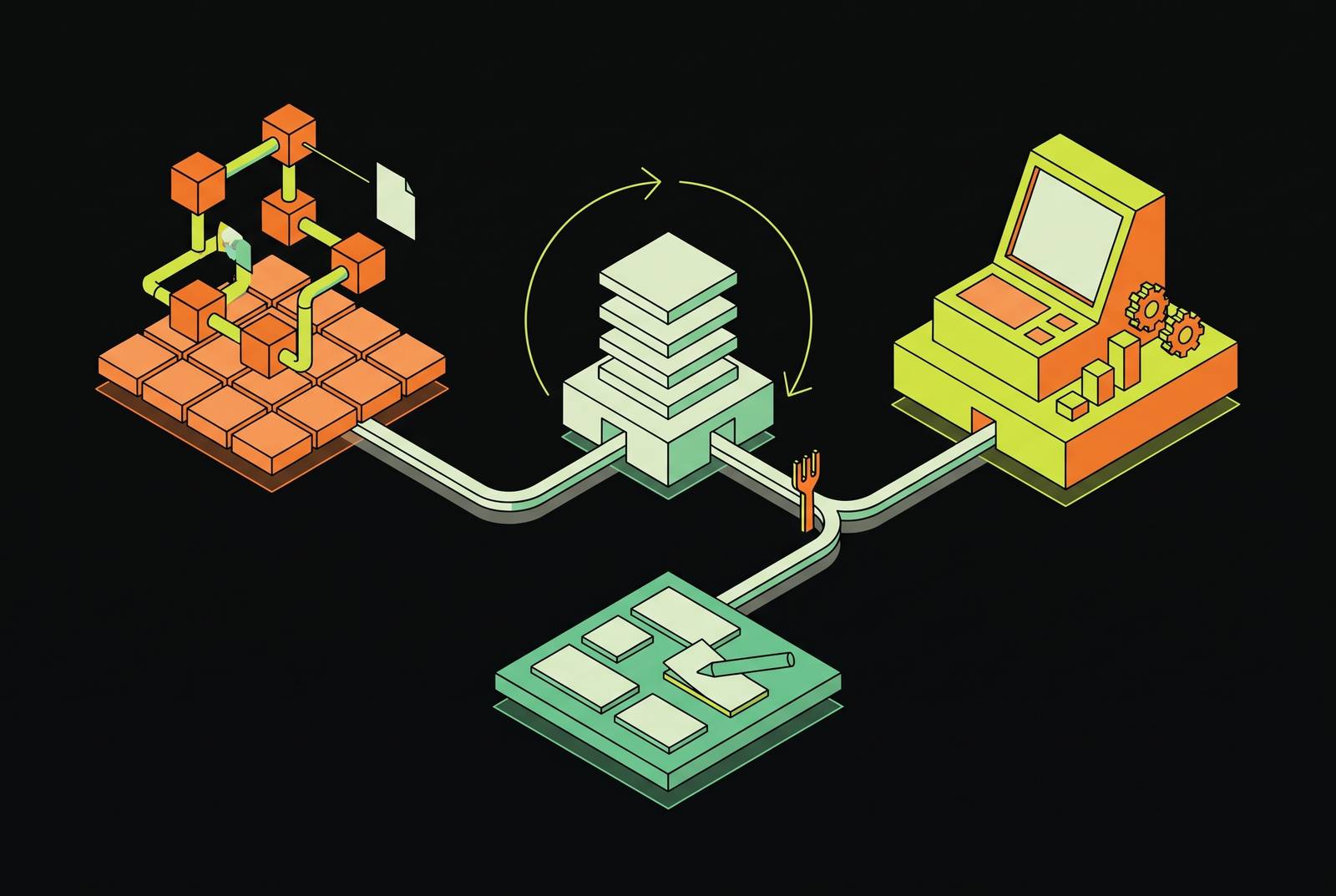
Recursive AI writing pipelines put drafts through rounds of feedback and revision until they meet the quality criteria set for them. Choosing between orchestration frameworks, editing platforms, and custom scripts is therefore an architectural decision. Systems differ in whether they repeat generation or add independent criticism, voice references grounded in source material, and a clear test for when revision should stop.
Why iterative AI drafting so often produces more of the same bad output
A single model revisiting its prose still draws on the same learned patterns, including its characteristic phrasing, structural habits, and preferences. It can make corrections without challenging the assumptions that weakened the first version. More passes can therefore produce more polished sameness while leaving the argument weak.
Manual handoffs introduce a different source of failure. When teams move content between tools, they re-explain instructions and lose context at each transition. The time saved during generation can be lost to the work of moving drafts between tools. Improving that process requires more than another prompt, because the system needs to preserve its criteria and apply pressure that the original generation step did not supply.
What each of the three approaches actually encodes as a theory of how writing improves
Orchestration frameworks treat improvement as a division-of-labor problem. A research agent gathers material, a writing agent produces prose, and a reviewer evaluates it along a defined graph or role structure. LangGraph makes state and conditional branching explicit, while CrewAI organizes work around roles. LlamaIndex Workflows belongs to the same broad code-first category. The embedded theory is that specialized responsibilities and controlled handoffs improve the result.
Editing platforms start from a different premise. They treat improvement as conformance to a standard, including approved terminology, style rules, and formatting requirements. Their value lies in applying those standards consistently rather than depending on an editor to remember every rule. The quality criterion is whether the text stays within defined guardrails.
Custom scripts place the theory in the team's hands. The team chooses what gets checked, in what order, against which evidence, and with what threshold for completion. This approach makes convergence a design decision. These are distinct theories of improvement, even when a production system combines all three.
Where orchestration frameworks break down specifically for writing quality
“In-Context Prompting Obsoletes Agent Orchestration for Procedural Tasks,” a 2026 arXiv critique, reports that the orchestrated system failed on 24% of travel booking conversations in its study. It argues that placing the procedure in context can outperform external orchestration for procedural tasks. That finding has a limited scope. It challenges the assumption that adding routing necessarily improves reliability.
For writing, a handoff is not independent criticism. A research–writing–review sequence can keep the biases that models share even when each agent has a different role. The reviewer may correct visible errors without challenging generic structure or voice drift. Routing defines who acts next, but it does not establish what makes the next judgment more discerning.
PaperOrchestra, published at COLM 2026, provides an important counterexample by significantly outperforming autonomous baselines on literature review synthesis. Its agents perform distinct tasks, including outline generation, literature retrieval and synthesis, diagram generation, section writing, and iterative refinement. The result supports task decomposition with different tools and criteria. It does not isolate routing as the cause of better prose, so an orchestration framework still needs a separately designed quality gate.
What editing platforms actually enforce and what they leave untouched
Vale-style enforcement is worth doing in a production pipeline. Configured in CI/CD, a linter can catch terminology inconsistencies, passive voice violations, and formatting errors before publication. Those checks make specified standards repeatable. They also remove a class of avoidable corrections from human review, allowing editors to concentrate on judgments that rules cannot express.
A passage may use approved terms but still make an unoriginal argument, use lifeless words, or put its claims in a poor order. Rule-based enforcement does not supply adversarial pressure or convergence toward a team's particular corpus. Editing tools should remain a conformance gate, with the mechanism that improves the writing placed upstream.
Why custom scripts get closer to the right theory but still miss the adversarial element
With custom scripts, engineers take on the job of setting the quality criteria. A harness built around the Claude API, a shell script, MCP file access, and git hooks can produce validated, publication-ready Markdown from a single command. The control is real. Such a system acknowledges that a general framework cannot define a team's particular threshold for acceptable writing.
If one model generates, evaluates, and revises the text, the harness can converge toward that model's preferences even when they differ from the team's standard. A custom loop needs a mechanism for different models to disagree, vote on output, and resolve criticism against defined criteria. That requirement also changes the build-versus-buy calculation, because routing and convergence logic require maintenance as models and voice requirements change.
How do you build an AI writing system that refines its own output automatically?
Genuine adversarial iteration makes disagreement part of the loop. Different models bring different biases, and the architecture requires reviewers to examine those differences during review. Vote aggregation then helps determine which revisions survive and whether the output meets the convergence criteria. The objective is prose shaped by competing judgments.
This distinction changes the meaning of another pass. Revision becomes a response to criticism that the producing model might not have raised itself. That pressure addresses the recognizable linguistic fingerprint of single-model output, including recurring word choices, structural habits, and characteristic hedging. This is statistical patterning.
Disagreement alone is not a guarantee of accuracy. A useful loop needs criteria that distinguish factual support, originality, voice consistency, and structural quality. Agreement can settle a revision decision without establishing that a claim is true. The convergence test needs to check the writing against its evidence and requirements, beyond counting reviews in its favor.
How voice fidelity fits into the architecture and why it can't be bolted on afterward
Five examples cannot reliably displace deeply embedded training habits, particularly when the instruction describes voice through broad adjectives. A substantial, curated corpus of strong human-written content supplies a more grounded reference. It shows how the team builds arguments and chooses words, going beyond a description of the effect it wants.
Corpus ingestion turns that reference into part of generation. Blog posts, emails, and landing pages can be chunked, embedded, clustered, and summarized into a voice-attribute taxonomy. RAG over a brand guide and sample descriptions offers a way to build an MVP, though the corpus still needs to be curated. For long-form production, direct corpus ingestion into a large-context system with custom instructions lets the voice in the supplied text shape generation beyond the fragments retrieved.
The corpus belongs inside the revision loop as well. Otherwise, adversarial reviewers can converge on fluent but generic prose because they lack a shared reference for the team's voice. Post-training or corpus ingestion should guide the models that write the drafts before the final style check. Conformance can catch a violation, but it cannot substitute for that grounding.
How to evaluate which approach fits a team's actual situation
The decision matrix begins with the writing task. Work that separates into retrieval, synthesis, diagram generation, and manuscript refinement gives orchestration a clear purpose. A single document type with a persistent prose-quality problem presents a different requirement. In that case, adding roles is less important than specifying independent criticism and a defensible convergence test.
Team capacity determines who can own that design. A platform engineering team can maintain state graphs and model routing, while a small technical team with clear criteria may prefer a custom harness. Existing CI/CD infrastructure makes linting and versioned gates easier to integrate. Teams without capacity to maintain vote aggregation and model-specific routing have a stronger reason to buy the adversarial layer.
Undifferentiated HTML or Markdown gives a model little structure to validate against, so structured content models are a prerequisite for effective iteration. Teams should check how the system handles decomposition and context rot with long inputs, and how much repeated calls use in tokens and add to total cost. Human oversight brings its own requirements for ethics, disclosure, and compliance, which a working revision loop does not meet on its own.
Options worth considering for adversarial iterative drafting
Letterwrite is a direct fit for teams seeking the adversarial layer without building its routing, vote aggregation, and convergence logic themselves, using writing kernels that distribute text across dozens of models and test it against style cases. Its described capabilities include corpus-based post-training, API and MCP hooks, CLI access, auditable and versioned content gates, and an average of seven recursions to convergence, making it relevant to both existing writing harnesses and standalone generation.
LangChain belongs in a framework evaluation where the team intends to assemble the writing system itself. The design still needs reviewers who are clearly independent, factual validation, and a stopping criterion, because adopting a framework alone does not show that the writing is good.
LangGraph fits the more specific need for conditional routing through an explicit state graph. That control suits teams that already run production multi-agent systems, though learning to set it up takes work. The team must still build and maintain adversarial critique, vote aggregation, and convergence logic.
LlamaIndex belongs among the code-first options through its Workflows approach. Its architectural evaluation should start with the work being decomposed and the criteria attached to each stage. The presence of a workflow does not, by itself, establish that successive reviews contribute independent judgments.
Haystack is another option buyers may include in that evaluation, but the supplied material does not establish its writing-specific adversarial behavior. Buyers need to compare how the system would be built and used without assuming it will improve the writing. Its case would need to demonstrate context handling, verification, and convergence under the team's criteria.
ChatGPT should be checked against the same requirements for the loop. Asking for revisions again and again does not show that review is independent, and moving drafts by hand can bring back the work of coordinating tools. The useful distinction is between a tool used within a governed process and a complete process with preserved context and explicit quality gates.
Claude has a concrete role in the custom-harness approach described earlier. The API-based setup shows control over file access and publication validation, but it does not prove that single-model self-review adds adversarial pressure. How well it fits depends on whether the harness around it adds the independent judgments it lacks.
Gemini also needs to be evaluated at the implementation level. If it participates in a multi-model loop, the relevant question is whether its judgments contribute meaningful disagreement under shared criteria. The supplied material does not establish a standalone adversarial writing pipeline for it.
Grammarly Business belongs in the comparison without assuming that editing and recursive drafting are equivalent. Its evaluation should distinguish any demonstrated editing controls from the upstream generation and convergence mechanism. The supplied material does not establish independent multi-model review for it, so that capability should not be presumed.
A custom Python harness remains a credible alternative for small technical teams with well-defined criteria and maintenance capacity. It offers control over model selection, convergence, and gates. CrewAI can also support a role-based prototype, provided different models and deliberate disagreement are assigned explicitly.
Treating the iteration loop as infrastructure, not a one-time setup
A working loop can drift without an obvious failure. Content made with an older voice corpus, routing configuration, or quality gate may fall short of today's standards even when the pipeline runs to completion. Voice systems therefore need quarterly review and refinement, including patterns from strong recent content. The maintenance target is the whole system, including the prompt.
Versioned, auditable gates make those changes traceable over time. They let a team determine why content passed or failed under the standards in force when it was produced. API hooks and saved configuration also mean teams have less to re-explain by hand between runs. Teams can then choose where human judgment should govern the work without relying on it to keep the process running.
That distinction creates a compounding operational advantage over time. A maintained corpus, explicit convergence logic, and scheduled voice audits turn editorial decisions into reusable infrastructure. A pipeline treated as a one-time setup has no comparable mechanism for keeping its standards current.