Recursive Editing and Iterative Drafting Systems
Separating editorial functions into discrete passes breaks the single-pass ceiling.
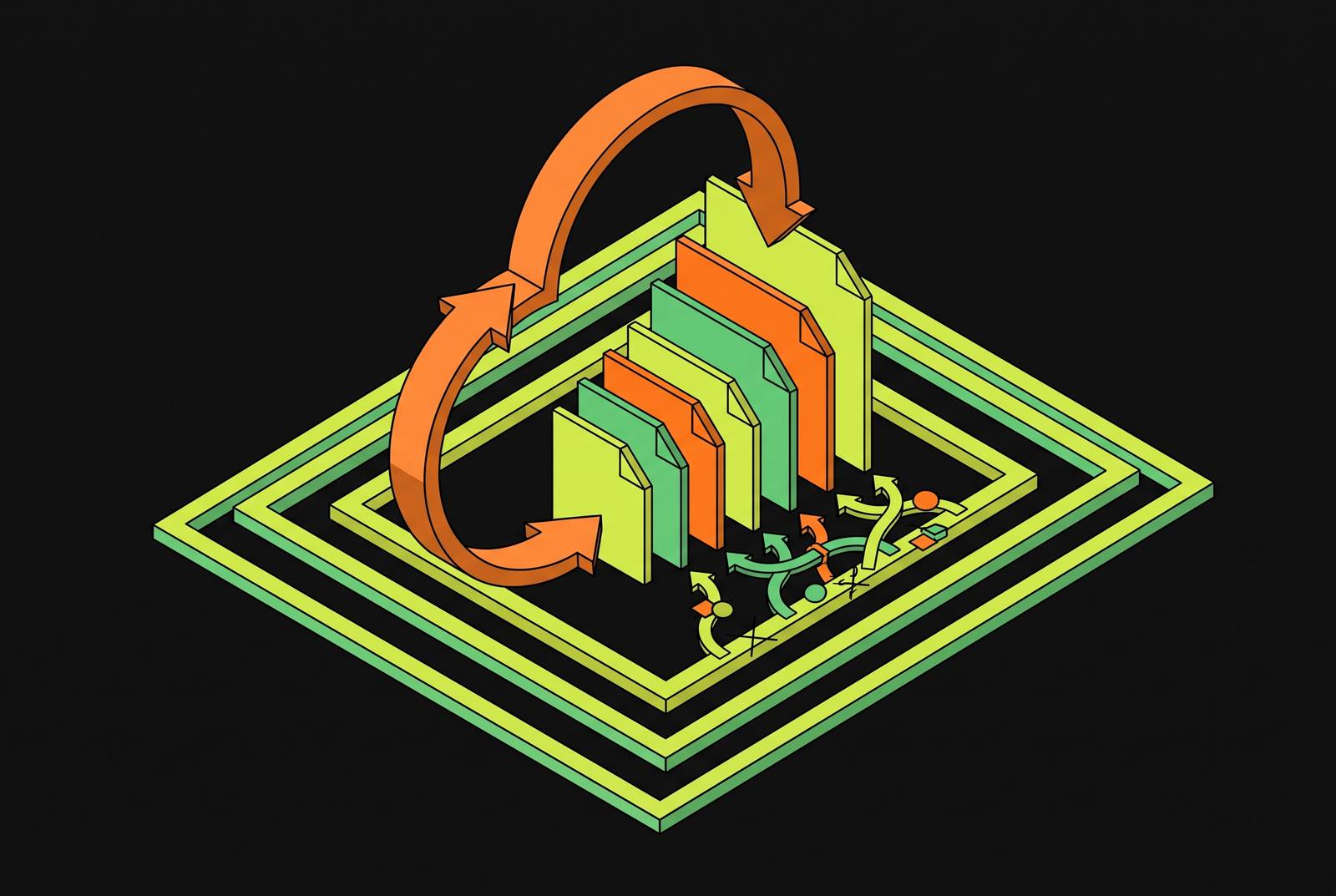
Recursive editing and iterative drafting systems make revision a structural property of the pipeline. They get past the single-pass ceiling by giving generation, critique, compression, and voice restoration a pass of their own. The gain comes from that separation, but it depends on carrying context through every handoff and enforcing standards that no individual model can quietly replace.
Why single-pass output has a structural ceiling, not a model quality problem
The draft is readable, coherent, and strangely forgettable. It explains subtext that should remain implicit, resolves every metaphor too neatly, and moves at a pace that never breaks rhythm. These are the predictable marks of a system trying to satisfy competing editorial objectives at once. The result lands in the middle, with some work done toward each goal but too little toward any of them.
That makes the familiar search for a better prompt or a better model a category error. Generation, critique, compression, and voice matching pull the same output in different directions. Producing material calls for latitude, while cutting it calls for restraint. A longer prompt does not remove that conflict. When it adds more simultaneous objectives, it can lower the ceiling by giving the model more demands to average across.
How separating concerns into discrete passes escapes the ceiling
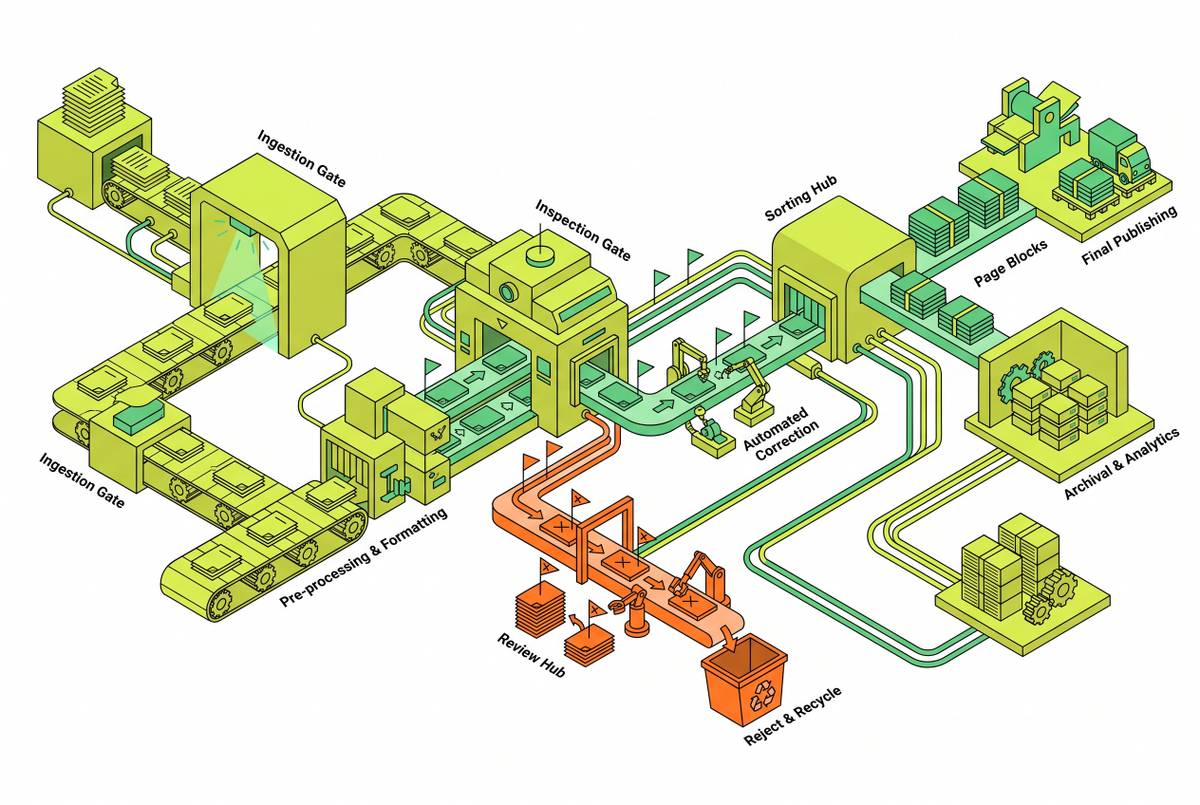
The architectural fix is to give each editorial function its own pass. The practitioner pattern has four roles, namely generation, destabilization, compression, and voice restoration. Generation produces raw material with high latitude. Destabilization finds what is too tidy and introduces friction into smooth arguments or predictable expression. Compression cuts without adding, while voice restoration brings back the author’s own patterns.
Order is load-bearing because each role works on the result of the last. Compressing before destabilizing makes the smooth draft shorter but leaves what made it weak in place. The Authenticator belongs last because its job is to restore a voice after the other passes have changed the text. Moving it earlier leaves its work exposed to later edits. This is separation of concerns applied to writing, with each pass free to do its job without simultaneously serving the others.
The Evaluator-Optimizer loop as the formalized version of writer-editor collaboration
Anthropic’s Evaluator-Optimizer framework gives this editorial relationship a formal architecture. One model generates, a separate model evaluates against criteria and returns feedback, and the generator revises until the evaluator is satisfied. Quality is defined by a criterion.
The Virginia Tech / UMD paper-review arms race study illustrates how production and evaluation change each other under pressure. As AI-mediated evaluation becomes more repeatable, authors can adapt to its regularities, pushing evaluators toward subtler signals. The analogy for content pipelines is direct without making scholarly publishing the subject of the system. A generator can learn to meet a critic’s usual objections while leaving deeper flaws in place. The loop must therefore tell when the work is getting better and when it is just getting better at passing its evaluator.
What must travel with the draft between passes, including context, metadata, and provenance
That distinction becomes harder to maintain when the draft travels as raw text. A downstream agent needs to know which claims came from which research points, where material was added beyond the brief, and what still needs verification. The handoff must carry both the draft and the information needed to judge changes to it. Otherwise, later passes can reintroduce problems that earlier passes already addressed.
The orchestration layer compiles agent outputs, recommendations, and confidence scores into a review package. This lets a human make strategic decisions instead of reconstructing the editorial history from scratch. It also creates a place to isolate errors, route weak output to a backup, or flag it for review without derailing the whole pipeline. Where tasks require dynamic decomposition, the Orchestrator-Workers pattern gives a central orchestrator responsibility for delegation and synthesis. That control has a cost because coordination overhead rises with agent count.
How multiple passes introduce voice drift, and what structural guards prevent it
Keeping the facts and their context can still leave the voice at risk. Each model pass can nudge the text toward its own defaults until the final draft sounds like no one in particular. Scope constraints such as “no new material” and “don't add plot” prevent compression and authentication from becoming fresh generation. The Compressor must cut, and the Authenticator must restore.
At team scale, the reference material can also become a source of drift. Training data that no longer reflects the brand can reinforce outdated patterns and hold the writing to a voice the team has left behind. Model collapse provides a broader parallel, as models trained on AI-generated material converge toward a recognizable house style. The pipeline-level problem is narrower and more directly governed. Strict role boundaries and models whose tendencies fit their assigned jobs reduce the opportunities for each pass to overwrite the author’s choices.
Building a voice spec from corpus measurement rather than adjective pairs
A reliable voice anchor requires more than a pair of adjectives. Guidelines state what a brand intends to sound like, while a published corpus shows how it actually writes. A useful authentication target needs both sources because intention and behavior are not interchangeable. The corpus also needs editorial selection. Feeding it everything ever published yields an average, while selecting the edited best gives the system a standard.
There is no agreed standard for what counts as a representative corpus, and extraction measures whatever the team supplies. That limitation does not make “confident but approachable” an equally precise alternative. A corpus-derived specification can be tested, adjusted, and improved as the corpus grows. Making that specification machine-readable gives later quality gates rules to check, so another model no longer has to work out what the same adjectives mean.
Watermarking as an external constraint that recursive systems must now account for
Voice is an internal standard, but provenance also brings external constraints. The 2024 EU AI Act’s watermarking requirement enters into force on 2 August 2026, with a grace period to 2 December 2026 for systems already on the market. That makes embedded provenance signals a requirement for the output. A recursive system produces text through several transformations, but the text may also carry signals introduced by its model providers. Editorial quality and provenance are separate properties of the same deliverable.
Anthropic says watermarks in future Claude models will be patterns of low-stakes word choices that repeat without readers noticing them. Access to its detection API is in private preview for regulators, media, educators, and obligated enterprises. OpenAI announced textGrain for use in the EU on 5 October 2026, with plans for a detection API for approved researchers and expert organizations. Testing for watermarked text currently requires knowledge of the producing model and access to its detector, so recursive pipelines must account for those requirements when assessing provenance rather than infer a simple yes-or-no property from the final prose.
Why same-family judges produce systematically biased evaluations in Evaluator-Optimizer loops
The evaluator creates another constraint because a separate model is not necessarily an independent judge. When it shares the generator’s training lineage, it tends to reward familiar stylistic defaults and overlook their weaknesses. The circularity is serious. A judge with the same priors can ratify the generator’s characteristic failures and make the loop a bias-amplifier.
The structural fix is to use a judge from a different training lineage. Its defaults are more foreign to the generator’s characteristic moves, which gives the review a better chance of exposing what a same-family evaluator accepts. That separation does not establish complete independence. Cross-lineage models may still have been trained on much of the same public web. Model diversity therefore reduces circularity by degree, while explicit evaluation criteria remain necessary to keep stylistic familiarity from standing in for quality.
Using model diversity across passes as a structural guard against stylistic convergence
Giving each pass to a model that suits its task can bring more varied work to the chain. A model that is good at generative surprise can leave precise cutting or voice restoration to another model. This division reduces the friction between a model’s inclinations and its remit. It also limits the extent to which one model’s house style governs every stage.
Different models tend to produce more useful variation than temperature shifts within one model, although temperature changes are faster and more controllable. Parallelization offers a complementary pattern by running the same generation task across models and then voting or synthesizing the results. Orchestrator-Workers routing instead lets the orchestrator assign subtasks at runtime. Adversarial multi-model review takes this further by having models critique each other’s work. Its strength is that the critic’s objections do not arise from the same defaults the generator used to construct the draft.
Style enforcement moving into CI/CD pipelines for content
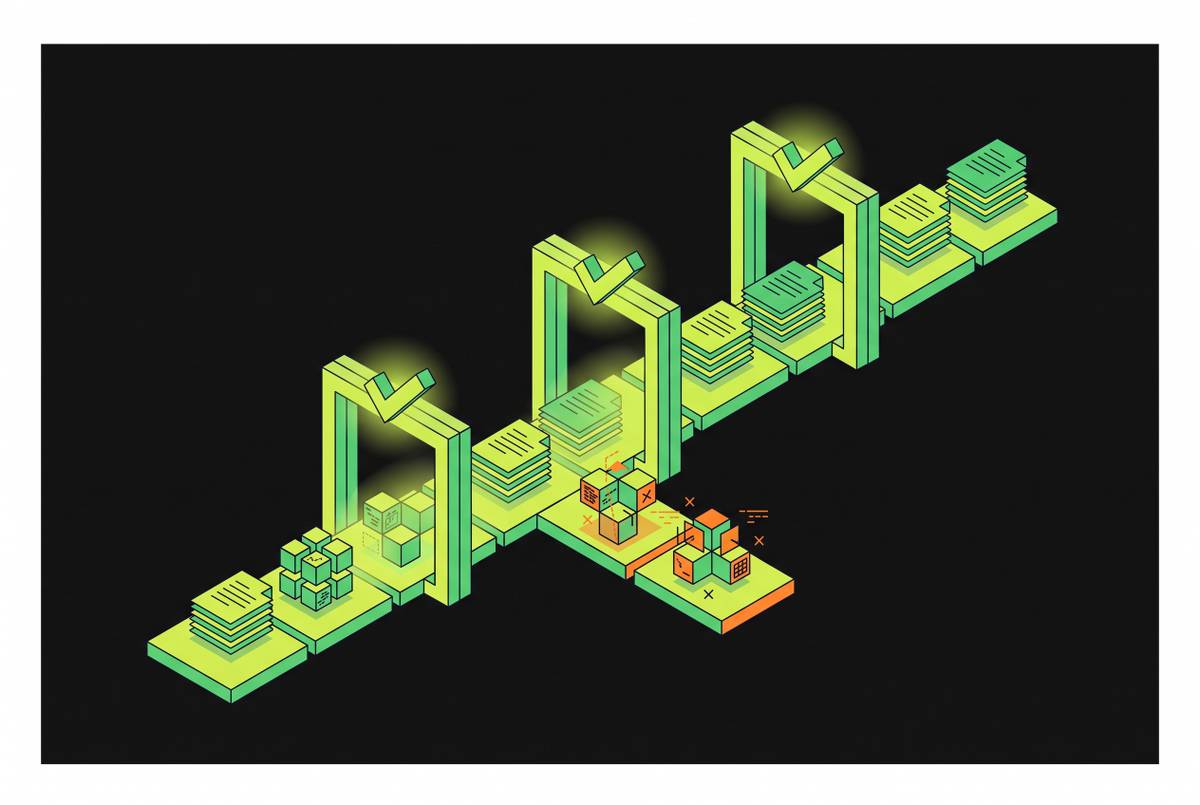
Different models still need the same standard for what can be published. Style enforcement in CI/CD makes that standard a gate by checking prose before publication and blocking merges when rules are broken. The pattern is familiar from code production, but the object under test is writing. A machine-readable voice spec gives the checks defined rules. Those checks apply to the output regardless of whether a human or an AI produced it.
Vale parses documentation files and checks them against style rules set out in YAML files, with its settings in a.vale.ini file. Running those checks on every commit makes style validation part of how the work gets shipped. Infrasity Claude Skills provide open-source slash commands for Claude Code that automate developer GTM work, including documentation audits, SEO analysis, AI discoverability checks, and content briefs. OpenHands, formerly OpenDevin, supplies agents that can work with code, terminals, file systems, and web browsers through Agent Canvas, a CLI, and an SDK/API. These tools work at different points in the workflow, but they bring content work out of a stand-alone chat and into systems that developers can run.
What building a recursive pipeline actually requires, without shortcuts
Implementation requires four connected foundations, namely role-specific pass design, context-carrying orchestration, a corpus-derived voice spec, and automated quality gates. Each needs to be concrete enough to constrain behavior. Role design includes a strict remit and explicit prohibitions, while orchestration preserves the evidence and review state needed at each handoff. The voice spec supplies an editorial target, and the gates make that target enforceable. A shortcut in any one foundation weakens the others because the pipeline depends on their agreement.
The cost is not just a longer prompt. Making several model API calls costs more per document than making one, more agents take more work to coordinate, and the orchestration layer takes engineering work to build. Maintaining the corpus and the rules also makes editorial standards an ongoing system responsibility. Those costs pay for a way of working that keeps revising until the text meets its criteria, even after generation ends. A draft that needs seven recursions can receive them automatically, and the resulting output is no longer bounded by what one pass can reconcile at once.
Sources
- The Emerging AI Paper-Review Arms Race: Adversarial Co-Evolution in Scholarly Publishing
- ABScribe: Rapid Exploration & Organization of Multiple Writing Variations in Human-AI Co-Writing Tasks using Large Language Models
- Academic english writing generation-evaluation closed-loop system driven by large language model: adversarial training and cognitive logic verification - ScienceDirect
- Overview of PAN 2026: Voight-Kampff Generative AI Detection, Text Watermarking, Multi-Author Writing Style Analysis, Generative Plagiarism Detection, and Reasoning Trajectory Detection