Content QA Pipelines for High-Volume Publishing
Structured pipelines catch AI content errors that spot-checks miss.
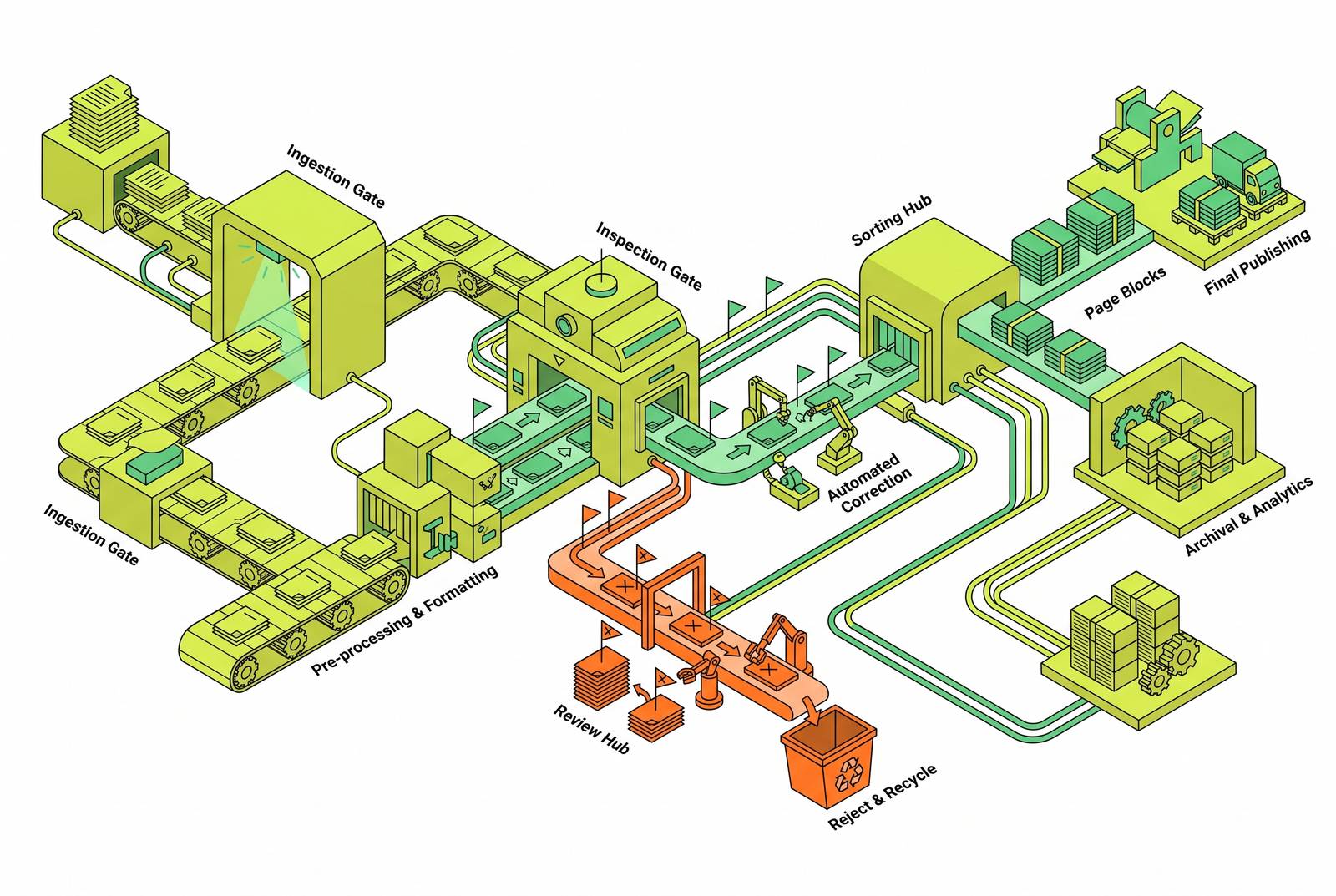
High-volume publishing needs content QA pipelines built as engineering systems. In practice, production needs testable stages, automated quality gates for distinct failure modes, and measurement of what escapes. Editorial judgment still matters, but structured pipelines make that judgment useful across an entire publishing operation.
Why high-volume publishing breaks editorial intuition
Even a low hallucination rate leads to a substantial number of errors across hundreds of monthly posts, landing pages, email sequences, and ebooks. A single hallucinated fact in an article requires a correction. The same error repeated across a content system damages brand integrity structurally.
Editorial judgment works when a reviewer can examine enough of the work to understand its weaknesses. When volume is high, a reviewer cannot check enough of the work, and spot-checks leave much of it unseen. Voice drift adds to the problem because each piece can seem fine while the work as a whole sounds more and more generic. Without explicit checkpoints, AI output trends toward generic phrasing over time, weakening brand differentiation.
What a monolithic content pipeline actually looks like when it fails
A monolithic pipeline uses one model, one system prompt, and one call per task to combine research, drafting, and reformatting. Those activities happen in a single unlogged pass, so the finished text conceals the path that produced it. When a claim is wrong, the pipeline cannot distinguish a flawed brief from an unsupported addition during drafting. When tone changes, it cannot establish whether the draft or the reformatting introduced the deviation.
MLflow's 2026 production agent guide describes monolithic designs, where a single LLM handles reasoning, routing, and execution, as deceptively easy to prototype but brittle in production. That brittleness also limits maintenance because an underperforming stage cannot be replaced independently. Changes intended to improve research remain entangled with drafting and formatting behavior. As the underlying models are replaced every few months, that coupling makes improvement harder to isolate. The architectural gap is explicit because there are no quality gates, no stage isolation, and no feedback loops that identify where a failure began.
How decomposing the pipeline into specialized stages creates quality gates
Specialization makes a quality gate possible by giving each stage a defined input, a defined output, and a testable failure condition. At minimum, the pipeline separates research and brief generation, drafting against the brief, factual and brand-voice review, and publish gating. Each stage belongs to a distinct agent with its own constraints and logging. A research agent turns the topic into a brief, and a writing agent receives that brief with brand voice instructions in its system prompt. A review agent then checks factual claims and tone before the content reaches the publish gate.
The outline agent defines the structure, while the brand guidelines define how the draft should sound. MLflow's production agent guide describes the architecture as a microservices-inspired approach in which a routing layer manages capabilities that can each be deployed on their own. An underperforming sub-agent can therefore be replaced without changing the rest of the pipeline. The boundary between stages becomes both a checkpoint and a point of substitution.
Communication and reproducibility belong in that design from the start. MLflow's guide identifies the Model Context Protocol (MCP) for exchanging context with tools and the Agent-to-Agent (A2A) protocol for communication between agents. Adopting those standards early avoids retrofitting custom communication layers later. Structured logging and model version pinning are also prerequisites because an unreproducible failure cannot be fixed systematically. Decomposition makes review possible by exposing the intermediate work that a reviewer needs to inspect.
Why adversarial multi-model review catches failure modes that a single reviewer misses
Separate stages do not, by themselves, create independent judgment. A model reviewing its own output, or output from a model with the same architecture, can share the assumptions that caused the original error. Adversarial examples that fool one model often do not transfer to models with different architectures or training procedures. Ensemble voting, model agreement checking, and diverse prediction aggregation use that difference to improve robustness. The relevant principle for content QA is diversity of failure modes.
In practice, the pipeline can draft on one model, stress-test factual claims on another, and check voice fidelity on a third. Because those reviewers have different training distributions, they have different reasons to question the draft. For high-stakes decisions, running the same brief side by side also exposes differences that a single output would hide. These approaches turn review from general approval into a deliberate attempt to find weaknesses.
Disagreement is itself a useful signal, but it is not a verdict. When structurally different reviewers disagree about a claim or a tone judgment, averaging their answers does not settle the issue. The disagreement should instead reach a human or a third model with a defined tiebreaker role. That escalation makes the review process accountable without treating model consensus as proof. The review still depends on asking each reviewer to check for the right kind of failure.
Hallucination, voice drift, and factual decay each need a different instrument
Hallucination is a grounding failure in which a generated claim lacks support in the source material or contradicts verifiable evidence. Hallucination rates have compressed significantly across frontier models, but they remain nonzero, and volume turns a low rate into a material number of errors. A broad quality review can miss those errors because prose that reads well and has a clear structure can still contain unsupported claims. The right instrument is a separate factual grounding agent that receives the draft and research brief, then flags claims it cannot verify against cited sources. In regulated industries, people still need to fact-check flagged claims because the pipeline shows where there is doubt and leaves those claims for them to judge.
Voice drift is an accumulation failure, so an isolated draft is not enough to measure it. Each piece may pass a spot-check while the work as a whole shifts toward generic web-English. Detection requires a reference corpus of brand examples with explicit voice descriptor tagging, against which a reviewer can compare new output. Semantic retrieval alone can find on-brand samples yet miss drift in new content categories, so the descriptor tags help cover categories it misses. Fine-tuning on brand examples gives the model a stronger hold on the brand's voice than retrieval alone, while explicit voice training helps it resist the pull toward generic phrasing.
Factual decay is different again because the claim was accurate when published and became wrong later. Neither a grounding check nor a voice review at drafting time can detect a future change. The appropriate instrument is a scheduled re-audit stage that periodically examines published content. This treats evergreen content as a living asset with a freshness TTL rather than as a completed item that permanently retains approval. Factual decay is especially easy to miss in standard editorial workflows because its failure occurs after the piece ships.
Where Vale and LLM-powered linters fit in the developer layer of the pipeline
The developer layer translates these review boundaries into checks that can run within CI. In the two-layer CI pattern, deterministic linters run first, executing in seconds and catching formatting and syntax issues. For prose, Vale parses documentation files and checks the writing against style rules set out in YAML configuration files. Those rules can check for passive voice, jargon, and how complex sentences are. This layer applies set rules without needing a model to judge each time the text breaks one.
The second layer runs a custom script that sends content and style rules to an LLM, then parses the violations into structured review comments. It addresses semantic issues that deterministic linters cannot reliably assess, including naming quality, documentation completeness, pattern adherence, and voice alignment. Because this review runs slower, it should be gated so it runs only where the cost is justified.
Adversarial semantic review fits into that second layer through a reviewer distinct from the drafting model. Factual grounding still needs the research brief and sources, while voice review needs the tagged reference corpus. Every stage should emit violations as parseable objects. Structured output lets the pipeline act on findings programmatically, send them to a human review queue, or use them as training signal.
How watermarking and detection APIs are changing the governance layer, and what they cannot do
Watermarking addresses provenance. The EU AI Act introduced a requirement for AI model providers to watermark their output, with the provision becoming applicable on 2 August 2026 and a grace period until 2 December 2026 for systems already on the market. That changes the compliance context for publishing, but it does not establish whether a claim is accurate or a draft is on-voice. A detectable origin is not a publish approval. Watermarking therefore sits beside the QA pipeline, with all of its checks still in place.
Google announced a SynthID-based detector in May 2025 and an expanded rollout to Search and Chrome in May 2026, followed by the full public rollout of the standalone Detector in October 2026. Anthropic announced in August 2026 that Claude would watermark all its output and released a detection API in private preview in September 2026. OpenAI announced watermarks for its models on 5 October 2026, initially in the EU only, using a technology it called textGrain. OpenAI also announced a detection API to be made available to approved researchers and expert organizations.
The watermarking mechanism influences word selection using a key and one or more preceding tokens. ETH Zurich's SRI Lab published Making Open-Source Text LLM Watermarks Durable Against Merging at NeurIPS E&D 2026 and a paper on LLM Fingerprinting via Semantically Conditioned Watermarks at ICLR 2026. Those papers address durability under model merging and adversarial modification. Durability matters to provenance, but even a durable watermark says nothing about factual grounding, voice fidelity, or freshness.
Access also limits what publishing teams can build around detection. Detection APIs are currently gated to eligible groups, including regulators, law enforcement, media, fact-checkers, independent researchers, educational organizations, EU civil society groups, and enterprises with EU compliance obligations. They are not available to content marketing infrastructure as a general self-audit tool. Publishing teams must therefore govern through logging, version pinning, and approval gates. The regulatory layer should make it possible to audit provenance, while teams still need their own checks to decide whether content is fit to publish.
Treating content quality as an observable, measurable system rather than a judgment call
A content QA pipeline remains reliable only if its feedback loops expose degradation over time. MLflow's production agent guide places monitoring of faithfulness, drift, and hallucination rates inside that reliability work. Evaluation needs to run within the workflow so the work can be audited in real time, as well as through offline batch analysis. Every stage should emit structured logs containing the failure type, stage of origin, model version, and content ID. Those records make aggregate failure rates trackable and give regressions a traceable origin.
Measurement must also connect to enforcement. MLflow's guide states that runtime governance decisions should be enforced deterministically before actions reach the wire. Applied to publishing gates, that principle means a blocked action must be structurally impossible rather than dependent on a model choosing to refuse it. Observability explains what happened, while deterministic gating constrains what can happen next.
A corpus of known-good and known-bad examples, run against the pipeline whenever a model or style guide changes, makes regressions visible before publication. Content QA becomes an engineering discipline because it uses structured logging, observable failure modes, and evidence-led feedback. Editorial judgment supplies the standards, and the pipeline makes those standards testable at scale.