Writing Test Cases as Quality Gates
Test cases catch quality failures that single models cannot fix alone.
Writing prose with a single model fails for structural reasons, not because any individual model is deficient. The failure is architectural: one system chasing multiple objectives at once guarantees mediocrity across all of them. What software engineering solved with the test suite, writing pipelines have not yet solved at all.
Why single-model LLM output fails as a production writing standard
The defect sits in how attention works under load. Ask one model to research, draft, optimize, and format at once, and you spread its capacity across competing objectives. Prompt complexity rises, and each objective degrades proportionally. The result is not catastrophic failure but the worse problem of uniform adequacy: output that passes casual inspection while falling short of every standard that matters.
A second failure mode compounds the first. Single-model generation converges on the statistical center of its training data. When the model predicts the most likely next token, it produces the most common next token for the industry at large, not the most useful one for a specific brand voice. This is why so much generated prose reads as it does: safe phrasing, generic industry tropes, the listicle structure that averages thousands of mediocre examples rather than one distinctive voice.
The economic consequence inverts the efficiency promise. You adopt AI writing to cut editing time, but the output needs more human fixes than you expected. Editing then shifts from line-level fixes to structural rewrites, which takes longer. The tool that promised leverage creates rework, because the foundational quality layer that would have caught the drift was never built.
What software testing discipline actually does that writing pipelines don't
Software engineering solved the ship-and-hope problem because it made quality verifiable, not a judgment call. A test either passes or it fails. There is no threshold for "pretty good" that lets broken code through, because the gate is enforced, not advisory. Failure stops the pipeline. Coverage thresholds are set deliberately, and they are often higher for AI-generated code than hand-written code because its failure modes are less predictable. The TriAdReview study on arXiv ran 75 experiments across five benchmark tasks so it could claim statistically meaningful quality margins for multi-model generation.
The CI/CD pattern is familiar to any working developer: a pull request opens, automated checks run, the pipeline fast-fails on the first violation, and no human reviews until the gates pass. Human attention is preserved for judgment, not triage. Writing currently skips this entire layer. A draft moves from generation to human review with no intermediate verification step, which means every reviewer is doing triage rather than judgment. The missing primitive is a definition of what passing looks like for a piece of prose, one that is specific, checkable, and independent of who happens to be reading it.
How documentation linting tools bring checkable assertions to prose
Documentation linting already exists and treats prose correctness as a verifiable property. The gap is that most writing pipelines do not use it. Vale is the dominant open-source CLI tool for this purpose. It scans Markdown, MDX, AsciiDoc, reStructuredText, HTML, and many other file formats for style and terminology violations. You run it as a command-line tool, and it integrates into Git hooks and CI/CD pipelines, so you get feedback locally before anything reaches review. It flags vague language, passive voice, non-inclusive terms, broken links, non-compliant terminology, and structural inconsistency.
The architectural point is the gate's indifference to authorship. The gate does not care who wrote the draft, so it checks both the same way. The check is automated, deterministic, and blocking: a commit that fails Vale does not merge. This is what separates a quality gate from a style guide. A style guide is advisory documentation. A gate is a machine-enforced contract that executes every time and cannot be skipped by oversight or deadline pressure.
The self-correction loop: how AI agents respond to linter failures
When an AI agent submits content that fails a quality gate, the failure is not a dead end. The agent can parse the error log and generate a correction commit, which turns the gate into a self-correcting loop rather than a rejection. An AI agent submits a pull request. Vale runs the same checks it would run on a human's PR. If the linter flags issues, the agent gets the structured error output and generates a correction on its own for minor violations. Only failures that exceed the agent's correction capability escalate to human review.
You can do the same thing at the agent middleware level with Claude Code hooks. The PreToolUse hook fires before any agent tool call, including file writes and Bash commands, inspects the content, and blocks actions that violate standards before they execute. The PostToolUse hook runs the linter after every edit, so the agent receives immediate feedback on each change rather than waiting for pull request time. The design principle this surfaces is that quality comes from gates that execute by default after every subtask, not from instructions asking agents to remember to check.
Why adversarial multi-model review catches what linting can't
Style linting catches rule violations, but the deeper quality failures in AI writing require a different mechanism. Over-engineering, generic structure, and blind spots inherited from training data cannot be reduced to lint rules, because they are not violations of anything specifiable in advance. Catching them requires a reviewer that does not share the generator's assumptions. TriAdReview tests this directly with a triangular adversarial review architecture: two independent reviewer models, one taking an engineering perspective and one a boundary perspective, plus a third-party judging model that resolves disputes rather than taking a majority vote. Evaluated across 75 experiments on five technical writing task types, the triple-model configuration achieves a meaningful overall quality improvement over the single-model baseline, with the strongest gains on security audit, code generation, and architecture design.
The mechanism that makes adversarial review different from instruction-based improvement is the direction of its prompts. A reviewer prompted to challenge naturally identifies what can be removed or simplified. A reviewer prompted to improve tends to add features. The first de-fats. The second bloats. The distinction matters because adversarialism is not universally beneficial. TriAdReview found that requirements analysis degraded under adversarial review, because reviewers trained to challenge removed necessary components. The honest finding strengthens the case for task-adaptive routing, not blanket adversarialism. De-fatting tasks and completeness tasks need different review prompts, and TriAdReview partially mitigates the issue with reviewer prompt adaptation for requirements analysis.
The self-review problem clarifies why architecture matters. When one model generates and reviews its own output, the reviewer inherits the generator's blind spots. Independent models from different training distributions do not share those blind spots, and that is what makes their disputes informative.
What watermarking and AI detection add to the quality gate picture
External pressure is compressing the timeline for adopting these gates. AI-generated content is now detectable at the model level, not just the surface level. Watermarks are embedded in word choice instead of metadata, so what counts as passing a quality gate changes. Anthropic and roughly 189 other signatories signed the EU Code of Practice on Transparency of AI-Generated Content in July 2026. Article 50 of the EU AI Act became applicable from August 2, 2026. Future Claude models will generate text containing a watermark, a signal of the likelihood that Claude was involved in processing the text, implemented specifically to comply with the Act.
The technical mechanism is more subtle than steganographic metadata. Some AI companies embed the watermark in the words the model chooses, so the signature lives in the generation itself. Research extends this in several directions: PostMark as a robust blackbox watermark, DualGuard defending against paraphrase attacks and spoofing simultaneously, error-correction-code-based watermarks, and semantic watermarks embedding the signature in meaning rather than token choice. The PAN 2026 shared tasks now include Voight-Kampff Generative AI Detection, text watermarking, multi-author writing style analysis, generative plagiarism detection, and reasoning trajectory detection. ETH Zurich's SRI lab published NeurIPS 2026 research on making open-source text LLM watermarks durable against model merging, and separately produced work on LLM fingerprinting via semantically conditioned watermarks.
For a writing pipeline, the implication is direct. A pipeline relying on a single model's output inherits that model's watermark signature: detectable, attributable, and increasingly subject to disclosure requirements. Leadpages' 2026 content guide flags Claude's watermarking behavior as a factor content teams should test for their own use case, particularly for ghostwriting, some freelance contexts, and certain editorial standards.
Distributing output across multiple models as a structural response to watermarking
Shredding output across multiple models, using different models for drafting, revision, and judgment, structurally dilutes the single-model watermark signature that detection systems look for. Leadpages' 2026 content guide identifies the winning stack as DeepSeek for drafting, ChatGPT for revision, and a human for final edit. No single model's fingerprint dominates the output. ChatGPT's tendency toward safe generic output is bypassed when it revises rather than originates, which means the same architectural logic that improves quality also disrupts the single-model detection signal.
The deeper argument is that single-model reliance creates two compounding liabilities. Generic prose and a detectable watermark are structural problems, not prompt-engineering problems, so they need an architectural fix, not better instructions. Task-adaptive model routing extends this logic. Different model strengths map to different pipeline stages: research synthesis, drafting, revision, and quality judgment. Routing deliberately to the right model at each stage produces a composite output that no single model could generate. This is the same specialization logic that makes multi-agent content systems outperform monolithic prompts, now applied to the watermarking problem.
Voice fidelity as the third quality gate that neither linting nor adversarial review fully covers
A pipeline can pass every style rule and survive adversarial review and still produce prose that sounds like every other brand in its category. Voice fidelity is a quality property requiring its own gate. The mechanism of voice failure is that LLMs without explicit voice training default to the statistical center of web-English, a flattening effect that turns under-documented brands into generic versions of their category. Narrative drift is the operational risk: a brand's persona diverges across models because different models have different training data and weighting. High AI share of voice with low narrative fidelity still erodes brand value.
Corpus-based voice gates address this. For long-form content, you need a minimum corpus of highly polished, representative text so you can prompt with few-shot examples formatted as input/output pairs. Fine-tuning on brand examples costs meaningful API fees and data prep time, but it produces a model that converges on a specific voice. RAG over a brand guide plus sample content works faster, but you must actively maintain a curated voice corpus. The failure mode to watch is corpus drift without verification: output quality degrades within weeks when verification is skipped. The verification step is not optional. A structured prompt asking the author to confirm or correct specific claims per post is the difference between voice fidelity and drift. The gate must be active, not assumed.
What a complete writing quality gate stack looks like in a production pipeline
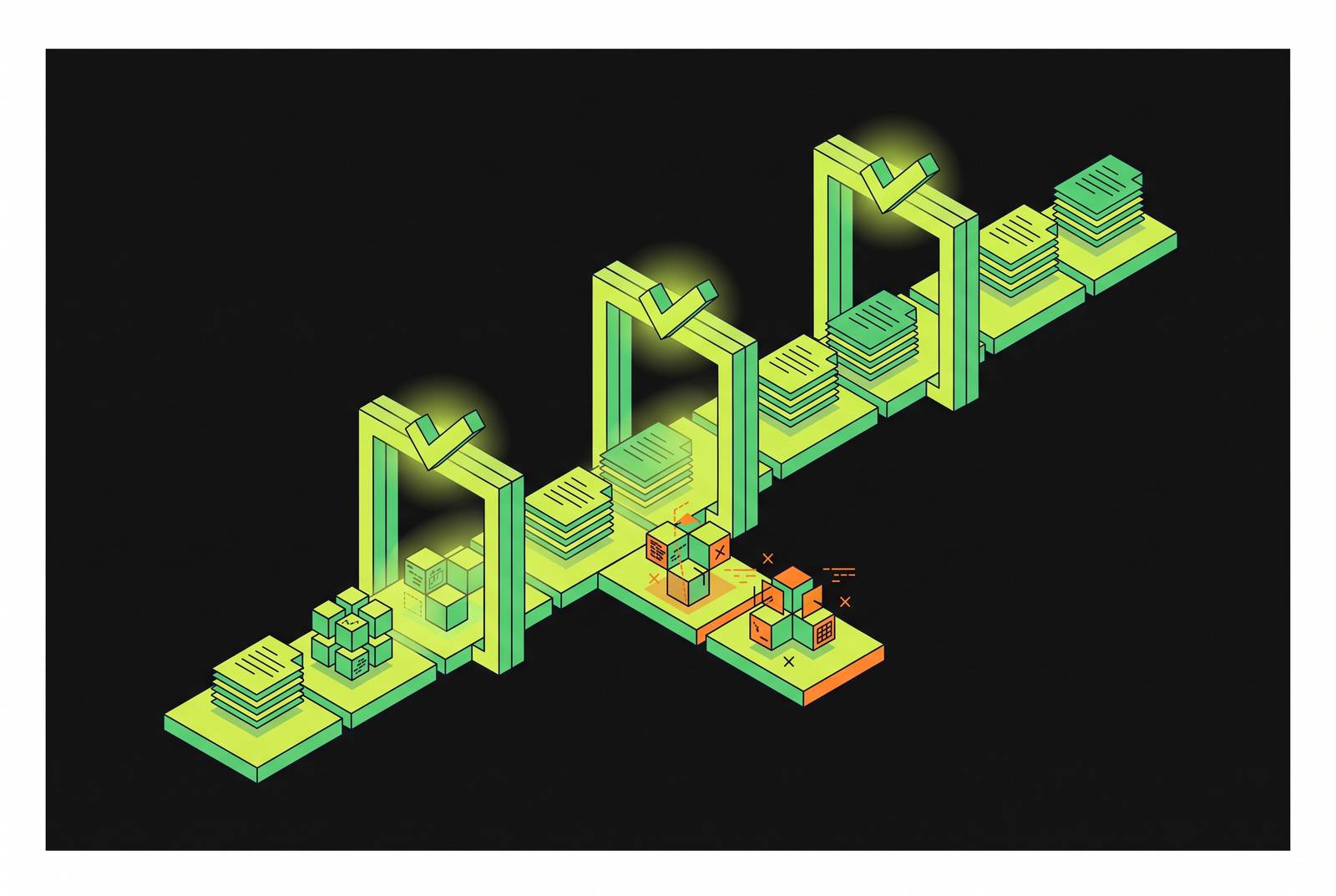
A complete writing quality gate stack is a sequenced set of checkpoints, each catching a different class of failure, with failure at any gate stopping the pipeline. The first gate is style and terminology linting via Vale or equivalent: deterministic, fast-fail, running on every commit, catching rule violations before any human sees the draft. The second is adversarial multi-model review, catching quality failures rules cannot specify, over-engineering, generic structure, blind spots, and routed by task type between de-fatting and completeness. The third is watermark and model fingerprint awareness, with output distributed across multiple models by design so no single model's signature dominates. The fourth is voice fidelity verification: corpus-grounded checking against documented brand voice, with active verification rather than assumed convergence.
The orchestration principle is that gates execute by default after each pipeline stage, not as optional review steps. Each gate produces structured, parseable output that the next agent in the chain can act on, which is what makes the pipeline agentic rather than merely automated. The seven-recursions-to-convergence design reflects the same principle as coverage thresholds in code testing: iteration is a feature, not inefficiency. Good writing takes passes, so make them automated and measurable.
Defining convergence criteria: when does a writing pipeline know it's done
A quality gate stack without a convergence criterion is an infinite loop. The pipeline needs a defined stopping condition the same way a test suite needs a coverage threshold. Convergence criteria for writing are definable and checkable. The style gate passes when you have zero Vale violations at the defined severity level. The adversarial gate passes when no reviewer model identifies a removable component or a blind spot the generator missed, or, under task-adaptive routing, when completeness criteria are satisfied. The voice gate passes when output scores above threshold against the brand corpus on defined dimensions. And no gate escalates to human review for the current revision cycle.
Convergence criteria define when automated gates are satisfied, not when human judgment is no longer needed. The gate stack's job is to ensure human review is spent on judgment rather than triage. The operational test is whether claims are verifiable: specific, named, machine-checkable criteria over subjective adjectives. "The writing is good" is not a convergence criterion. Zero passive-voice violations at severity level 2, an adversarial reviewer agreeing that no components can be removed, and a voice similarity score above threshold, that is. The discipline exists, the tooling exists, and the teams that treat writing like code ship with the same confidence that code testing provides.
Sources
- Yuvion VL: A Multimodal Foundation Model for Adversarial Content and AI Safety
- TriAdReview: Triangular Adversarial Review Architecture for Multi-Model Technical Document Generation
- Overview of PAN 2026: Voight-Kampff Generative AI Detection, Text Watermarking, Multi-Author Writing Style Analysis, Generative Plagiarism Detection, and Reasoning Trajectory Detection