Instrumenting a Quality Gate Stack Around AI Drafts at the Sentence Level
Four ordered checks catch the flaws that whole-document review misses.
AI content quality gates for content teams should test each sentence against clear standards before publication, instead of approving a document because it looks good as a whole. A production stack combines deterministic linting, factual checks, voice scoring, and adversarial review, with targeted correction for failures and human sign-off for unresolved cases. Its value depends on where the gates run, what evidence they require, and whether revisions must pass the checks again.
Why document-level review lets sentence-level failures through
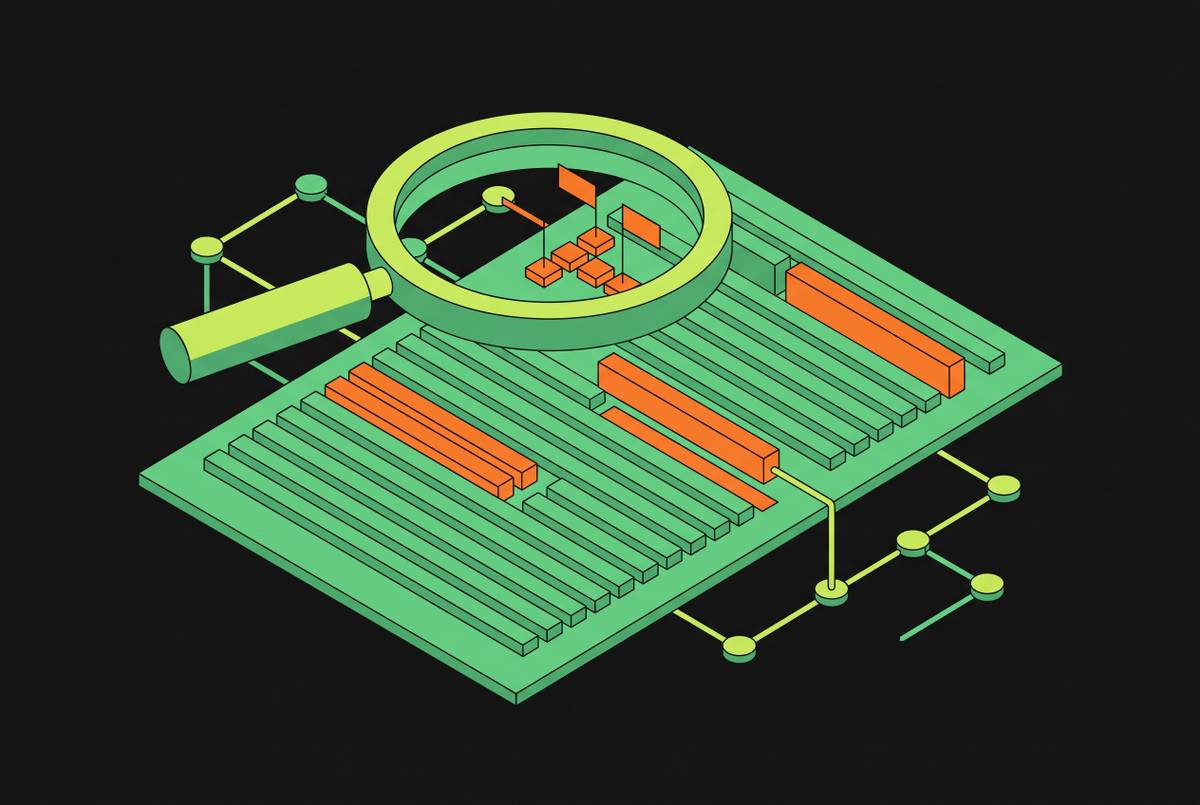
Document-level review checks the structure of a piece. It can identify a missing section or the wrong angle while overlooking an unverifiable claim inside an otherwise coherent paragraph. A banned filler opener is smaller still. Neither defect necessarily disrupts the document enough to attract attention during a holistic read, yet each can weaken factual integrity or voice fidelity.
Single-model, single-pass generation has a related weakness. When one pass handles coverage, argument, facts, and style together, it has no separate checkpoint for each responsibility. Shallow subtopic coverage and topic drift can appear in individual lines before they become obvious across the whole piece. A sentence may name a topic without developing it, or introduce a claim that moves the argument away from its purpose. Fluency can conceal both failures from a reviewer following the overall narrative.
This is a problem of resolution. Structural assessment checks whether the piece has the right parts and is headed in the right direction. It does not establish that every assertion has evidence or every transition belongs in the publication’s voice. Those checks need to look at smaller parts of the text on their own.
What it means to treat a sentence as a testable unit
Treating a sentence as a testable unit means assigning explicit pass/fail criteria to it, much as a function is tested against its specification rather than the apparent success of the whole program. The test has a defined question. It might ask whether the sentence contains an em-dash, opens with a banned transition, or makes a claim supported by the supplied source material.
Automated content linting can run before a piece is published, run on every commit, and block merges when the content breaks style rules. In a multi-agent pipeline, the same principle applies at handoffs, where one agent’s output is validated before another agent builds on it. The sentence becomes an inspectable unit within that larger flow. Its tests do not replace tests of the outline or document.
An opt-in second-pass CLI command can audit em-dashes, jargon, clichés, contractions, sentence length, and banned openers through deterministic rules with binary results. A model-evaluated test can instead assess whether a line makes a verifiable claim or merely gestures toward one. That distinction controls both cost and confidence. Deterministic checks cost almost nothing to run, while model-evaluated checks can be batched rather than processed through a separate sequential call for every sentence.
The gate stack and its four ordered layers
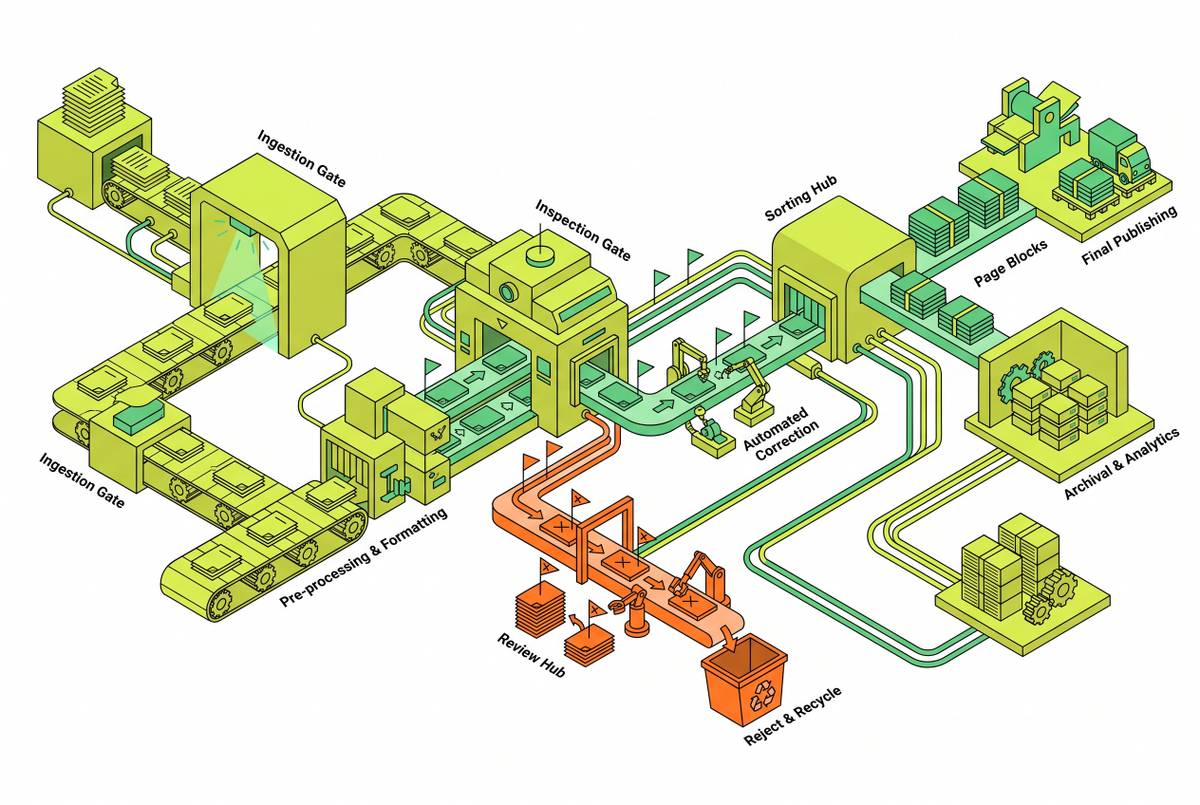
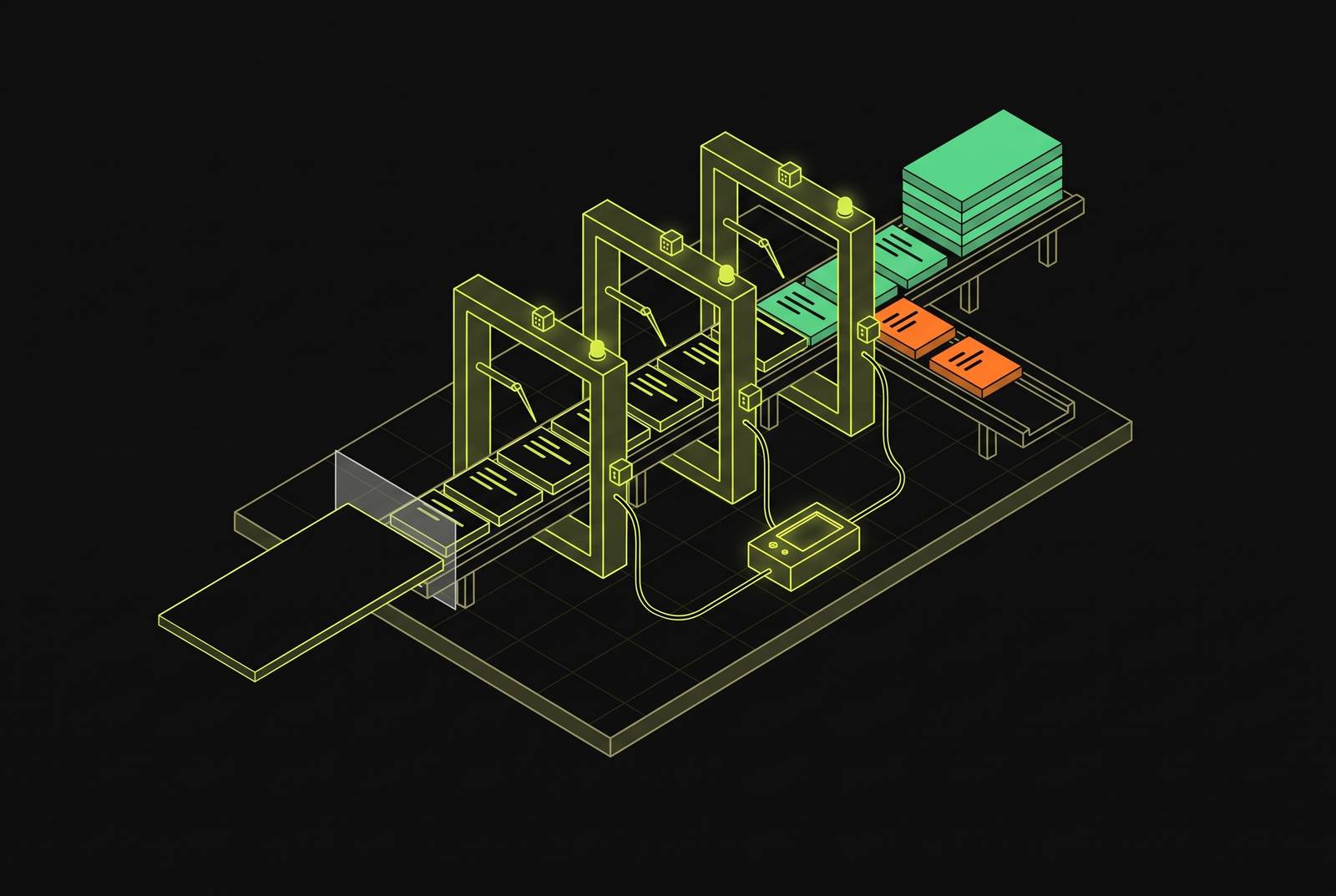
A production gate stack orders checks by cost and resolution. Cheap, unambiguous tests run before checks that require interpretation, so obvious failures do not consume model review unnecessarily. The four layers are deterministic linting, structural and factual completeness, voice and style scoring, and adversarial review. Each has a different acceptance question. Passing an earlier layer establishes only that its particular requirements have been met.
Layer one is deterministic linting. It checks banned phrases, sentence length bounds, contraction policy, em-dash frequency, and repeated sentence starts without a model call. These checks run on every sentence on every commit, serving the role that ESLint or Prettier serves for deterministic code formatting and style. Their failures are directly actionable. A prohibited construction either appears or does not, even if the editorial reason for prohibiting it requires judgment.
Layer two tests structural and factual completeness. A dedicated fact-checking sub-agent isolates claims in structured JSON payloads and evaluates them against source material. An unsupported assertion, an unsourced statistical reference, or a claim the pipeline cannot verify is routed to correction or human review. Layer three then evaluates voice fidelity against the team’s corpus, including register, sentence rhythm, and lexical choices. Correctness alone does not establish that a sentence belongs.
Layer four applies adversarial review to the claim or phrasing. Its critique agent looks for the strongest objection, including the possibility that a sentence is so broadly true that it adds no information. A sentence can obey every mechanical rule and resemble the corpus while still offering an argument that could appear in any article on the topic.
Where in the pipeline the gates fire, and why order changes what they catch
If the full stack runs only after drafting, the pipeline may already have built several stages of work on an unchecked premise. In a multi-agent workflow, each structured output becomes the next agent’s input. A flaw in the outline can thus shape how the prose is built, spreading beyond the plan itself. The final review then has to deal with both the first error and the later errors it caused.
Structural completeness checks run on the outline before any prose is written. A section that cannot be mapped to a verifiable claim is flagged before the drafting agent develops it. As each sentence is written, deterministic checks can fire inline and give feedback while the agent can still fix that line. The timing changes the repair burden. The same banned opener is simpler to resolve immediately than as one item in a batch of accumulated failures.
Commit-level review adds another check before a piece is published. In the two-layer CI pattern, traditional linters run first, and a second layer sends the pull request diff plus style rules to an LLM. Within these execution layers, its response is parsed into structured review comments for semantic issues requiring model evaluation, while the four editorial gates describe the judgments being made.
Recursive correction and what happens when a sentence fails a gate
The sentence is routed to a correction agent with the specific failure reason as its instruction. A banned opener calls for an opener rewrite. It does not require regenerating the whole sentence, much less the document, when the rest of the content already meets its requirements. This keeps the repair tied to the detected defect.
The revised sentence re-enters at layer one. Going back only to the failed layer would assume that the new wording still passes all the other checks it passed before. A voice correction must still pass deterministic rules and factual checks before it reaches adversarial review. The critique agent then looks for the revised sentence’s weakest point, instead of taking the correction agent’s rewrite as proof that it is better.
Convergence requires an explicit stopping condition. Successful termination means that the sentence passes the applicable gates. The pipeline also needs a maximum recursion count per sentence and a defined fallback for cases that do not converge. That fallback can route the sentence to human review, hold it for editorial assessment, or escalate it to a higher-capability model. Iteration is part of the design, but an unlimited loop is not.
Why detection scores are a weak gate signal and what to use instead
AI detection scores answer the wrong quality question. A sentence can evade a detector while remaining vague, generic, or unsupported, so detectability cannot establish publication readiness. The reverse is also possible. Entropy, burstiness, stylometric patterns, and model-specific fingerprints can occur in highly edited, technical, academic, or non-native writing. Treating those signals as failures risks rejecting sentences because of statistical resemblance.
Watermark detection introduces a separate access constraint. OpenAI’s textGrain announcement limits its detector at launch to approved researchers. Google’s developer documentation offers SynthID Text with a Bayesian detector, while its public SynthID Detector works with images, video, and audio but does not cover text. These are different interfaces with different scopes. Regulatory watermarking requirements do not turn them into a uniform quality instrument available to content teams.
The durable alternative is a style gate keyed to the team’s own voice corpus. Semantic fingerprinting can identify recurring model-family patterns in transitions and word choice, but removing a fingerprint is not itself an editorial objective. The replacement needs a positive standard. Established patterns from the team’s writing provide that standard, shifting the question from whether a sentence looks machine-generated to whether it uses the publication’s register, rhythm, and vocabulary.
Anchoring the gate stack to a voice corpus rather than a generic style guide
A generic style guide defines acceptable conventions. A voice corpus supplies examples of the particular writing the team wants to preserve, so the gate can assess fidelity. That distinction changes the correction target. Two sentences may both be clear and grammatical while only one matches the publication’s characteristic rhythm and lexical choices. The corpus gives the style reviewer something more specific than an instruction to sound professional.
Fine-tuning can embed those patterns in a base model’s weights. It offers consistency but requires technical expertise, a meaningful labelled corpus, and maintenance as the voice evolves. For most content sites, custom instructions can achieve a substantial portion of that result at significantly lower cost. The choice is a cost-accuracy tradeoff. It does not change the need to define what the gate accepts.
The strongest objection is inside the corpus itself. If the reference writing is generic, a faithful gate will approve generic sentences, and fine-tuning will make that outcome more consistent. Corpus matching cannot resolve this circularity on its own. Adversarial review is still needed to check whether a sentence is worth reading, even when it matches the reference material. Fidelity and editorial value are related but independent tests.
Post-trainability addresses the other weakness of a fixed reference set. The stack should be trainable on new writing from the team so that its standards evolve with the actual voice. Repository-level files such as CLAUDE.md and.cursorrules can make voice guidelines, rhythm constraints, lexical preferences, and banned constructions available to every agent. Correction then uses the same standard as generation.
How to automatically enforce content standards before publishing in a developer workflow
For teams implementing this architecture, the starting point is deterministic linting on every commit. Layer one immediately exposes common failures at negligible runtime cost, without depending on a representative voice corpus. Factual completeness comes next for content types where claim integrity is the primary risk. Voice scoring and adversarial review follow when the pipeline is stable and the corpus is representative. Unresolved failures need the human-review path defined by the correction loop.
Deterministic style linters handle explicit rules, specialized fact-checking agents evaluate claims against sources, and model-based reviewers handle voice and adversarial critique. Fern’s integration of Vale provides a production example of automated documentation style enforcement, with local and CI runs, reusable or custom rules, and selective disabling in MDX sections such as code blocks. AI-generated changes pass the same style checks as human-authored changes.
CLI access keeps these checks in the developer’s working environment. An opt-in second-pass command is useful for local review, but a gate that depends entirely on someone remembering to run it is not publication infrastructure. API and MCP hooks let teams call gates from different pipelines. The checks can then participate in the same workflow as other release requirements.
Those requirements should be auditable and versioned, just as code tests are. Teams need to keep content rules, corpus standards, correction limits, and escalation behavior up to date as the program changes. A passing result is meaningful only against a defined standard.