Line-Level vs Document-Level AI Writing Review
Different architectures solve different revision problems, not better and worse approaches.
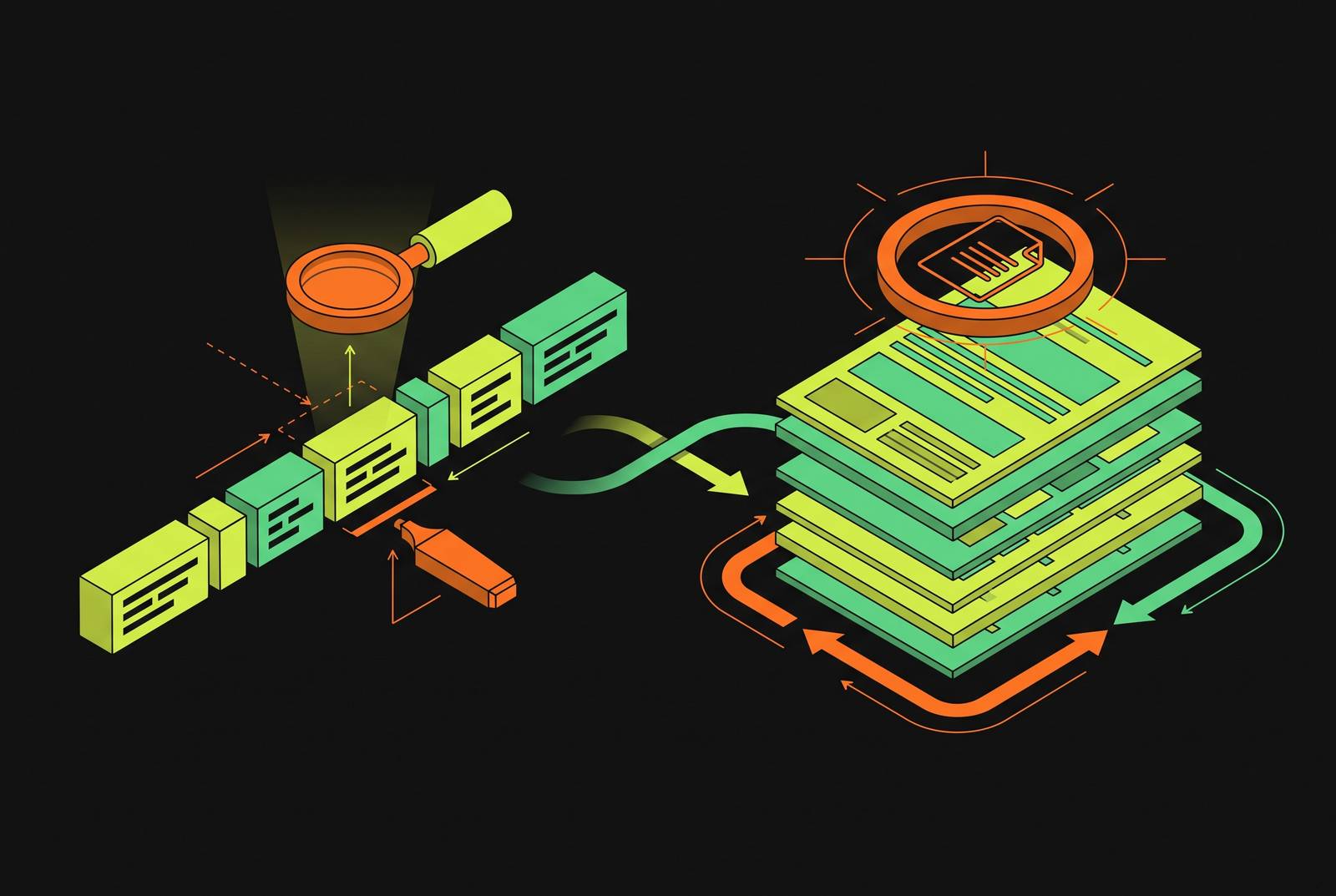
AI writing review splits into two distinct architectures, not two points on a single quality scale. Line-level review treats each sentence as a self-contained unit, correcting grammar and tone on contact. Document-level review holds an entire piece in context before making any change, so an edit to paragraph three stays consistent with what paragraph twelve says. These are different tools built for different jobs, and the rest of this piece is about knowing which job is in front of you.
How AI review divides into two operating modes
Line-level review works sentence by sentence. A model reads a line, checks its grammar, measures its tone against a target, adjusts its phrasing, and moves on. It does not need to know what the paragraph before it argued or what the conclusion will claim. Its unit of analysis is the sentence, and its judgment is local: is this clause clear, is this verb doing its job, does this phrase match the house style.
Document-level review works from the opposite premise. Before a single word changes, the system holds the whole piece, and in more capable implementations the research behind it, the outline that shaped it, and any related documents it needs to stay consistent with. An edit only gets made once it has been checked against the piece as a whole, including the sentence sitting in front of the editor. Each mode treats a different thing as the unit being evaluated: a sentence, or a document.
That distinction has a practical consequence most writers recognize immediately. Highlighting a paragraph and asking an AI tool to improve it works, and the paragraph genuinely gets better. Neither mode is better in the abstract. They are built to catch different kinds of error, and a document that only gets one kind of review will quietly fail the other.
Why Single-Context Review Breaks Down
The failure mode here is structural drift. Correctness at the sentence level does not add up to correctness at the document level.
Context-window pressure is the mechanism behind this. Something gets left out, and what tends to get left out is the document's through-line, the thread that connects the opening claim to the closing one. None of the three calls knows what the other two decided, so the finished document carries three versions of the argument stitched together rather than one argument carried through.
Legal document review shows the same pattern from a different angle. Columbia's Tow Center measured the best general-purpose assistant citing sources incorrectly 37% of the time: the model would paraphrase a clause slightly wrong, attribute a term to the wrong party, or answer from general knowledge when the actual document was silent on the point. The output read fluently in every case, which is exactly the danger. Fluency at the sentence level gave no signal that something had gone wrong at the document level, and the only way to catch the error was to go back and check the text against its source. Writing review has to catch something harder: a sentence can be well-formed and still contradict something the document said two pages earlier, and nothing in the sentence itself reveals the contradiction.
What document-level review requires architecturally
Solving this takes more than a bigger context window. A model that can technically fit an entire manuscript into memory still needs a reason to treat the whole document as the unit it's optimizing for, rather than optimizing for whichever passage it's currently looking at. Genuine document-level review requires edits grounded in a shared, persistent representation of the document's goals, structure, and voice, something every review pass can check itself against rather than reinventing its own implicit target each time it runs.
An orchestration layer has to support that representation. Without something tracking which review passes are complete, maintaining the shared knowledge base, and resolving conflicts when two review agents disagree, a multi-pass system does not converge on a better document. It degrades into several agents each optimizing against a different idea of what the document should be, which produces the same drift that single-context review produces, just distributed across more compute.
The pattern that addresses this in practice splits the task across specialized roles instead of asking one model to do everything. One agent produces a draft. A second reviews it for clarity, accuracy, and tone. A third checks structural consistency and argument coherence across the whole piece. The agents iterate through rounds of feedback before anything gets finalized, and because each one is responsible for a narrower slice of the judgment, none of them is forced into the context-window squeeze that causes a single agent to drop the thread. The multi-agent pattern Letterwrite employs follows this structure directly: it distributes review across an adversarial council of models rather than threading an entire document through one context window, with each model specializing in a dimension of critique, clarity, tone, structural consistency, argument coherence, and their feedback converging on a document-level consensus instead of a series of locally optimized patches.
Line-level review versus document-level review
None of this makes line-level review obsolete. It remains the correct architecture for tasks that are genuinely local, grammar enforcement, tone normalization, checking for forbidden terms, polishing phrasing on a passage that is structurally finished and isn't going to change the document's argument, because the sentence really is the right unit of analysis when nothing about it depends on what the rest of the document says.
Rule-based systems that encode a style guide as code, YAML files listing forbidden terms, banned transitions, and formatting requirements, are built exactly for this job. Vale is a working example of this category: it flags style-guide violations against YAML rules and plugs directly into continuous-integration workflows, which is precisely the kind of deterministic, composable check line-level work calls for.
Running full document-level review on every single sentence edit is a resource error, not a safety margin. When the unit of work is one paragraph and the document's structure isn't actually in question, maintaining a shared knowledge base and running multi-agent reconciliation to check it costs time and compute without buying anything back. The practical split follows from the task, not from preference: line-level enforcement belongs at the edit-pass stage, after structure is already set, and document-level review belongs earlier, at the draft stage, while the piece's argument, voice, and internal consistency are still being worked out.
AI writing detection and watermarking
Single-model, single-pass review leaves a signature behind. The same model's statistical patterns run through the whole document, and detection systems look for that consistency, as does regulation increasingly. A document reviewed start to finish by one model is easier to fingerprint than one that passed through several specialized agents with different outputs at different stages.
Access to detection tools is not evenly distributed. Anthropic released a detection API in private preview in August 2026, limited to eligible organizations: regulators, law enforcement, media, fact-checkers, independent researchers, educational institutions, EU civil society groups, and enterprises carrying comparable EU compliance obligations. Regulators and researchers can check whether a document was AI-written or AI-reviewed. The teams producing that content at scale have no equivalent way to check their own output before it ships.
The tools available for this kind of detection are also not settled technology. OpenAI discontinued its own AI writing detector in 2023 because its accuracy was too low to trust, and detectors built since then have repeatedly turned out to be unreliable in their own right. That leaves content teams in an uncomfortable position: the risk of being flagged is unpredictable, and the instruments used to do the flagging cannot be counted on, so there's no dependable way for a team to audit its own work before someone else's imperfect detector does it for them. Spreading a document's drafting and review across several different models disrupts the single fingerprint that makes detection possible. When a document has been drafted by one model, critiqued by another, and revised by a third, no single model's statistical pattern dominates the finished text, which is a direct structural consequence of adversarial multi-model review rather than a side effect anyone engineered on purpose.
Voice fidelity as the test that document-level review must pass
Structural consistency is necessary but it isn't the finish line. A document can hold together logically, every section agreeing with every other section, and still read as generic, because the shared knowledge base a multi-agent system draws on reflects general training data unless someone has deliberately built it from the organization's own writing. Coherence and voice are separate properties, and a system can achieve the first without coming close to the second.
Research published in September 2025 tested this directly: even frontier models given real examples of a specific author's writing still measurably failed to reproduce that author's informal, personal style. The failure here is a document-level one in the same sense structural drift is: a single sentence can look fine in isolation while the finished piece reads as competent and interchangeable with anyone else's writing on the same topic, and nothing at the sentence level reveals that it's happened.
This changes what the actual constraint on a content program is. Once generation is cheap, the limit is no longer how much a team can produce but how consistently that output matches a specific voice. An underspecified voice does not fail all at once. It degrades one plausible, generic draft at a time, and because the failure is a property of the whole document rather than any one line within it, line-level review has no way to catch it.
Fixing this takes real material, not a well-written prompt. Corpus construction has a floor: best practice for long-form work calls for 200 to 500 pieces of on-brand content, spanning multiple formats and cleaned of the boilerplate that would otherwise confuse what the model learns from it. Below that floor, a model has too little to generalize from and tends to default back toward generic phrasing.
How that corpus gets used matters as much as how big it is. The refusal rules carry as much weight as the generation rules: a model needs to be told explicitly not to inflate claims, not to invent statistics, not to reach for hype language or banned transitions, because these are exactly the failures that slip past sentence-level review and only become visible once someone reads the finished document end to end.
Mapping this architectural choice onto practitioner tools
The tools on the market split along the same line the rest of this piece has been drawing. Some are built to hold a document-level, multi-agent review process together. Others are built to enforce rules at the line level, fast and deterministic. Picking between them is a question of what the task in front of a team actually requires.
Letterwrite sits on the document-level side of that line, built around the adversarial multi-agent structure described earlier: specialized models handling clarity, tone, structural consistency, and argument coherence as separate passes that converge on one consensus document rather than a string of locally patched edits. Because the architecture distributes review across models instead of threading everything through a single context window, it's also built to avoid concentrating the single-model fingerprint that makes AI-reviewed text easier to detect, and to carry forward the corpus-grounded voice work that keeps a document-level review process from producing something structurally sound but generic.
Vale belongs firmly on the line-level side. It encodes a style guide as YAML rules, flags forbidden terms and formatting violations, and runs inside a CI pipeline the way any linter would, fast and deterministic, best used once document-level review has already settled the structure and voice, as a final gate rather than a first pass.
Deploying line-level and document-level review together as a two-layer quality gate
The mature way to run this is to sequence both modes: document-level adversarial review while a piece is being drafted, line-level rule enforcement once it's ready to publish. The order matters. Running line-level style checks before document-level review has converged means enforcing rules on text that is about to change anyway, which wastes a pass and produces false confidence that the piece is done when its argument might still shift underneath those rules.
A production evaluation system puts both layers to work in sequence. Rule-based checks handle policy compliance: disallowed terms, formatting problems, stylistic inconsistencies, the kind of thing a YAML rule catches reliably. A model acting as judge handles the document-level work, checking relevance and factual accuracy by cross-referencing the source material, catching hallucinations, overclaims, and policy violations that only show up when the whole piece is read against what it's supposed to be saying.
That sequencing changes what a human's job looks like in the stack. AI now produces the first draft by default, and the human's role is to review and correct it. The mental work has moved from generating text to validating it. A workflow still built for the old order, where a person drafted and an AI polished afterward, puts the review step in the wrong place for how the work actually happens now. Treating AI as a capable junior copywriter, someone who can produce a strong first pass but still needs an editor checking both the line and the argument, is the governance posture that makes a two-layer system hold together rather than collapsing back into the single-context drift this piece started with.