Logging and Observability for AI Writing Pipelines
Treat output quality as observable telemetry, not just successful API calls.
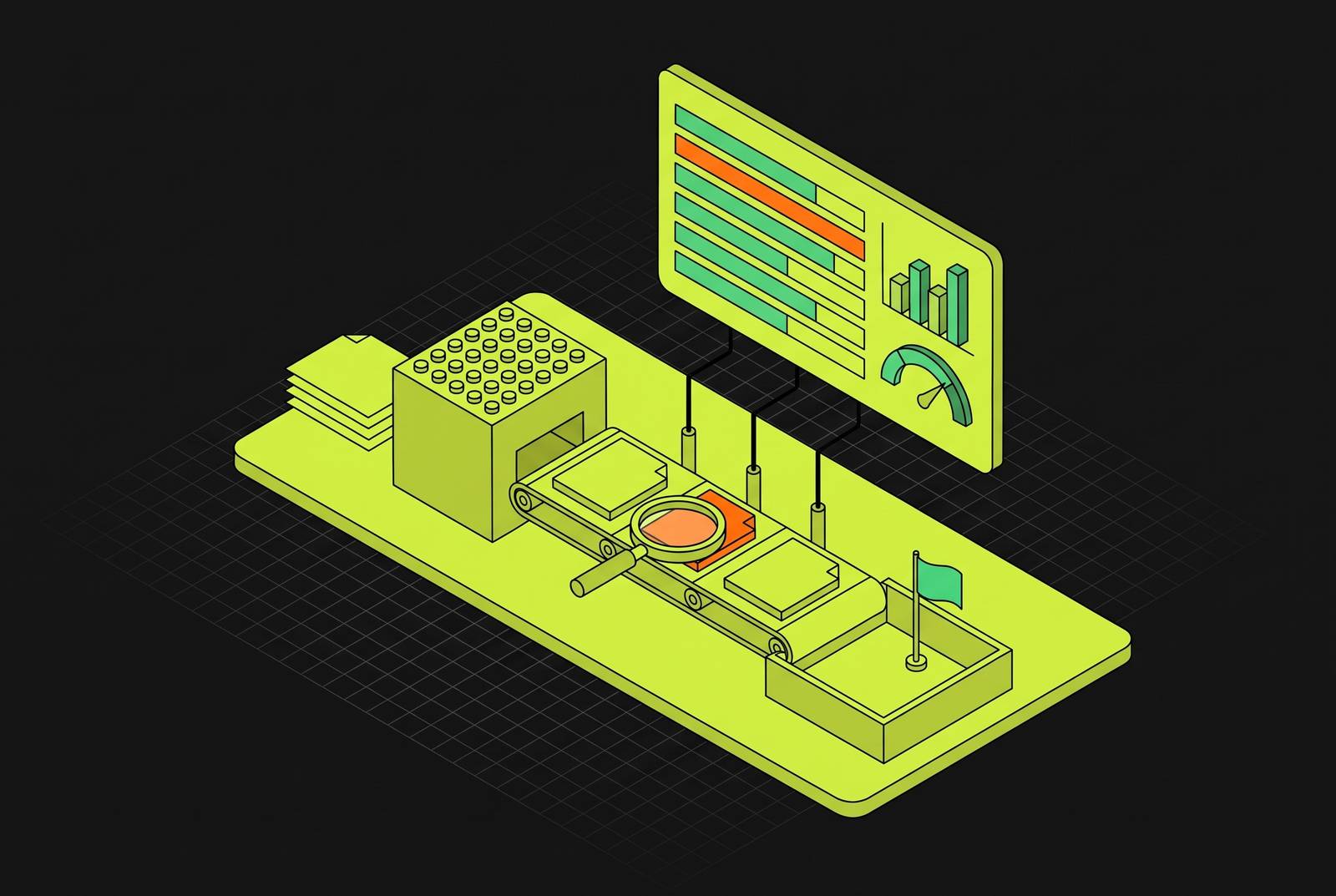
AI writing tools for developers need more than successful model calls to produce dependable documentation, code comments, technical blogs, and project overviews. Logging and observability for AI writing pipelines must treat output quality as first-class telemetry, connecting each draft to its prompts, source material, model calls, and evaluations. The decisive capability is not simply generating text, but exposing where factual confidence, voice fidelity, or alignment with the brief deteriorates.
Why traditional logging fails AI writing pipelines
A writing request can finish without an error yet produce hallucinated claims or lose the intended voice. Standard application monitoring captures HTTP status codes, CPU utilization, and request latency, but those signals do not describe the quality of the text. The service can be healthy while the draft degrades. Semantic failures need evidence about what the pipeline produced and how that output changed.
That evidence must cover more than model inference. Prompt construction, retrieval, evaluation scoring, and multi-stage handoffs are each a point where quality can drop. A revision may drift from the brief, and a prompt change may weaken voice consistency across a whole content run. Neither failure necessarily produces a stack trace. Treating the whole run as one HTTP span therefore hides the distinctions needed to diagnose it.
What observability actually means for a writing pipeline
LLM observability is a structured telemetry discipline. It represents the steps of a generative AI request as typed spans with attributes that describe their operation and results. One trace represents one pipeline run. Its child spans represent planning, model inference, retrieval, tool calls, and evaluator passes, making the relationship between stages explicit rather than leaving it to reconstruction from separate log entries.
Within that structure, model name, token counts, dollar cost, latency, and output quality scores become attributable data. Evaluation belongs in the same record as execution. For writing pipelines, behavioral monitoring tracks output quality and voice consistency, while operational intelligence links those signals to prompt versions and how the pipeline behaves. GPU kernel timings can show how well the infrastructure runs, but they cannot show whether a revision made the writing better. The distinction is between observing that computation occurred and observing whether it served the brief.
What to trace in a writing pipeline and why the span tree matters
The trace should expose every stage where quality can degrade, including brief ingestion, retrieval, prompt assembly, model calls, review passes, and evaluation. OpenInference provides a vocabulary for distinguishing these operations. A CHAIN span represents orchestration, such as brief assembly or a handoff between agents, while an LLM span represents a model call. RETRIEVER spans identify RAG lookups, TOOL spans describe external checks, and reranking spans record candidate scoring and selection. Evaluator spans attach quality judgments to the work being assessed.
For a single article draft, a concrete five-span sequence consists of brief retrieval, prompt assembly, a model call, a review pass, and an evaluator. Retrieval records chunk IDs, retrieval scores, and document sources. Prompt assembly identifies the construction stage, while the model span records the model, token counts, temperature, and system prompt hash. The evaluator then records writing quality, voice fidelity, and factual confidence, so the trace preserves both the draft’s production path and its assessment.
MLflow specifies vendor-neutral OpenTelemetry attributes for LLM spans, including gen_ai.system, gen_ai.request.model, gen_ai.prompt, gen_ai.completion, gen_ai.usage.input_tokens, and gen_ai.usage.output_tokens. Attributes that hold content need the capture controls discussed below. Parent-child relationships make the hierarchy useful by attributing latency and cost to the request and its particular steps. In a multi-model pipeline, that hierarchy also records which model produced which fragment. A flat log lacks that explicit structural connection between a contribution, its stage, and its evaluation.
The metrics that surface writing quality failures: what to put on the span
Token cost, latency, and time-to-first-token remain necessary operational metrics, but they do not establish whether writing stays on voice or improves through revision. Voice fidelity needs a measurable reference. Its score should compare output with the brand corpus on dimensions such as sentence length distribution, lexicon, and hedging patterns. Style conformance checks the text against a set of rules drawn from the corpus and records a pass or fail.
Semantic drift measures a different failure mode. A cosine distance or equivalent between the draft and source brief, tracked across revision passes, makes changes in alignment visible. Factual confidence adds a model-reported calibration signal on claims, with results below threshold routed to human review. That signal is not factual verification itself. Together, these measures distinguish a draft that follows the brief from one that merely sounds appropriate, and a stylistically compliant draft from one whose claims need review.
Each output also needs its exact prompt version tag, because a quality change without version attribution cannot identify a prompt regression. The connection rests on span_id. An offline evaluation can write its score back to the production span, preserving the link to the model call, prompt version, and retrieval chunks that produced the text. Without that link, scores remain aggregate statistics.
Building evaluation into the pipeline rather than bolting it on afterward
Evaluation of samples pulled from logs after the run is auditing. It can reveal defects, but it cannot act on the original run in real time. Pipeline-integrated evaluation instead makes the assessment a traceable operation, allowing regressions to be detected before they compound across a content run. Integration does not require synchronous scoring of every request. MLflow recommends full tracing with evaluation of a small fraction, because traces are cheap while LLM-as-judge scoring is not.
An asynchronous evaluation service dequeues traces and scores the sampled subset, then writes results to the originating spans through shared span_id values. That preserves the exact prompt, model, and retrieval configuration behind each judgment. A golden benchmark dataset of realistic prompts and edge cases runs on every pull request that changes system prompts, retrieval chunking, or model configuration. Shadow mode then sends a share of production traffic to the proposed configurations so their quality can be compared before full rollout.
SemEval-2026’s RAGthoven study illustrates why this architecture must include intermediate candidates. Its Judge selected from multiple drafting candidates and Reflector rewrites, with candidate diversity and corpus quality constraining results alongside prompt tuning. Those constraints require candidate-level evidence. In adversarial multi-model writing systems, each recursive drafting, critique, and voting pass therefore needs an attributable span and score. Evaluation must track convergence across passes as well as grade the final text, and quality gates needed before publication must finish before content ships.
Data exposure and redaction in a writing pipeline's telemetry
Full tracing does not require unrestricted content capture. Raw prompts can expose sensitive client material, so telemetry itself can be a major source of data exposure. Production logging should thus use metadata by default, with prompt hashes in place of prompt text. Full prompt, completion, and tool content capture should be explicit opt-in, short-lived, access-controlled, and aggressively redacted. Tool input and output logging should start from an allowlist, so instrumentation does not become permission to record every available field.
Redaction belongs inside the instrumentation wrapper, before data reaches the observability backend. MLflow recommends automating prompt data scrubbing there rather than relying on developers to remember it for every call. A second transform in the collector provides defense in depth if the first redaction point fails. Tenant boundaries need equally explicit treatment. Pipelines that serve more than one client or brand voice need per-tenant cost attribution, redaction policies, and access control to keep useful records of the work without exposing another tenant’s prompt content.
Prompt version regression and the case for treating prompts as versioned code
Prompt changes are deployments because they change pipeline behavior. Without version tracking, an output can deteriorate while its execution record offers no explanation for the change. That regression can then compound across subsequent content runs. Every system prompt, retrieval prompt, and evaluator prompt therefore needs a version tag recorded as a first-class span attribute on every run it produces. Versioning the evaluator is especially consistent with this discipline, since its prompt is part of the system producing the quality record.
Release controls give those tags operational value. A prompt change should start automated evaluation against the golden benchmark before it goes into production, then a shadow comparison against the current version. If scores fall below threshold in the shadow cohort, automated rollback should bring back the previous prompt version without a manual deploy. Assessing the potential blast radius of a prompt modification before deployment treats its downstream effects with the same rigor as other changes to pipeline behavior.
Multi-model systems also require versioning at the agent level. A change to an editor agent’s prompt must remain distinguishable from a change to a researcher agent’s prompt in the evaluation record. Otherwise, a run-level label obscures which specialist changed and which stage lost quality. Voice fidelity is the hardest regression case. It can be visible in style conformance scores before human reviewers notice it, so evaluation must happen before publication, when there is still time to act before a post-publication audit.
What should developers look for in a production-grade writing observability stack?
For developers choosing AI writing tools, the concrete criteria are attributable generation, integrated evaluation, controlled telemetry capture, and version-aware release controls. A dashboard alone is not enough. OpenTelemetry provides a consistent set of attributes, OpenInference provides span types, and an evaluation service adds judgments tied to those records. These complementary architectural roles contribute to a complete writing pipeline.
End to end, the run begins with a trace whose child spans cover brief ingestion, retrieval, prompt assembly, model calls, review, and evaluation. Prompt and model versions, cost, latency, and quality scores stay attributable to the relevant stages. The evaluation service consumes sampled traces and returns scores to their originating spans, while benchmark runs and shadow comparisons govern proposed changes. Redaction constrains capture throughout this path. Metadata-only defaults, prompt hashes, tenant access controls, and SDK and collector transforms allow the execution record to remain useful without making raw content the default.
Adversarial multi-model writing systems fit this structure because their drafting, critique, and voting stages already produce separate pieces of work to assess. Recursive work is not inherently a quality failure. A writing kernel that takes seven recursion passes to converge presents seven measurable quality gates, each with a span and an attached score. The scores across passes show whether revision is converging or drifting, and model attribution shows which model’s work changed the result.
Model-level signals still need to be connected with infrastructure behavior to form coherent operational intelligence. Voice degradation and semantic drift describe the writing, while token cost spikes and retry loops describe execution. Neither view is sufficient in isolation. Their shared span tree links a drop in quality to the work, configuration, and resource use around it. That connection is the engineering basis for deciding whether a prompt or model change is ready to produce the next content run.