Content Infrastructure Debt in Marketing Organizations
AI-driven content generation exposes broken systems for managing, measuring, and retiring assets.

AI has solved the difficulty of producing content while exposing a larger failure in marketing organizations. Content infrastructure debt grows when generation outruns the systems governing what gets written, reviewed, versioned, and retired. The path out is to treat writing architecture as the core engineering problem.
Why content debt is now an engineering problem, not an editorial one
Contentful draws a useful analogy to technical debt. Integrated tooling becomes obsolete, but teams must keep running it. Content debt develops when assets accumulate without infrastructure connecting them to purpose, performance, or a lifecycle. The system has an unfinished editorial backlog and cannot account for what it contains or determine what should happen next.
That failure begins with a lack of visibility. When an organization cannot connect an asset to its intended job, it cannot measure whether the asset delivers value. Without that connection, decisions about what to fix, retire, or promote lack a dependable basis. The library grows, but the organization’s ability to govern it does not.
Four failures compound as that gap widens. Workflows slow because updates require searching, cross-checking, and republishing across duplicate instances. Customer trust weakens when product details conflict, pricing becomes stale, or links break. Search and answer-engine performance suffers when underperforming pages remain unaddressed. The risk of breaking regulations also grows because industries including healthcare, insurance, and finance must review content on a schedule, which is harder to do when content is unmanaged.
How AI volume generation converts a slow accumulation into a structural crisis
AI changes the rate at which this failure develops. Generation can accelerate while review, versioning, measurement, and retirement remain constrained by systems built for slower production. Faster writing therefore creates more work for the parts of the system that have not become faster.
Contentful says the pressure comes from having more content than technology and marketing teams can control across a digital ecosystem. AI generation intensifies that existing pressure. The decisive distinction is whether the organization has built an operational layer around AI use or added generation capacity to unresolved debt.
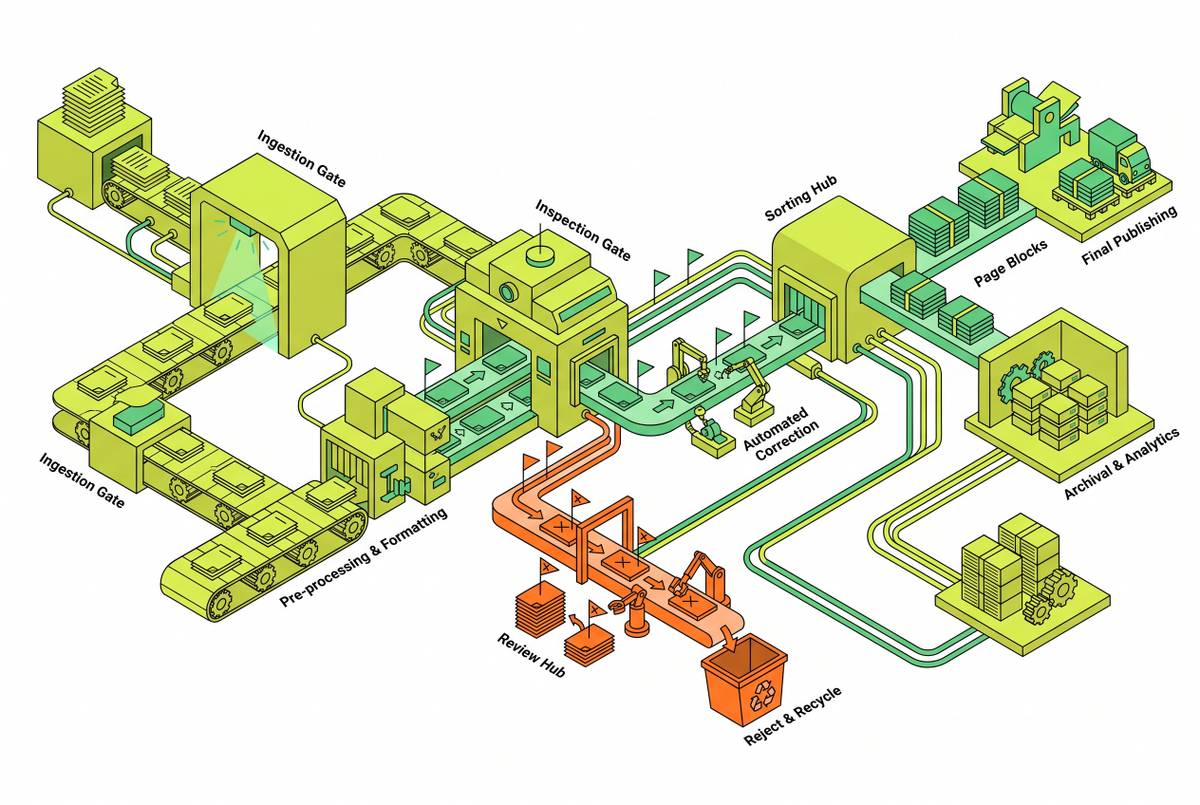
Content operations in 2026 consequently means more than using AI to write. It means running a system that generates, refines, distributes, measures, and iterates content as a coordinated process. Generation is only one stage in that process. When the other stages stay disconnected, faster production makes content harder to govern because it enters the system faster than the organization can decide whether to keep it there.
Why the debt accumulates where it does: the intent-to-asset connection that never gets built
The connection is often missing before writing begins. An asset produced without a declared job has no defined basis for evaluation and no clear condition for retirement. Publication becomes the only visible completion point. The system can establish that something was produced without establishing why it exists.
Contentful identifies several conditions that deepen this disconnect, including missing analytics, owners changing roles or leaving, and assets scattered across drives. Those conditions separate content from the information needed to govern it. Duplication and conflicting messaging then become difficult to distinguish from legitimate variations. A team cannot reliably judge two similar assets without knowing their intended purposes and current owners.
At AI generation speed, three missing controls reinforce one another. Without declared intent, there is no measurement baseline against which to diagnose underperformance. Without ownership, no human or system is responsible for deciding whether an asset still serves its purpose. When the system has no lifecycle definition, versioning breaks down, so AI can produce v2 without the system knowing v1 exists. Manual search cannot reliably reconcile the resulting duplication.
AI-powered search surfaces content partly through its clarity, structure, and currency. Outdated or duplicated assets can distort a brand’s retrieval profile or leave it absent from AI-generated responses. The failure extends beyond keeping a library tidy. It affects which information becomes available when an answer engine represents the brand.
Why adding more generation tooling to a debt-laden system makes things worse
Adding generation capacity to a governance-deficient system is an engineering mistake. It increases input to a process that already cannot control its output. When weak content performance comes from missing ownership, conflicting versions, or undefined purpose, another generator addresses none of those causes. It produces more assets that depend on the same missing controls.
Using single-model generation also brings problems with the quality of the writing. Base models can write competently while defaulting to generic web-English that lacks a brand’s specific voice. Their recognizable transitions and word choices accumulate as undifferentiated volume. These patterns are a structural fingerprint, distinct from deliberately embedded regulatory watermarks, and can make generated content recognizable to tools and readers.
Evaluation does not automatically correct that weakness. When a model judges its own output, or a judge shares the generator’s base, preferences for familiar phrasing and length can reinforce the same blind spots. Confident approval is not independent evidence of suitability.
The governance-first lesson is to define what evaluation must test before increasing generation. Brand guidelines that describe impressions give a system little it can test. Prohibited phrases, required disclosures, claim-evidence standards, and reading-level requirements give it specific things to check. Without them, more output cannot reliably converge on brand voice, because the system has no operational definition of that voice.
What treating writing architecture as the core engineering problem actually requires
A governance-first writing architecture makes intent declaration a production precondition. Before generation begins, every asset needs an audience, a purpose, a lifecycle expectation, and an owner. This is a system decision. It establishes the information that later measurement, review, and retirement depend on.
The next decision is to express brand rules as machine-checkable evaluation criteria. With prohibited phrases, required disclosures, sentence complexity bounds, and claim-evidence standards, an evaluation loop has clear tests to run. A vibe is not a test. Teams maintaining style-rule files in version control and running automated style checks in CI pipelines are already applying this distinction, treating writing quality as a gate.
Asset-level versioning supplies the control that generation otherwise bypasses. Content needs to be committed, attributed, and diffable so that an AI-generated update can be understood as a change to an existing asset. Ownership must remain attached to that asset. Together, those decisions make responsibility explicit and allow retirement triggers to be automated.
Performance feedback must also return to the asset itself. A dashboard can show that results are getting worse without prompting any change to the content behind them. A lifecycle feedback loop instead makes underperformance or outdated information trigger review automatically.
How adversarial multi-model evaluation closes the governance loop that single-model generation leaves open
Output must pass through models that did not produce it and whose task is explicitly to find faults against the declared rules. A group of similar agents set up to cooperate can agree quickly while leaving the generator’s original weaknesses in place.
Adversarial design counters that tendency by making criticism an assigned function. Without it, clones of a cooperative dialogue model may converge politely and leave one another’s judgments unchallenged. Multiple agents then provide little benefit over one. Using different models and asking them to find faults helps catch what they might otherwise all miss, while testable rules keep their disagreements tied to what the asset needs to do.
Recursive iteration supplies the correction mechanism. Seven passes through an adversarial council that checks defined rules form an automated quality gate, much as a test suite does for code. The passes are not valuable merely because they repeat evaluation. Their purpose is to expose failures and drive revision toward the brand’s requirements.
Post-training on the team’s own corpus adds brand-specific judgment. A writing kernel trained on actual high-performing content can evaluate against the brand’s voice. Corpus quality becomes part of the architecture. Low-quality samples embed low-quality patterns, so curation must remove unsuitable examples and return on a regular cycle as the brand’s voice evolves.
What the EU AI Act's watermarking mandate changes for content infrastructure planning
The European Commission’s Article 50 guidelines state that the EU AI Act’s marking obligations apply from August 2, 2026. Providers of generative AI systems newly placed on the market must mark generated content in a machine-readable way so it can be detected as AI-generated. Providers of systems already on the market before that date have until December 2, 2026 to comply. For content infrastructure planning, however, they make provenance an operational requirement.
The Commission’s voluntary Code of Practice on Transparency of AI-Generated Content had attracted signatories including OpenAI, Anthropic, Meta, Google, and Microsoft by August 2, 2026. Anthropic stated that every Claude model released on or after that date embeds a watermark based on the SynthID-Text approach in all generated text, enabled by default without a user option to disable it. OpenAI announced on October 5, 2026 that it would roll out watermarks for its models, initially EU-only, using textGrain. Its detection API would be available to approved researchers and expert organizations. Implementation is therefore specific to the provider and model.
Statistical watermarking works through the model’s word selection. Of the words that would fit, the model is slightly more likely to choose those picked by a secret key. The signal sits in the probability distribution. Nothing visible is added to the text, which continues to read normally.
Detection also extends beyond these embedded signals. Generation-time cryptographic watermarks depend on a cooperating model, while open-source or adversarially fine-tuned models require other approaches, including weight-embedded watermarks or statistical detectors that do not depend on a watermark. Semantic fingerprinting examines model-family patterns in transitions and word choice. Stylometric analysis compares passages against a user’s past writing. These methods address different signals and provide distinct kinds of evidence.
The planning consequence is a need for asset-level provenance. An organization that has not tracked which model produced which asset, and in which version, cannot retrospectively establish its exposure simply by reading the library. Adversarial architectures distributing output across dozens of models can reduce the fingerprint left by any one model family. That property supports brand voice fidelity, but reducing a stylistic fingerprint does not establish watermark status or resolve regulatory exposure. Provenance remains a separate governance requirement.
The practical starting point: auditing what you have before adding what you think you need
The first action is an audit of existing assets, ownership, and governing rules. The audit first checks whether every asset can be connected to a declared intent and a current owner. Missing links reveal the scope of the visibility failure. They also show where the organization lacks the information it needs to decide what to fix, promote, or retire.
Second, the audit tests whether brand guidelines provide machine-checkable rules or depend entirely on human interpretation. The third is whether the content system has asset versioning and retirement triggers. These questions test different parts of the architecture. One establishes whether evaluation has concrete criteria, while the other establishes whether updates and end-of-life decisions are controlled.
The audit’s fourth question tests whether the organization can identify which content was AI-generated and by which model. If it cannot, its Article 50 exposure remains unquantified. This question also connects the audit to corpus curation. Content used for training or evaluation must be chosen with care because unsuitable samples repeat the patterns the architecture is supposed to reject.
That selection cannot be a one-time cleanup. Removing samples that no longer reflect the brand and adding recent high-performing content on a regular cycle are governance tasks. Stronger operational fundamentals let AI work in a system that controls its content, keeping it from adding to an unmanaged one. The audit establishes which of those fundamentals actually exist before the organization adds more content that depends on them.