Version Control for Content in Engineering Organizations
AI-generated content demands version control, audit trails, and model checkpoints.
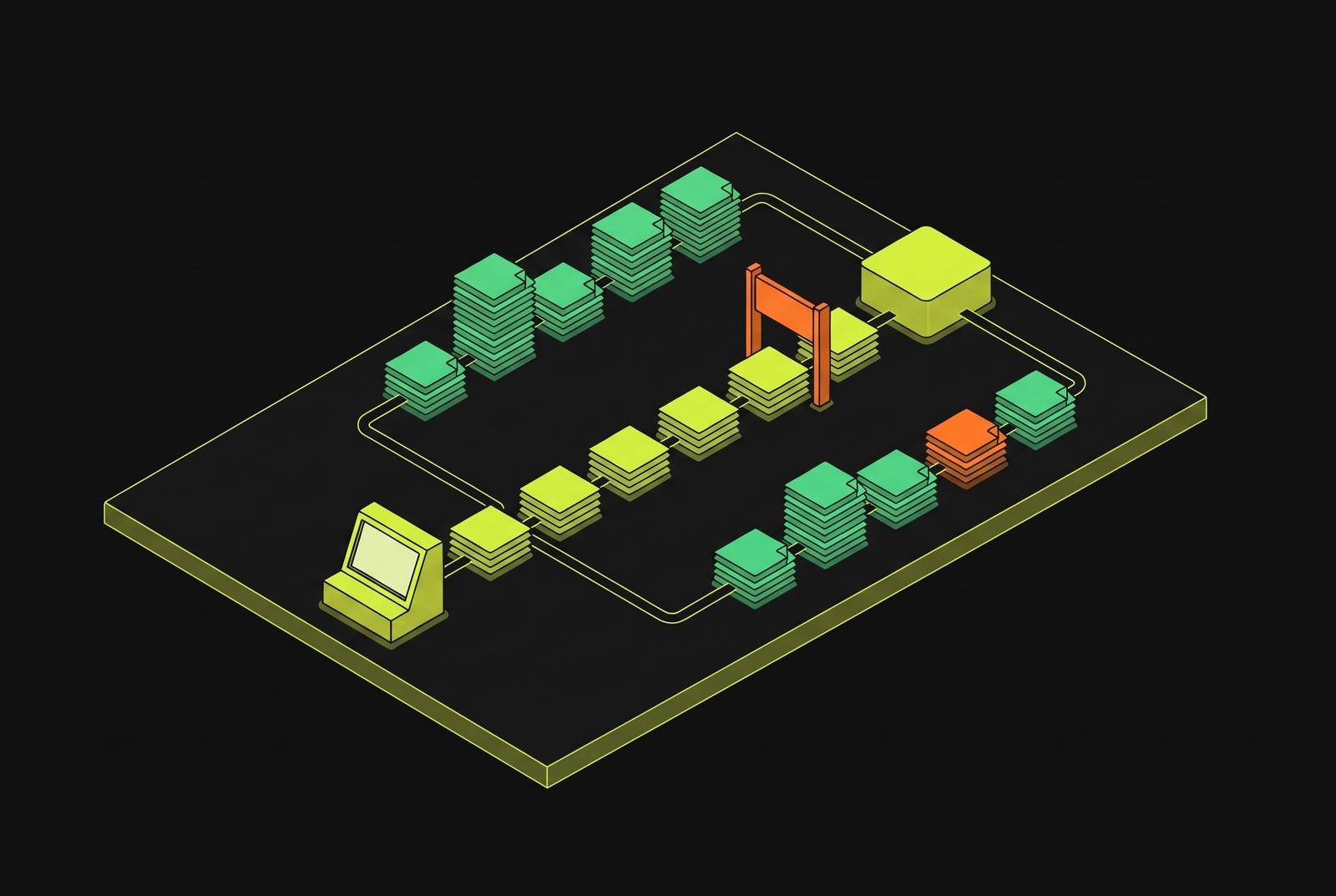
AI writing tools for developers should produce documentation, code comments, technical blogs, and project overview files through versioned, reviewable workflows. Version control for content in engineering organizations is a practice problem. The strongest foundation combines repository-native authoring, automated quality gates, and attributable model checkpoints so that AI-generated changes remain auditable and reversible as volume grows.
Why engineering organizations don't apply version control discipline to content
“Final_v3_REVISED_March_JB-edits” is a filing convention. Yet content teams in 2026 still use names like this in organizations whose engineers stopped doing the same thing with software decades ago. The filename attempts to encode sequence, status, and authorship without establishing any of them reliably. It cannot explain why an edit happened. The organization has disciplined change management for its code, but not for the material that explains, markets, and documents it.
Engineering organizations already operate immutable, auditable, reversible workflows, but those habits stop at the boundary of content production. A proper version control system identifies the current authoritative version, shows what changed, records who changed it and when, and preserves the reason. Most content assets lack that complete account. Knowing which colleague probably has the latest draft is not the same as having a system of record.
Without an authoritative history, a team cannot reliably connect a published claim to the review and decisions that produced it. That disconnect becomes especially significant when documentation or product copy accompanies a software release. Code and its explanation can have different standards of accountability even though they describe the same product.
How AI-volume pressure is making the content version-control gap critical right now
Anthropic merged an average of around 2,500 code changes per day in May 2026. By September, that number had grown more than tenfold, driven by AI agents independently of engineer headcount growth. Anthropic responded by building Scion, an in-house source control system, to replace Git for its monorepo. Generation was no longer the principal constraint. The infrastructure responsible for managing generated work had become the bottleneck.
Anthropic found that latent demand for merging code was practically infinite, with each removed bottleneck immediately producing another increase in volume. Content pipelines running through AI harnesses face the same pressure. AI writing tools can produce updates at a rate that human review processes were never designed to handle. Faster drafting does not create faster accountability. Without version-controlled infrastructure, the additional output becomes a larger body of changes whose origins and approval states are difficult to reconstruct.
Three pressures make that gap critical now. Regulators need records of what was accurate at a given time, while AI-generated updates add more changes without making them easier to track. At the same time, content scale defeats tribal knowledge about what changed and when. These pressures reinforce one another because the record becomes harder to reconstruct precisely when more people need to interrogate it.
The objection that content has lower stakes than code does not hold for every asset. Compliance documentation, API references, and product copy shipped with a release can make an untracked content change as risky as an untracked code change. The relevant distinction is whether the organization can account for a change to material on which users or regulators rely.
What version control actually provides — and what content teams are missing without it
Version control is a system of record for change. Its first property is a single source of current truth, with one identifiable published version of each content object. Where several drafts compete for the status of “final,” storage has preserved the ambiguity.
Diff capability makes any two versions directly comparable. For AI-generated updates, that comparison helps isolate the edit that introduced an inaccuracy instead of forcing a reviewer to assess the entire asset again. Rollback lets the team restore the previous version without rebuilding it from scratch. Comparison and recovery serve different purposes. A team needs both to investigate an error and reverse it.
An audit trail adds a chronological, attributed record of every change. In regulated settings, that record lets an organization answer questions about an asset’s history as well as show what it contains now. Attribution also connects a change to its reason. Without it, a diff shows the alteration but leaves the decision unexplained.
These properties are not inherently limited to source code. Modern version control systems extend them to AI prompts and model weights as first-class versioned assets. Content can use the same discipline. The missing capability is not another place to store prose, but a workflow that gives published language an authoritative state, a comparison history, a recovery path, and an accountable record.
Why single-model AI content pipelines fail the auditability test even before volume arrives
A single-model content pipeline can fail this test before it produces much content. Its output may be stylistically fingerprinted, attribution-ambiguous, and dependent on assumptions about how one model writes. When that model changes, assumptions about style in later stages can all fail at once. Without model-version attribution, it is hard to pin down the cause. A textual diff can show changes in wording, but on its own it cannot show which model version made them.
The EU AI Act and California AI Transparency Act require watermarking and detectability specifically for AI-generated images, video, and audio from specific dates in 2026. For an audit of AI-generated assets, however, the underlying provenance question remains essential. The organization needs to know which model produced which version of which asset.
Anthropic announced in August 2026 that Claude would watermark output from models launched on or after August 2, 2026, with older models retrofitted on a rolling basis. OpenAI announced on October 5, 2026, that it would roll out model watermarks, initially only in the EU, using technology called textGrain. Both implementations embed the signal in word choice. Provenance therefore resides within the text itself. A history that ignores asset versions cannot reliably account for that signal through successive edits.
Watermarks are adversarially fragile, but that does not remove the need for version control. Detection remains the stronger policy posture, while the organization’s engineering obligation is provenance and auditability. A single model is not inherently impossible to audit. The failure is a pipeline that treats its output as an unattributed final artifact instead of a recorded stage in the asset’s development.
How multi-model adversarial pipelines create auditable content checkpoints by design
The INFERENCEDYNAMICS paper describes three ways to build multi-model systems. Ensembling gives the same input to multiple models and aggregates their output, while cascaded systems escalate from smaller to larger models when quality thresholds require it. Collaborative agents give each model its own role. That last pattern fits auditability most directly. Each role has a stage that can serve as a checkpoint in the content history.
A role-based pipeline can assign drafting, critique, tone, and final polish to separate models. At each handoff, the team can then compare the version that went in with the one that came out. The record can distinguish what the critic challenged from what the tone pass revised and what survived to publication. Those distinctions make review legible to downstream reviewers. They also prevent a final document from concealing every intermediate decision behind one generation event.
The audit structure remains stable when the models change. A better model can take over a role without erasing the distinction between drafting and critique or changing what a stage represents. Model attribution still belongs in the record. The architectural advantage is that the workflow no longer depends on one model’s identity to define the history of the work.
This structure corresponds closely to code review. A pull request exposes the proposed change, the reviewer’s request, and the states before and after revision. Content can keep the same link between an edit and the reason for it. Multiple models alone do not supply that record, but distinct roles create natural boundaries at which to capture it.
How should developers build a version-controlled AI writing pipeline?
A content pipeline built with engineering discipline has a single source of truth, machine-readable diffs, pre-publication gates, and a full audit trail. The harness should establish those properties by design. Harness engineering sets up the infrastructure, constraints, and feedback loops in which agents work. Prompts are only part of that environment. Writing agents then produce changes inside a reviewable process.
Mintlify provides one example of repository-native content through its MDX-based authoring model. Pages use Markdown with embedded React components, allowing documentation to live in the same repository as the code it documents. Content and code can therefore share a commit history. That is a concrete foundation for traceability. It addresses where content lives and how changes are recorded, rather than replacing the need to review those changes.
Acrolinx handles another part of the work by checking content against a style guide and terminology database before it is published. Siteimprove turns static style guides into automated policies that check content as it is created. These functions resemble linting within a build. Readability, brand voice, terminology, and formatting checks become pre-publication gates. Repository-native authoring and automated policy checks are complementary capabilities.
Voice fidelity also depends on the version of the reference material used to guide generation. A curated, versioned brand corpus lets the organization change that material as its voice evolves without requiring full retraining. Retrieval-augmented generation can use that archive while preserving updateability and auditability. The reference history belongs with the production history. Otherwise, a team may see that the output changed without seeing how the guidance behind it changed.
Scion illustrates how that history can become accessible infrastructure. Anthropic exposes all source control queries used by its client through APIs, so jobs often do not need a local repository. A content pipeline built on similar principles would expose history and diffs to downstream tools and compliance workflows. For buyers of AI writing tools for developers, these are concrete evaluation criteria. The relevant comparison is whether tools support recorded changes, review gates, attributable stages, and accessible history.
The audit trail as a first-class engineering deliverable, not a documentation afterthought
The audit trail is a compliance deliverable, a debugging surface, and a quality feedback loop. Those functions require it to be designed into the pipeline from the start. The media-specific requirements of the EU AI Act and California AI Transparency Act make traceability concrete without establishing the same watermarking obligation for text. Scope does not erase the engineering requirement. A provenance record must still answer which model produced which version of which asset, and when.
The audit trail helps with debugging even when those requirements do not cover an asset. If an AI-generated update makes something inaccurate, attributed version history lets a team find the change, trace where it came from, and revert it. The same history supports quality improvement when it records what the critic flagged, how the draft changed, and which versions performed better against defined metrics. Review becomes evidence for the next iteration. Without a record of those stages, the organization keeps the result but loses much of what it needs to improve the process.
Writing kernels that run adversarial multi-model review and vote on output line by line until convergence make this record a structural byproduct. Each recursion is a version, each critique is a diff, and the convergence record is the review history. Seven recursions to convergence are not merely overhead. They document how the content developed and which objections were resolved before publication.
The required shift is familiar to engineers. Every content asset needs the disciplines already applied to a code module, including a commit history, a review record, a merge policy, and a rollback path. That changes what the organization is building. The deliverable is no longer just a better document, but infrastructure that can explain, reverse, and improve the changes that produced it.