Content QA Tool Integration With CI/CD for Developer Marketing Teams
Automated content checks in CI/CD enforce style rules before publication.
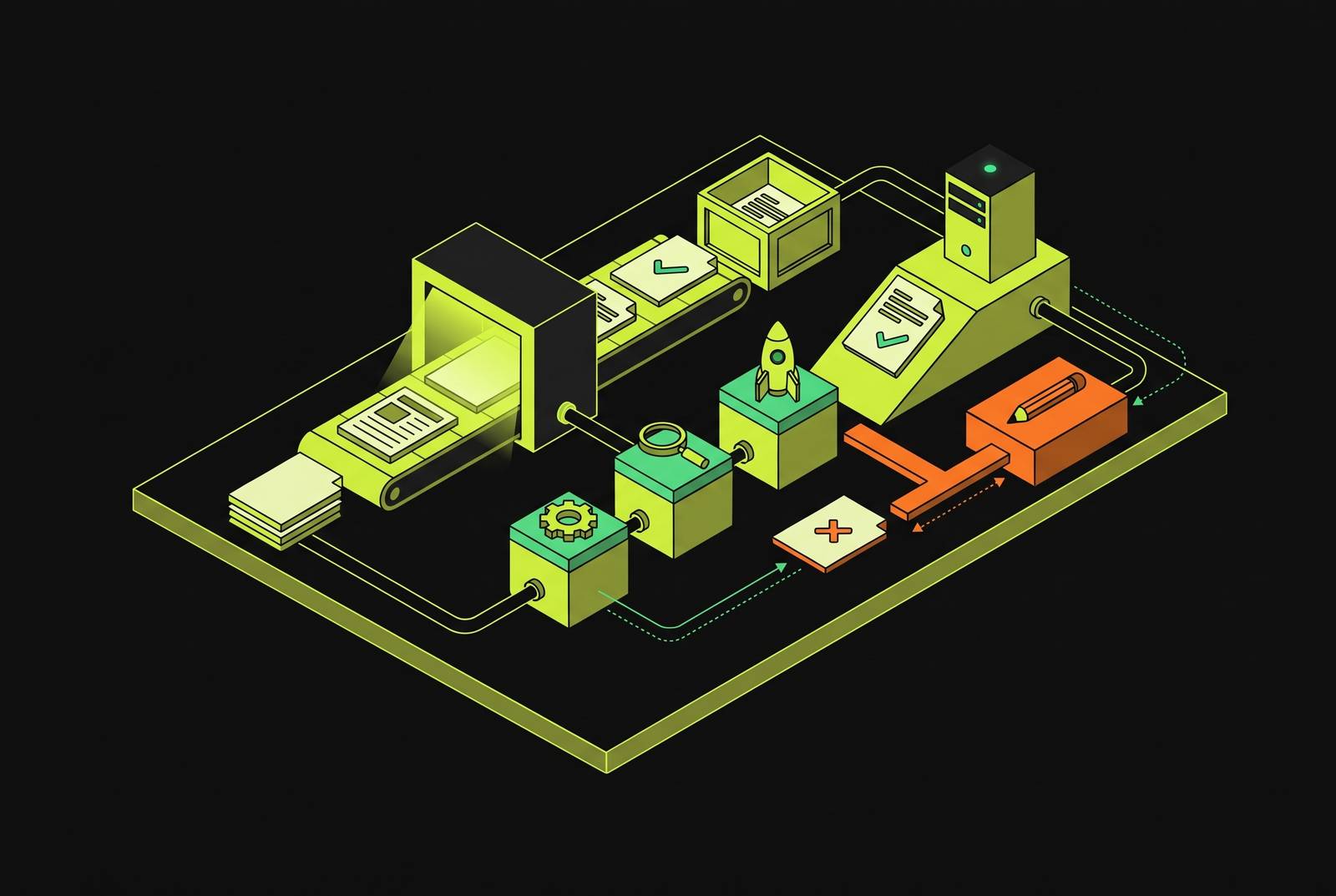
AI writing tools for developers need more than a drafting model to produce reliable documentation, project overviews, and technical blogs. With content QA built into CI/CD, style rules, voice checks, and automated review become test gates that block unsuitable output before it is published. The strongest architecture separates generation, linting, quality evaluation, and provenance tracking, automating rule enforcement and leaving human reviewers to judge accuracy and argument.
Why content pipelines fail developer marketing teams at scale
A team that would never merge unreviewed code can still merge unreviewed prose. Changelogs, API docs, blog posts, and product announcements compete for limited editorial attention, while contributors keep producing changes. Manual review becomes a bottleneck and an unreliable gate. Voice varies across contributors, off-brand phrasing survives review, and AI-assisted drafts accumulate recognizable cadence patterns.
Linters and test suites catch predictable problems automatically, while reviewers concentrate on decisions that require interpretation. Content often lacks that division of labor. Style guides stay in wikis, voice instructions sit in onboarding documents, and the rules get enforced by whoever has time to comment on a pull request. At commit frequency, consistency depends on reviewers being available to enforce those documents.
How treating documentation as code became the baseline for technical teams
Docs as code puts documentation in version-controlled repositories, routes changes through pull requests, and runs automated checks in the pipeline that governs software releases. The repository becomes more than a storage location. It connects each proposed change to review, validation, and a decision about whether the change can merge. That connection supplies the infrastructure missing from a style guide maintained separately from publishing.
Datadog already uses this pattern operationally. Its documentation team roughly doubled in size while maintaining a developer-to-author ratio of 200 to 1 and merging tens of thousands of documentation pull requests a year. Manual style enforcement cannot cover that workload reliably. Automated checks give contributors the same rules to follow without an author having to check every predictable violation. For teams operating at that scale, content validation is a prerequisite for growth without quality collapse.
What a content quality gate actually checks — and how those checks are defined
Vale is the reference implementation for prose linting. It is a cross-platform command-line tool written in Go, used by teams at AWS, NVIDIA, Microsoft, GitLab, and Red Hat. Rules are YAML files that match patterns such as banned words, sentence length, and capitalization. Styles group related rules into folders, while a .vale.ini file at the repository root specifies which styles apply to which file types.
Packages that teams can install cover the Microsoft Writing Style Guide, Google's developer documentation style guide, and custom rules for their organizations. These rules catch recurring problems including wordy phrasing, banned jargon, missing Oxford commas, and passive voice in technical contexts. Findings should distinguish warnings that surface issues for review without blocking from errors that prevent merging until corrected. The team must decide which preferences are advice and which rules must be met before release, then encode each to match. A useful rule set is therefore the team's style guide operationalized, with both the requirement and its consequence defined.
Wiring content checks into GitHub Actions and GitLab CI
To implement those rules, a team connects Vale to GitHub Actions or GitLab CI as a required content check. Each push triggers the pipeline, which runs Vale on changed Markdown files and surfaces findings as pull request annotations. Writers see violations where they already review changes. A failed content check consequently has the same release consequence as a failing unit test rather than the uncertain status of an unresolved style suggestion.
Fern provides a concrete reference architecture for this integration. Its Vale checks run automatically when API definitions change, blocking builds that violate the style rules configured through .vale.ini. Those rules can come from Microsoft, Google, or custom style sets. AI-generated documentation updates face the same checks as human-authored changes, so generation does not create an exemption from the team's standards. For a custom setup, the reproducible pattern is the same. A commit starts the pipeline, Vale evaluates changed prose, annotations expose violations, and unresolved blocking errors stop the merge.
Why single-model AI content introduces a class of failure that lint rules alone cannot catch
Vale can identify explicit violations, but recognizable generation patterns extend beyond individual words and punctuation. Asking one model to research, outline, write, and match a voice also puts competing demands on its context window. Earlier instructions can be crowded out as the task expands, leaving a flat, context-averaged cadence that a YAML rule cannot adequately describe.
The ELOQUENT 2026 Voight-Kampff research shows that detectors respond to distributional signatures as well as grammatical mistakes. Structural shifts can defeat adversarially fine-tuned detectors, whereas retraining on simple grammar-level perturbations closes that gap within a single fine-tune pass. The SHADE framework achieved 98.5% surrogate detector evasion with full fine-tuning in the 2026 ELOQUENT lab research. Yet high evasion correlated with shorter, simpler, less lexically diverse output.
For developer marketing, the relevant Google content-quality risk is low-effort, derivative patterning produced at scale, regardless of AI authorship. That distinction changes the engineering response. More banned phrases cannot resolve a generation architecture that repeatedly produces the same structural weaknesses.
How adversarial multi-model review catches what single-model output cannot self-correct
Role decomposition gives each agent a task with clear limits and its own context window. A research agent concentrates on competitive analysis and passes a structured summary to a planning agent. The planner develops the argument from the research summary, while the writing agent concentrates on prose and leaves SEO rules outside its task.
Independent review supplies the next quality gate. A reviewer model that has not seen the draft's generation process critiques the result against criteria different from those used by the producer. TriAdReview uses two independent reviewer models with engineering and boundary perspectives, plus a triangular judging mechanism. Its experiments found that output quality was 10.1% higher than with single-model generation, but each run cost more.
That improvement comes with a coverage tradeoff. Adversarial review favors precision by cutting weak material, but it can reduce recall when it cuts material the draft needs to cover. The full review loop should be triggered selectively. Adding agents alone is not the quality lever, because coordination can consume resources that would otherwise improve the document. Whether the architecture is worth the extra cost depends on how specialized the agents are and how well they work together.
AI watermarking and model fingerprinting as compliance-layer content QA
Provenance answers a different question from editorial quality. The EU AI Act requires AI-generated text to be watermarked and detectable, while the California AI Transparency Act excludes text-only output from its watermarking requirement and covers AI-generated images, video, and audio. OpenAI announced on 5 October 2026 that it would roll out model watermarks, initially EU-only, under textGrain, with a detection API limited to approved researchers and expert organizations.
NIST AI 100-4 identifies a practical limitation. Most current watermarking schemes have consistently proved vulnerable to removal, so an absent watermark cannot establish human authorship. The ELOQUENT research separately shows that structural changes in register and form can bypass adversarially fine-tuned detectors, with some strategies achieving up to roughly 50 times higher evasion rates than previous methods while preserving naturalness. Neither mechanism provides a dependable editorial verdict.
Model fingerprinting adds attribution when contributors or agents use different models. In pipeline design, that information supports content audits and accuracy reviews by identifying which model generated a piece. Watermarking and fingerprinting therefore belong in a tracking and accountability layer.
Post-training on a brand corpus as a voice-fidelity gate, not a one-time setup step
Brand voice requires a more specific target than generic fluency. A general-purpose model defaults toward statistically averaged web-English, while an organization's voice depends on a curated body of examples. Prompt instructions alone do not provide consistent voice matching at scale. The generation process needs voice material that is kept up to date, and the output needs to be checked against it.
Retrieval-augmented generation over a curated corpus is faster to set up because it supplies brand guidance and sample content as context. Weight-level fine-tuning gives more consistent results, with a different cost-quality tradeoff. Both approaches depend on the quality of their examples. Training on rushed or weak content teaches the very patterns the gate is meant to reject, so corpus curation is part of QA as well as preparation for it.
Validation remains separate from the generation method. Providing exemplary samples to a scoring model and asking it to assess new content is less precise than fine-tuning, but it can establish a CI gate quickly. That gate flags drift before content is published as the corpus and generation system change. Voice is thus a property validated on every generation, just as a test suite validates software behavior on every commit.
Writing test cases the same way engineering teams write unit tests
The practical shift is to define assertions before generating content. A Vale YAML rule file is a test specification, a failed Vale check is a test failure, and a merge blocked by that failure is the content equivalent of a failed build. The rule states what must or must not appear. Executing the rule tests a particular draft against that requirement, without asking a reviewer to reinterpret the style guide each time.
Higher-order tests work the same way, though model-based scores are less deterministic than pattern matching. A voice-fidelity test can supply five exemplary brand samples and require a scoring model to rate the draft above a defined threshold. A structure test can require headings to follow a pattern, sections to stay within a word-count limit, and required code examples or callouts to be present.
An AI-detectability test can also require detection confidence to stay below a set threshold. However, the detector research limits what passing proves. This tests only a detector's response, leaving human authorship and prose quality unproven and voice, structure, and editorial assessment necessary.
What a complete content QA pipeline looks like end to end
The implementation blueprint has four sequential layers. In the generation layer, role-decomposed agents research, plan, draft, and revise content, with the maintained voice corpus informing generation. Adversarial review runs where its additional precision justifies the cost and coverage tradeoff. The resulting draft enters the content repository as a pull request, creating the artifact that downstream checks evaluate.
The lint layer runs Vale against that pull request using the repository's .vale.ini configuration. Custom style rules, banned-word lists, and rule-based structural assertions produce inline findings. The quality gate layer then runs the higher-order tests, including voice-fidelity scoring, AI-detectability checks, and structural assertions with explicit thresholds and failure conditions.
The provenance and compliance layer logs watermark metadata, records model contributions through fingerprinting, and maintains an audit trail. GitHub Actions or GitLab CI connects the layers so every commit to a content branch triggers the configured pipeline and failed required checks prevent merging. For documentation generated directly from API definitions, Fern demonstrates tighter coupling by validating style during generation.
Passing checks allows the pull request to proceed to lightweight human review. The remaining task is substantive judgment about accuracy, argument, and editorial suitability, including weaknesses that no threshold can settle. CI focuses the editor's role on decisions the pipeline cannot make.
Sources
- Team DArgk at the 2026 ELOQUENT lab for evaluating generative language model quality: Residuals of Humanity: AI Detection Evasion via GRPO Fine-Tuning
- UTS at ELOQUENT 2026 Voight-Kampff: structural shifts in AI writing bypass state-of-the-art detectors
- TriAdReview: Triangular Adversarial Review Architecture for Multi-Model Technical Document Generation
- International AI Safety Report 2026