Automated Release Announcement Generation From Git History
Release notes need structured pipeline stages, not just a better writing model.
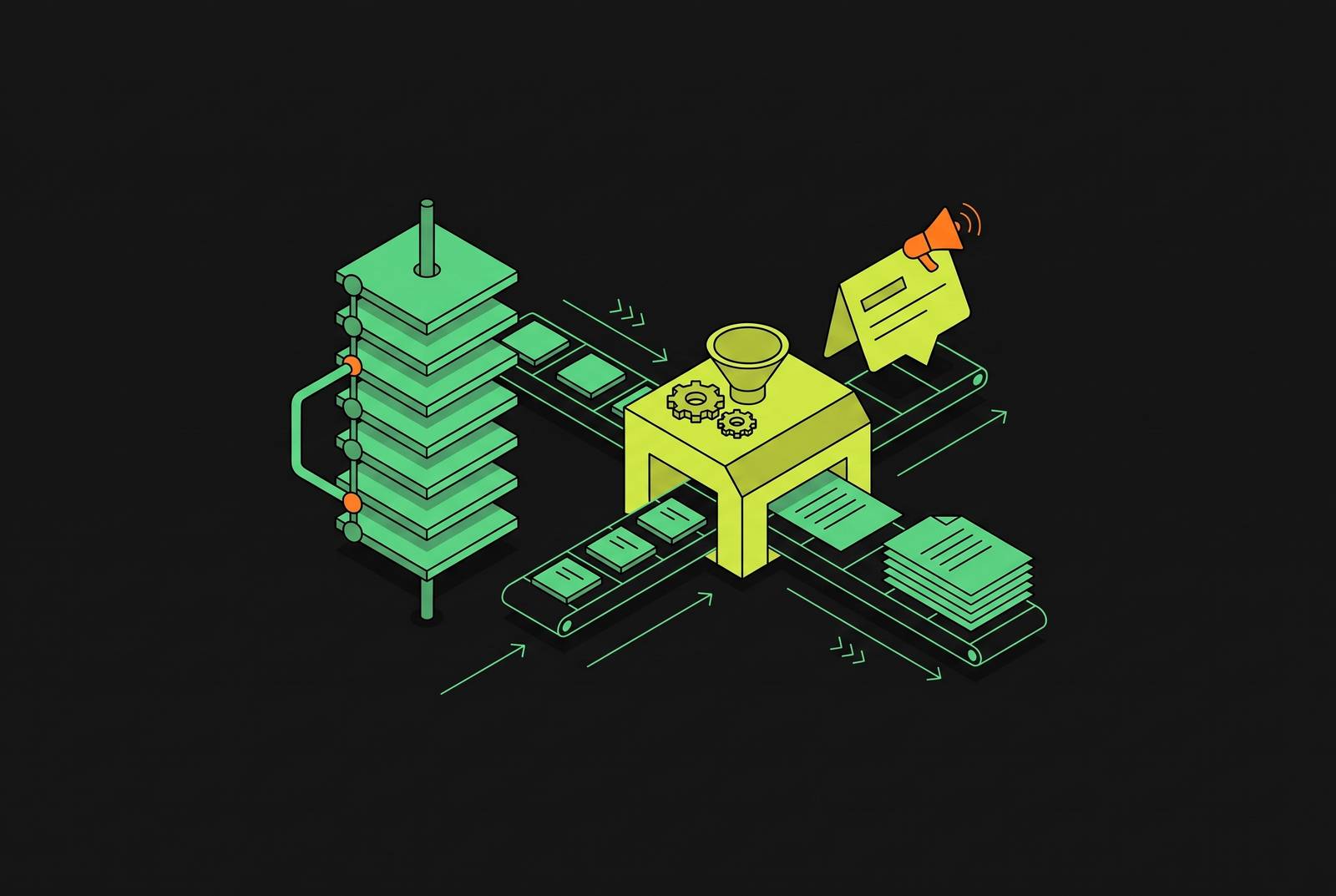
Automated release announcement generation from git history is a pipeline task that includes AI writing. Tools such as changeish, LLM Release Action, and n8n connect release events to change collection, summarization, and publishing. Their usefulness depends on input quality, technical analysis, audience-specific prose, and distribution, rather than on the fluency of a single model’s first draft.
Why generating release announcements from git history is a pipeline problem, not a writing problem
Writing about a release often involves difficulty getting started, wording that varies from one announcement to the next, or a last-minute search for missed changes. Beneath those symptoms is an extraction problem. A promotion event can bundle commits from many contributors across many pipeline tasks, while the explanation of what changed is spread across commit messages, PR descriptions, and diff statistics. Reading and reconciling that material grows tedious as release batches grow. Manual preparation then varies in depth, tone, and coverage according to who writes the announcement and how much time remains.
Bhati’s March 2026 framework paper describes a container-orchestration-native platform managing over sixty Tekton tasks across more than twenty release pipelines. At that scale, reliable communication requires a repeatable way to identify substantive changes and explain their downstream effects. The trigger, collection, filtering, summarization, and publishing stages each need their own quality gate, because polished prose cannot compensate for an incorrect release boundary or an omitted change.
What the standard automated pipeline actually looks like, end to end
A standard workflow starts when a new release tag identifies the version to describe. It then collects changes since the previous tag, using a command such as git log v1.2.0..v1.3.0, and determines which changes belong in the announcement. The chosen material goes to an LLM API through a structured prompt. The last step is to publish the result, often by posting it to GitHub Releases.
The implementation can remain small and local. changeish uses a Bash script to call a local model through Ollama, with minimal dependencies and no data leaving the machine. If no local model is available, it falls back to a prompt file. By contrast, LLM Release Action separates processing into flattening, semantic analysis, and changelog generation, with audience transformations running in parallel. Its GitHub Marketplace documentation specifies map/reduce chunking when inputs exceed 8,000 tokens.
The n8n workflow template expresses the same sequence through visual orchestration. It listens for a git push --tags event, invokes AI summarization, and publishes to GitHub Releases. These approaches perform the same basic task through the same stages, with different interfaces, orchestration, and processing depth.
Why the quality of commit input determines the quality of the announcement output
Raw commit messages mix intent, implementation detail, maintenance, and intermediate work, leaving the generator to decide which entries describe changes a reader needs to understand. Structured, semantically labeled input reduces that uncertainty before generation begins. This is the highest-leverage place to improve an announcement because later stages can only interpret the evidence they receive.
Conventional Commits make the kind of change clear through a type, optional scope, and description. The fix type maps to patch, feat to minor, and a BREAKING CHANGE footer to major. GitLab takes a stricter opt-in approach by including a commit only when it has a Changelog trailer. Its accepted values largely overlap with Keep a Changelog categories but also include performance and other, which are outside that specification.
Richer context can reduce dependence on message discipline. PR descriptions and linked Jira issues provide detail that commit messages, without rich-text support, cannot express as well. Models can also read commit content or diffs directly, but that does not eliminate the value of filtering. Bhati’s framework suppresses dependency bumps, documentation updates, and style changes through pattern-based classification before summarization. Removing noise at that point cuts token cost and hallucination risk, and makes it less likely that intermediate work will be described as a feature.
What the LLM summarization step gets wrong when given a single prompt and a single model
A single model given a single prompt must do semantic analysis and write for the intended audience at the same time. The first job asks what actually changed, whether compatibility breaks, and how far the effects extend. The second asks how to explain those findings to developers, executives, or customers. Those jobs have different optimization targets.
Technical accuracy can produce terse, jargon-heavy summaries, while a more natural voice can soften or distort technical distinctions. Without clear guidance, the tone can also change from one paragraph to the next. Niche technical contexts add fabrication risk because missing context invites plausible but invented explanations. Fluency offers no reliable warning that a detail lacks support.
A feature added and then reverted can appear in a naive summary even though the release does not contain it. The Action’s flatten phase addresses that problem by consolidating the net state before semantic analysis and generation. This ordering is essential because summarization needs the release’s resulting state after intermediate changes have been reconciled.
How splitting the pipeline across specialized model roles fixes the structural problem
One model analyzes the changes, while another turns the analysis into an announcement for the intended audience. The architectural benefit is a clearer boundary between establishing what the release contains and deciding how to explain it.
The llm-release-notes Python tool accepts any OpenAI-compatible chat completions endpoint, including OpenAI, OpenRouter, vLLM, and Ollama. That flexibility lets a team send technical diff analysis to a high-reasoning model and use one better suited to natural voice to write the prose, with different providers if needed. Endpoint compatibility supplies the routing flexibility. The team still has to define the roles rather than treating provider choice as an architecture.
Evaluation adds a separate editorial responsibility. The Evaluator-Optimizer pattern uses one model to generate output and another to assess it against criteria, provide feedback, and repeat the process until the evaluator is satisfied. It also makes the assessment criteria explicit instead of leaving the first draft to serve as its own judgment. The output becomes the product of distinct roles interacting, rather than one model attempting every task in a single pass.
How prompt injection from commit messages becomes a security surface in this pipeline
Commit messages are text that users control and that goes into a generation prompt. Any contributor to the repository can write a message that attempts to override instructions or manipulate the announcement. This puts a trust boundary within the release data the model reads.
A crafted message could push the generator to invent a feature, omit a breaking change, or otherwise misrepresent what customers will receive. An announcement can sound technically sound and still be wrong because the model followed hostile input.
The practical response is layered validation of that input. A regex filter may miss an instruction-override attempt that an LLM validator trained to recognize such patterns detects. In a multi-model pipeline, that validator has a different purpose from the prose evaluator. One assesses whether input is trying to redirect the system, while the other assesses the generated announcement. Treating those responsibilities separately keeps security review from disappearing into a general request for better writing.
Why AI watermarking in 2026 creates a provenance problem for multi-model release pipelines
Anthropic announced in August 2026 that Claude would watermark all output and released a detection API in private preview in September 2026. Access was limited to regulators, law enforcement, media, fact-checkers, independent researchers, educational organizations, EU civil society groups, and obligated enterprises. OpenAI announced model watermarks on October 5, 2026, initially only in the EU, under its textGrain strategy. Its detection API was available to approved researchers and expert organizations. Access to detection is therefore a separate question from whether output is marked.
The watermark is in the choice of words, with no added characters. It is invisible to human readers but detectable with the appropriate tool. That mechanism complicates attribution when one model performs semantic analysis and another writes the final announcement. The published text may bear only the final model’s watermark, leaving the earlier model’s contribution unresolved by detection alone.
Generic detectors answer a different question from provenance tools. GPTZero and Turnitin infer AI origin from stylistic signals such as perplexity and burstiness. Their judgments can reflect how the text sounds without showing which model helped write it. For teams mixing cloud endpoints with local inference through Ollama or vLLM, the design implication is an explicit provenance policy. Watermark behavior can differ across endpoints, so a multi-model workflow cannot assume that its final text documents its full production history.
How can AI writing tools make release prose sound like the team that ships the software?
Technical correctness does not establish a recognizable team voice. A generic announcement can accurately describe changes yet sound interchangeable with announcements from unrelated products. The team’s voice needs to shape how the prose is generated as well as how it is edited at the end. The model needs examples and constraints that reflect how the team communicates with each audience.
Fine-tuning retrains a base model on approved content so that voice patterns are in the model weights. It requires technical expertise, a labeled dataset, and maintenance as the voice evolves. Context-based approaches instead combine a structured voice profile with writing samples in a persistent workspace. They have lower overhead, are easier to update, and offer most of the benefit for most teams, while the case for fine-tuning is strongest at large enterprise scale with thousands of on-brand examples.
For release announcements, the corpus must show what successful announcements look like. Raw commit data cannot stand in for examples of the desired prose. Useful guidance covers industry terminology, the tone to use, keywords to avoid, and how to structure each kind of announcement. The Action’s context_files input provides a lightweight way to supply a README or ARCHITECTURE document, helping distinguish public-facing changes from internal details. Its developer, customer, executive, marketing, security, and ops presets still require separate voice calibration, because an audience label alone does not define how that audience should be addressed.
What the publish and distribution step must do that most pipelines treat as an afterthought
GitHub Releases reaches developers who watch the repository. It does not, by itself, reach customers, ops teams, security reviewers, and executives who need the same changes explained through other channels. Multi-audience generation is useful only when distribution preserves that audience distinction. A customer announcement posted exclusively to a release page has been published, but not delivered to customers.
Bhati’s framework sends the results by email after promotion, with full provenance links. Email provides a push channel for stakeholders who do not monitor the repository. The format must also fit its destination. HTML allows rich formatting and embedded media, plain text works for email clients that strip HTML, and JSON lets downstream systems use release data programmatically. These are separate delivery requirements to establish before generation.
Human review needs a place in that same planned sequence. Human review serves as a consistent quality gate when its place, owner, and editing permissions are defined, and returns to ad-hoc preparation when they are not. Even well-generated prose can fall short when no one is clearly responsible for review or the intended reader never visits the place where it is published. When the final step sends the wrong format to the wrong channel, technically excellent automation produces the same user outcome as no announcement at all.