ChatGPT Output Watermarking and What It Means for Publishers
OpenAI's watermark requires publishers to rethink AI disclosure practices.
AI writing sounds like AI when a model’s familiar sentence patterns and word choices displace a publisher’s own voice. ChatGPT’s textGrain watermark is a separate signal, embedded during generation. For publishers, the two problems converge on infrastructure. Publishers cannot rely on editing alone to manage provenance, and they need to examine their reliance on one model beyond whether it meets watermark rules.
What textGrain actually is and why OpenAI built it now
OpenAI built textGrain in response to a legal deadline. The EU AI Act’s transparency rules took effect on August 2, 2026, while pre-existing generative AI systems have until December 2, 2026, to meet the provider-side machine-readable marking and detection requirement under Article 50(2). That transition is narrow. It is not an extension for all transparency duties, nor a general December deadline for publishers to begin disclosing AI use.
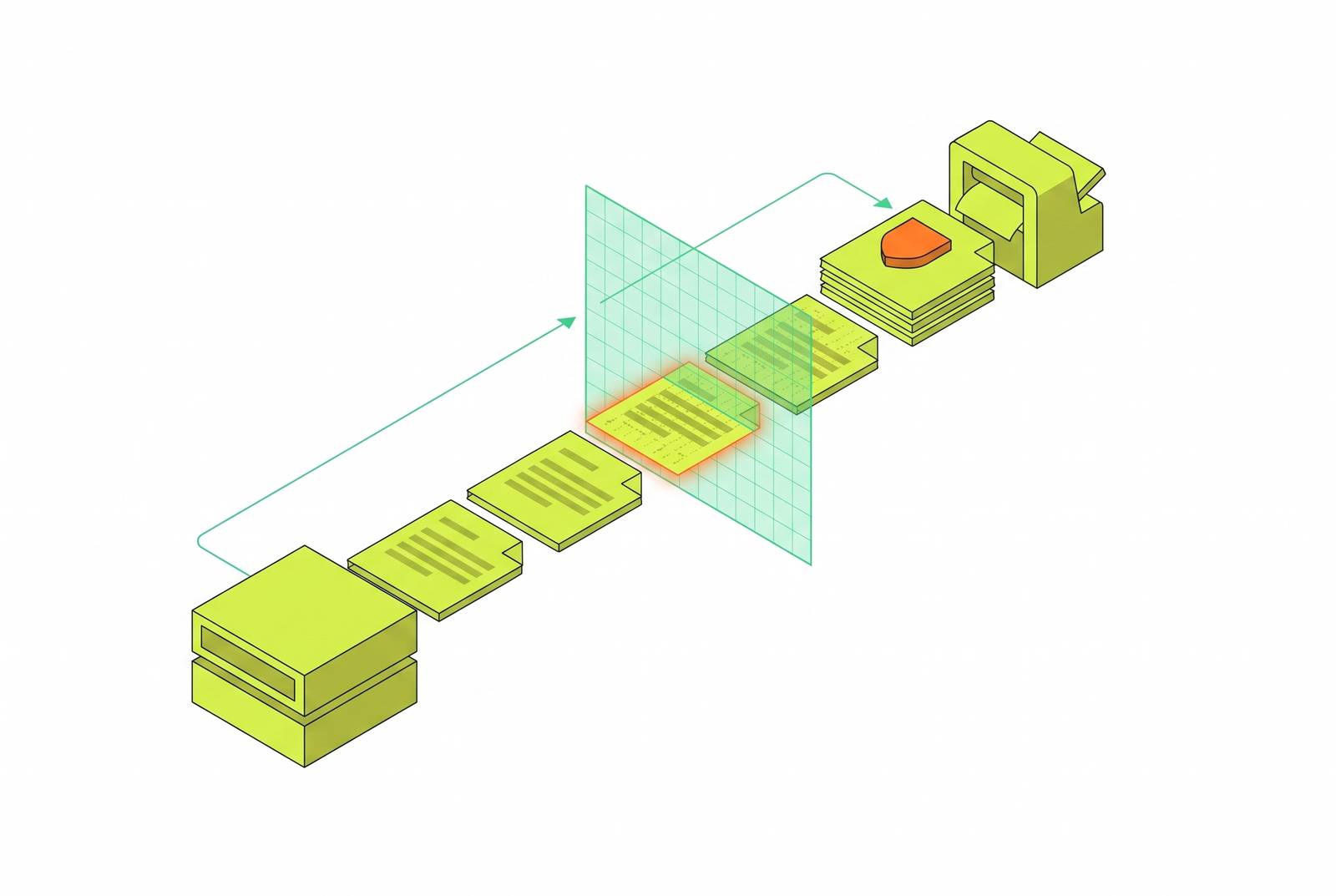
textGrain subtly biases word-choice probabilities during generation using a secret key. The resulting statistical pattern accumulates across hundreds of token selections, rather than residing in hidden characters, invisible Unicode, or metadata. Copy-paste therefore preserves the words in which the signal lives. EU ChatGPT users receive marked output by default, API developers anywhere can opt in, and other ChatGPT users receive no watermark by default because OpenAI ruled out a global default at launch.
How the watermarking landscape actually looks across the major labs right now
Anthropic applies marking at the model level. Every Claude model released on or after August 2, 2026, watermarks text worldwide, without an opt-out, across Claude products and third-party cloud platforms. Google’s Gemini used SynthID for generated text before the EU Act deadline. xAI, publishing as SpaceXSI, states in its developer documentation that text responses from supported Grok models include an invisible watermark effective November 7, 2026.
The direction is convergence. ChatGPT outside the EU and OpenAI’s API without opt-in remain major sources of unmarked output, while the other deployments depend on their stated model coverage. Verification also differs across providers. Gemini offers public verification through SynthID, Claude detection is in private preview, and textGrain detector access is gated.
Those distinctions make a model’s name insufficient to establish a passage’s marking status. Which model release and product route were used, where the text was made, and whether someone opted in can all affect the answer, depending on the provider’s policy. A publisher with a distributed team or global audience may already be producing marked content from several sources without recognizing the differences between them.
What the watermark can and cannot actually prove about a piece of text
OpenAI states that watermarks “can indicate that an OpenAI system generated or processed part of a passage, but not how much human judgment, editing, or creativity went into it.” A positive result is therefore provenance evidence, with misconduct and the full account of authorship remaining separate questions. The distinction is consequential for edited publishing workflows.
A negative result is equally limited. Outputs under roughly 150 words are excluded, and longer passages may lose detectable signal through editing or translation, or originate from an unmarked model. Style detectors answer a different question. GPTZero and Turnitin analyze signals such as entropy, burstiness, and sentence predictability to estimate AI authorship. Their errors on highly edited, technical, or non-native writing prevent those estimates from serving as interchangeable evidence.
Access creates a further operational asymmetry. OpenAI allows only approved researchers and expert organizations to use its detector, and bars its use for academic integrity checks such as checking student essays. Anthropic’s detection API has been in private preview since September 2026 for specified institutional groups. A third party that qualifies may thus be able to check a publisher’s text at launch even when the publisher cannot use the same test.
How much editing actually degrades the textGrain signal
OpenAI’s benchmark starts with a high rate of detection for passages of 400-token length. Synonymizing roughly a tenth of the words substantially reduces detection, while replacing roughly a quarter lowers it to an unreliable level. Editing can weaken the signal. But the benchmark does not show that an ordinary editorial pass has the same effect.
Restructuring paragraphs, adjusting tone, cutting sentences, and moving passages are not equivalent to replacing one word in four. A light copy-edit may leave much of the generated wording as it was. Detection also depends on the starting material, because short text, math answers, and translated text are difficult cases even before editing. The statistical pattern needs enough token diversity to accumulate.
For publishers, the useful question is therefore economic as well as technical. Editing to weaken the signal in a predictable way would take work without showing how much human judgment went into the finished article. Pursuing synonym diversity could also damage meaning or precision. These benchmarks describe the watermark’s limits, but they do not turn routine editing into a dependable provenance control.
Why multi-model rewriting trades one fingerprint for another rather than removing the signal
Chainwash, published in 2026, found that repeated rewriting by external language models substantially reduced watermark detectability while largely preserving semantic content. The rewriter did not need the original watermark key or model. Its scope needs care, however. The research’s relevance to textGrain is limited to findings on diffusion language model watermarks, specifically LLaDA 8B Instruct.
Even where rewriting weakens an original watermark, it does not establish that the finished text is unmarked. A pass through a watermarking model can introduce that model’s own signal. Claude’s covered models, Gemini, and supported Grok models make this a practical distinction. A publisher may replace one provenance signal with another, or leave several signals in the same passage.
Pipelines built to improve quality can also mix signals this way without trying to remove marks. In an evaluator-optimizer loop, one model generates, another evaluates and supplies feedback, and the generator revises. That process can dilute an earlier provenance signal as the wording changes. It does not follow that mixed provenance eliminates detectability, and the resulting text still has a production history relevant to disclosure.
What the disclosure rules actually require from publishers, and where they bite
The EU AI Act places disclosure obligations on some publishers as well as obligations on AI providers. AI-generated text published to inform the public in the EU on subjects of public interest requires disclosure when no person reviews it and takes editorial responsibility. Human review and responsibility are therefore central to that obligation. Watermark status is not the deciding criterion.
The FTC’s 2023 Endorsement Guides update and 2024 Consumer Review Rule add a separate set of US rules, with 2025 staff guidance giving more detail on how they apply. AI-generated testimonials are banned even with disclosure, while material connections in AI-generated endorsement content must be disclosed. Stories of customer success that are LLM-generated can require disclosure even after a human edits them. Editorial intervention is not a blanket exemption from these requirements.
A detected watermark does not provide adequate disclosure, and degrading it does not remove an obligation tied to production. A split-location ChatGPT team illustrates the distinction. A staff member outside the EU can generate unmarked text while a colleague inside the EU generates marked text through the same workflow. The editorial policy applies to both, although their technical provenance trails differ.
Why AI writing sounds like AI, and why single-model pipelines compound the problem
Single-model pipelines flatten voice because the model interpolates from its training distribution rather than reliably enforcing every stated and unstated brand constraint. Even fine-tuning on brand guidelines does not make the model meet all those constraints. Phrases such as “bold but approachable” offer little differentiation. When those abstractions substitute for a precise account of voice, familiar model patterns can dominate the finished copy.
That explains why robotic writing and detectable watermarking must not be confused. The former is a reader’s experience of language, while the latter is a keyed statistical signal. Neither requires the other to be present. Removing a watermark would not make generic prose distinctive, and distinctive editing would not necessarily erase a watermark.
Gartner’s September 2026 research found that a majority of US consumers thought brands were producing too much AI-generated marketing content. More than half said it had made them less trusting of brand messaging overall. The longer-term structural concern is model collapse. When AI tools train on AI-generated content at scale, their output becomes progressively more generic. That training feedback loop differs from using a model over and over, but both give reason to doubt that producing more will keep a publisher’s editorial identity recognizable.
What an adversarial multi-model architecture actually does differently for publishers
An adversarial multi-model architecture makes drafting and criticism separate functions within production. One model drafts, another critiques, and the generator iterates rather than treating the first output as the finished article. The distinction is architectural. Criticism is designed into generation.
Chainwash supports the narrower observation that multi-hop rewriting can change provenance detectability while preserving semantics in the systems studied. It does not prove that distributing generation across models eliminates textGrain, or that a multi-model system automatically preserves brand voice. Those are separate performance questions.
For publishers adopting this approach, the notes’ proposed design is a council trained on the team’s own corpus, with voice treated as a modular, task-specific objective. BrandFusion, published in March 2026, offers a related but limited example by treating brand consistency as a system goal in text-to-video generation. It makes no finding about comprehensive brand documents or system prompts for writing.
A draft-critique-vote loop, even one that takes seven recursions to reach convergence, makes iteration part of the work of production. Writing test cases, style enforcement, and automated adversarial review belong in the same infrastructure layer as other quality gates. Their purpose is editorial fidelity.
What publishers should actually do before the December 2 compliance deadline
The immediate action is to audit which models the team uses and where it uses them. That audit should distinguish EU and non-EU ChatGPT output, OpenAI API opt-in status, Claude models covered by the August 2, 2026 policy, and supported Grok output marked from November 7, 2026. Location is now an operational variable. A single label such as “AI-assisted” does not describe the different marking conditions within a distributed workflow.
A light editorial pass is not a reliable way to push textGrain below its detection threshold, and detector results do not settle disclosure duties. The December 2, 2026 transition covers the marking and detection that providers must support for pre-existing generative AI systems. Most other Article 50 duties have applied since August 2, 2026, so that later date should not become an assumed grace period for publishing policy.
Publishers should also check how well their infrastructure keeps the writing true to their voice. A pipeline that routes every article through one model risks accumulating generic language across the archive, even when each individual draft passes a light review. For teams ready to change that design, a multi-model adversarial architecture trained on their own corpus offers a way to make voice and quality explicit system objectives. It does not erase disclosure duties or guarantee an unmarked result. As marked output becomes normal across the major labs, publishers have a stronger reason to use this infrastructure to keep their editorial identity.