RAG vs Fine-Tuning for Content Quality Systems
RAG handles facts that change; fine-tuning shapes how models write.
AI content quality gates for content teams need to check that facts have support and that writing follows the rules before the team publishes it. RAG supplies current, traceable knowledge, while fine-tuning shapes voice, structure, and register. Neither is a publishing gate by itself. A separate model that checks output against clear criteria adds the review layer, but this setup works only when teams tell missing knowledge apart from unwanted behavior.
Why RAG and fine-tuning are not competing answers to the same question
A model can write in a brand’s voice while giving a product specification that is out of date. It can also retrieve the correct specification and describe it in language the brand would never publish. Treating those failures as one customization problem directs effort toward the wrong mechanism. More training does not establish a current source of truth, while more retrieved documents do not make a writing habit reliable.
The confusion begins because both approaches promise to customize a model. Their mechanisms differ. Retrieval-augmented generation, or RAG, keeps model weights as they are and adds the information the model needs at inference time. Fine-tuning changes weights through training examples so that the model adopts different behavior. One changes the evidence available for an answer, while the other changes how the model tends to respond.
Choosing RAG because it seems easier, or fine-tuning because it featured in a recent conference talk, leaves the underlying failure undefined. Teams should first ask whether the system lacks knowledge or fails to follow the rules for how it should behave. A content quality system may have both problems, but each requires its own diagnosis. Otherwise, a successful intervention in one area can conceal an unresolved failure in the other.
What RAG actually controls — facts that change
Policies, prices, product specs, support tickets, and internal documentation belong in retrieval when they change weekly or faster. Their value depends on currency. If those facts are encoded in weights, they stay accurate only as long as the source data stays the same after training. Updating a retrieval store, by contrast, requires no retraining, so the knowledge layer can change without rebuilding the model’s behavior.
The mechanism is brief. At query time, code retrieves relevant document chunks and places them in the context window, giving the model evidence to reason over rather than leaving it dependent on weight-encoded knowledge. Keeping knowledge separate in this way lets answers use new facts as soon as the retrieval store is updated. It also allows the base model to be replaced without repeating the knowledge work.
A RAG answer can cite the source chunk that supports it, whereas a fine-tuned model cannot identify the training example responsible for an output. That distinction is decisive when an answer must be auditable or attributed to an approved source. Fluency cannot substitute for evidence.
Long-context prompting provides a narrower alternative. When a corpus fits within a very large context window and rarely changes, prompting with caching can cost less than a full retrieval pipeline. However, most enterprise knowledge bases are too large, dynamic, or sensitive for whole-corpus inclusion. A larger context window does not remove those constraints.
RAG quality is capped by retrieval quality, not generation quality
A generator cannot reliably compensate for a retriever that supplies the wrong evidence. Many failures described as “RAG doesn’t work” begin upstream of generation, with plain cosine-similarity top-k retrieval acting as a preventable limit on quality. Diagnosis therefore starts with the returned chunks.
Chunking creates the first set of tradeoffs. Fixed-size chunks can sever context at boundaries, while sentence-aware chunking encounters difficulties with tables, code, and lists. Recursive chunking with overlap preserves more context but increases storage and retrieval noise. The appropriate choice depends on how the information is structured.
Reranking tackles a different weakness by using a cross-encoder to check the retrieved candidates before they reach the generator. Anthropic’s Contextual Retrieval work showed a large reduction in failed retrievals, with a further improvement when reranking was added. This is a substantial lever that teams often skip. Cohere Rerank and other reranking models are options for that stage, while Ragas, TruLens, and DeepEval provide evaluation harnesses.
A production RAG stack in 2026 also needs domain-appropriate embeddings and a vector store. Omitting a component is a quality tradeoff. For hard, multi-hop questions, agentic RAG adds iterative retrieval, query decomposition, self-correction, and tool use. Naive single-shot retrieval remains appropriate for high-volume simple lookups, so complexity should follow the question.
What fine-tuning actually controls — form, not facts
Fine-tuning can help when a model has the facts it needs but keeps using the wrong voice, structure, or register. These are failures of behavior. When prompting cannot hold the required pattern reliably at scale, training examples can change the model’s response tendencies through weight adjustment. The resulting behavior does not require retrieval at inference time, although the answer may still need retrieval for its facts.
Structured output illustrates the distinction clearly. A model that invents fields despite prompt instructions needs better output adherence. Similar cases include domain vocabulary that the base model hedges on, refusal and tone instructions that get overridden, and small-model distillation from a working large-model pipeline. In each case, the target is a repeatable way of responding.
LoRA and QLoRA provide the small-adapter route to these changes. Style, structure, and output adherence can respond well to such adapters, which makes full fine-tuning difficult to justify as the initial approach to a bounded behavioral problem. The scope should remain specific. Training for an identifiable failure is different from expecting a training run to improve every dimension of quality.
Fine-tuning cannot fill in missing context or ensure that business facts are up to date. Baking those facts into weights produces answers that can become stale and cannot be traced to their training examples. It also risks catastrophic forgetting of general capability. A model’s command of the right terminology is therefore not proof that it knows the current policy.
The real cost of fine-tuning is not compute — it is data curation and lifecycle ownership
The training run is only part of the commitment. Data preparation, evaluation infrastructure, and a year or more of lifecycle ownership change the calculation for teams that reach for fine-tuning early. Before training, a team needs a written evaluation that distinguishes a better checkpoint from a worse one.
Examples need diversity of format with consistency of voice so that the model learns the voice pattern across content types. Avoidance rules are equally important. Explicit negative constraints identify the habits the brand rejects, while positive examples alone can leave those habits insufficiently defined. Fine-tuning can strengthen unwanted behavior just as easily as the behavior the team wants.
That preparation is not a one-time expense. A fine-tuned model learns behavior as it stands at one point in time, so a brand voice that changes calls for another training cycle. Teams that frequently revise their guidelines must repeat data preparation and training as those standards change. Cheap compute does not remove that obligation.
Prompt engineering with custom instructions can deliver much of the benefit without the same cost and complexity, especially while the desired behavior is still changing. Parameter-efficient fine-tuning, or PEFT, is justified when the team can name and measure the stable behavior that prompting can no longer keep in place.
Where the confusion produces the most damage — brand voice in content quality systems
A system needs facts about the brand, but it also needs to reproduce the author’s patterns of expression. Those requirements can appear in the same brief, which makes them easy to collapse into one task. They remain different problems. Knowing what a brand says about itself does not guarantee that a model will write as the brand does.
This produces two recognizable failure modes. A retrieval-led system can provide approved information and on-brand exemplars yet fail to keep the same voice across new edge cases. A fine-tuned system can sound convincing while using business knowledge that is out of date. In the first case, access to examples has not become dependable behavior. In the second, dependable behavior makes unsupported content sound more authoritative.
LLMs begin as zero-shot generalists. Without explicit voice training or retrieved on-brand exemplars, their default is generic web-English. Prompt instructions can improve the result, but a single model with neither retrieval nor adaptation is structurally insufficient for governed production at scale.
The diagnostic difficulty is that polished prose can hide both defects. A content team may recognize the tone and overlook the unsupported claim, or recognize the accurate claim and overlook a recurring voice violation. Factual consistency and behavioral consistency need to remain separate criteria even when the published result must satisfy both.
The hybrid pattern that production systems actually use
The hybrid assigns fine-tuning to form and RAG to facts. This is not combination for its own sake. Real content pipelines commonly contain both changing knowledge and stable writing requirements, so the two mechanisms address different parts of the same output.
The adoption sequence is narrower than the final architecture. Teams should start with prompting, add RAG when knowledge is missing, and add fine-tuning only for behavioral failures that remain after retrieval has done what it can. That sequence makes each addition answer an observed problem. It also avoids committing to a training lifecycle before simpler approaches have been tested.
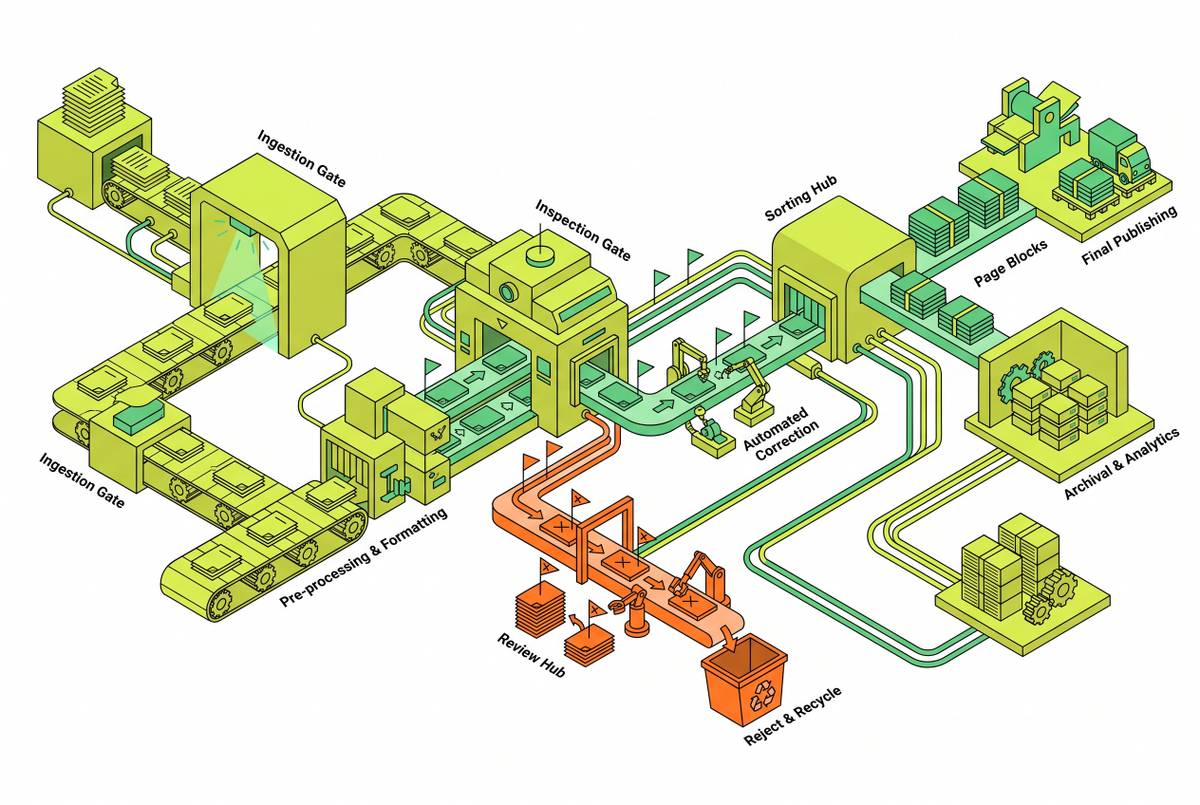
A separate review layer addresses what that hybrid still leaves open. In an Evaluator-Optimizer pattern, one model generates output and another evaluates it against criteria, separating drafting from editing. Adversarial multi-model review extends that separation by assigning different criteria to different evaluators. A model reviewing its own output cannot be relied on to catch its systematic failure modes, so independent evaluation has a distinct role from generation.
This review is the publishing gate that evaluates whether the output meets the explicit standards before it ships. The hybrid requires maintenance of retrieval and training systems, evaluation of both, and renewed training when voice evolves. Teams should accept that burden only after validating the simpler approaches.
How should content teams choose RAG, fine-tuning, or both to enforce standards before publishing?
The first decision concerns missing information. If the model lacks facts it could not have been trained on, or facts that change frequently, retrieval is the appropriate response. The same choice applies when output must be cited, audited, or attributed to sources. These are evidence requirements.
The next decision concerns persistent behavioral failure. If the facts are correct but voice, format, or register remains consistently wrong after prompting has been tested, LoRA or QLoRA becomes a candidate. Stability is the condition. When the desired voice or output preference changes frequently, prompt engineering comes first because locking a moving target into weights creates repeated preparation and training work.
Cost and latency introduce a separate fine-tuning case. Distillation can transfer behavior from a working large-model pipeline into a smaller model, rather than trying to solve a knowledge gap through training. Before any such run, the team still needs a written evaluation capable of comparing checkpoints. Without it, the training loop has no dependable signal of improvement.
When both fact and form failures remain, the justified architecture is a hybrid with separate evaluation before publication. Ragas, TruLens, and DeepEval support evaluation of the RAG pipeline, while the content gate needs explicit criteria for factual support and behavioral adherence. Those functions should not be confused. Retrieval evaluation tests whether the system supplies suitable evidence. Adversarial review evaluates the output against the publishing standard. Tests can serve as legitimate quality gates for writing, just as they do for code.