Encoding a House Voice as the Stopping Condition in Iterative AI Drafts
Voice classifiers can turn brand style into a pass-or-fail test.

Recursive AI writing pipelines refine drafts automatically by feeding evaluation results into later editorial passes. Encoding a house voice as the stopping condition means accepting a draft only when a voice classifier clears a measurable fidelity threshold. This requires an architecture that separates editorial roles, makes voice constraints executable, and returns repairable feedback whenever a draft falls short.
Why prompting a house voice never sticks past the first few paragraphs
Attention is position-sensitive, so a voice document placed at the top of a prompt loses influence as the context fills with the draft itself. The model must write the content, put the argument in order, and keep the style on track within the same inference. Voice is often the first constraint to slip. This failure is instruction drift, in which a piece begins on-voice and gradually defaults to generic corporate language.
Repeating voice context in every prompt keeps attention on it throughout generation, but probabilistic inconsistency persists. Each inference can handle instructions that compete with each other differently, even when the voice it is asked for stays the same. The inconsistency extends beyond any single document. As teams publish more and more contributors join, variation between prompts can lead to several slightly different brand voices across the same program. Prompting supplies direction, but it cannot guarantee adherence.
Why statistical regression to the mean makes fine-tuning on a generic corpus equally dangerous
Fine-tuning does not automatically remove this variation in a useful direction. If the existing brand corpus is generic, training on it makes generic output more consistent. It adds precision to sameness. The model learns the examples supplied, including their failure to express the distinction the brand intended.
Training on AI-generated content at scale introduces the related risk of model collapse. Repeated exposure to common linguistic patterns reinforces familiar structures while losing edge cases, opinions, and lived specificity. Output moves toward the statistical center of “acceptable marketing language.” That is a competitive problem as well as an editorial one, because technically acceptable prose can erase the distinctions a house voice exists to preserve.
Voice documents built around adjectives such as “bold but approachable” can likewise push output toward the statistical center. A model can associate those words with many different examples without extracting a usable constraint. The operational alternative is more exact. Instead of “use short sentences,” the specification can target a specific ratio of sentence lengths with a hard maximum. This gives generation and evaluation the same rule to follow, while an adjective can be read differently from one call to the next.
What it means to treat voice as a scored exit criterion rather than an input instruction
A stopping condition is a test the current draft must pass before the system may accept it and end revision. In this architecture, that test is a voice-fidelity score compared with a defined threshold. The classifier moves voice enforcement into verification, while prompts remain a way to guide the work.
Agentic Artifact Creation: Systems, Evaluation, Principles, and Opportunities distinguishes direct generation from construction loops in which intermediate observations redirect later decisions. Direct generation runs on a fixed schedule, so failures build up until the final check finds them. A construction loop instead couples the draft, the policy for changing it, and runtime verification.
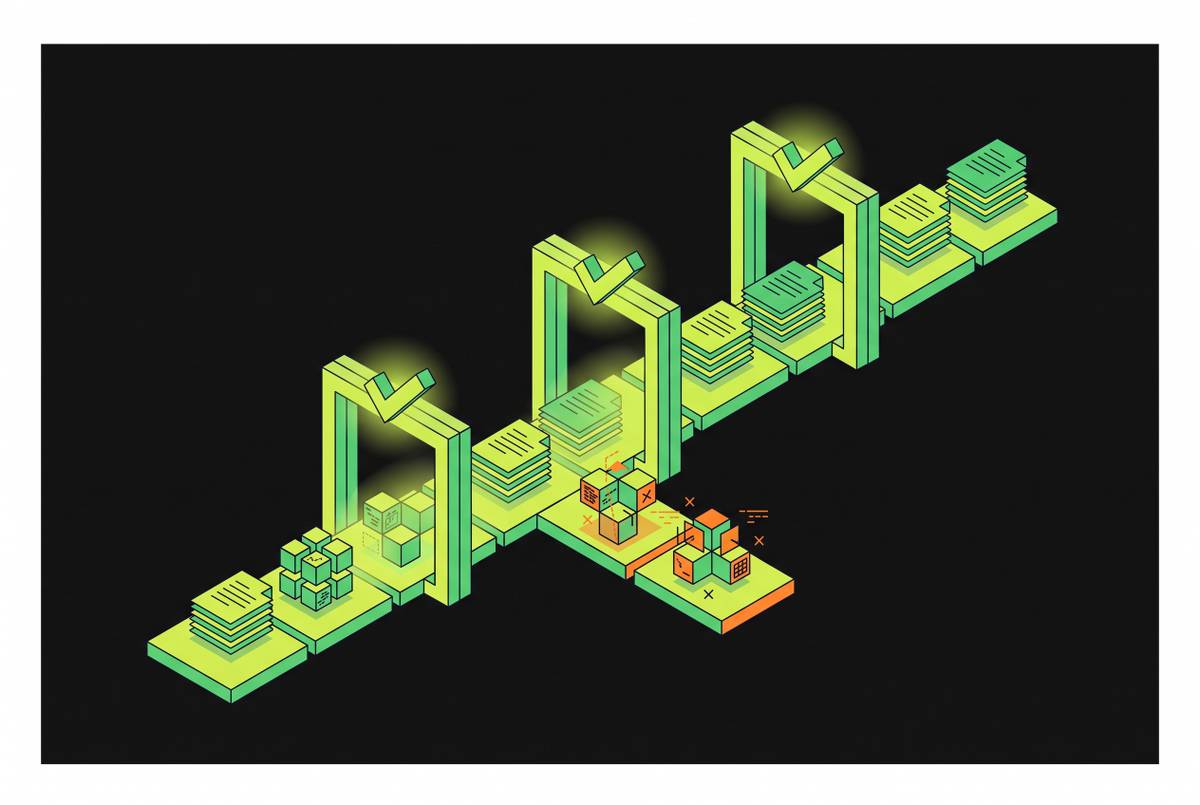
The threshold therefore has to control delivery: a draft below it returns for revision, while a draft that clears it can leave the loop. Seven recursions to convergence can represent the intended operation. The relevant distinction is whether those recursions respond to evidence of voice failure or simply ask the model to try again.
How multi-pass handoffs with distinct editorial roles create the conditions for voice convergence
Separate editorial passes make that feedback easier to act on because each pass has a defined responsibility. The Drafter creates the initial text, the Destabilizer challenges its smoothness, the Compressor cuts, and the Authenticator restores the house voice. These roles are functional boundaries. They keep every editorial concern from falling to one inference, where it is hard to tell which part went wrong.
The order is consequential. Compressing before destabilizing produces a shorter smooth draft rather than giving the Compressor something distinctive to cut around. The Destabilizer must introduce roughness first, and its challenge also counters the tendency of uncalibrated AI feedback to converge on approval. The Authenticator belongs last because its task is restoration after the other passes have changed the text.
This separation also gives orchestration a place to intervene when a particular pass produces subpar output. The system can flag that pass or route it to a backup without treating the entire workflow as one indivisible operation. Evaluation then has a clear final target. The voice classifier scores the Authenticator’s output, and the draft needs another revision if that score does not meet the stopping condition.
What the voice classifier actually measures and how to build one that generalizes
The classifier must measure properties that distinguish the house voice, rather than treating general writing quality as a substitute. Sentence-length ratios, hard maxima, and vocabulary constraints give it clear targets to check. Fluency alone is not enough to establish fidelity. A coherent, factually accurate draft can still fail every meaningful test of whether it sounds like the brand.
Training approaches differ in how consistently they preserve that distinction. Few-shot prompting uses examples at the standard API cost, but its judgments can stray unless the prompts are changed. Retrieval-augmented generation against a live database of approved content balances consistency and flexibility without full retraining. Fine-tuning offers a route to production scale, provided the corpus encodes the intended voice. Depending on the approach chosen, evaluation can become reusable infrastructure or remain dependent on a small set of examples.
The training corpus needs approved content and explicitly rejected drafts so the classifier learns both sides of the boundary. Its confusion matrix then distinguishes false positives, which admit off-voice work, from false negatives, which reject acceptable work. That distinction is essential for calibration. A classifier that approves almost everything can seem agreeable while failing to catch off-voice drafts, and one that rejects valid examples adds work without making drafts sound more like the brand.
Why watermarking and model fingerprinting change what the classifier must account for
Multi-pass drafts can carry statistical traces from several models, so word choice alone is a less reliable sign of house voice. Watermarking adds another source of influence by nudging word selection into patterns recognizable to a detector holding the right key. A classifier focused on those choices may mistake a provenance signal for the intended editorial style and reward or penalize it.
The EU AI Act sets machine-readable marking requirements for AI-generated audio, image, video, and text output by new providers’ AI models from 2 August 2026, with existing providers affected from 2 December 2026. The California AI Transparency Act, SB 942, excludes text-only output from its watermarking requirements. These differences matter for provenance-aware systems, but rules are only part of what shapes their design.
The DITTO vulnerability at EACL 2026 demonstrated a spoofing attack using watermark radioactivity, in which a model trained on watermarked output inherits the pattern. That finding establishes propagation through training. In multi-pass systems, inherited or retained signals nevertheless complicate attribution. Patterns in transitions and word choice that come from a model family make attribution harder still, so voice classifiers need model-agnostic structural features because surface vocabulary alone is too ambiguous.
How do you build an AI writing system that stops on voice match?
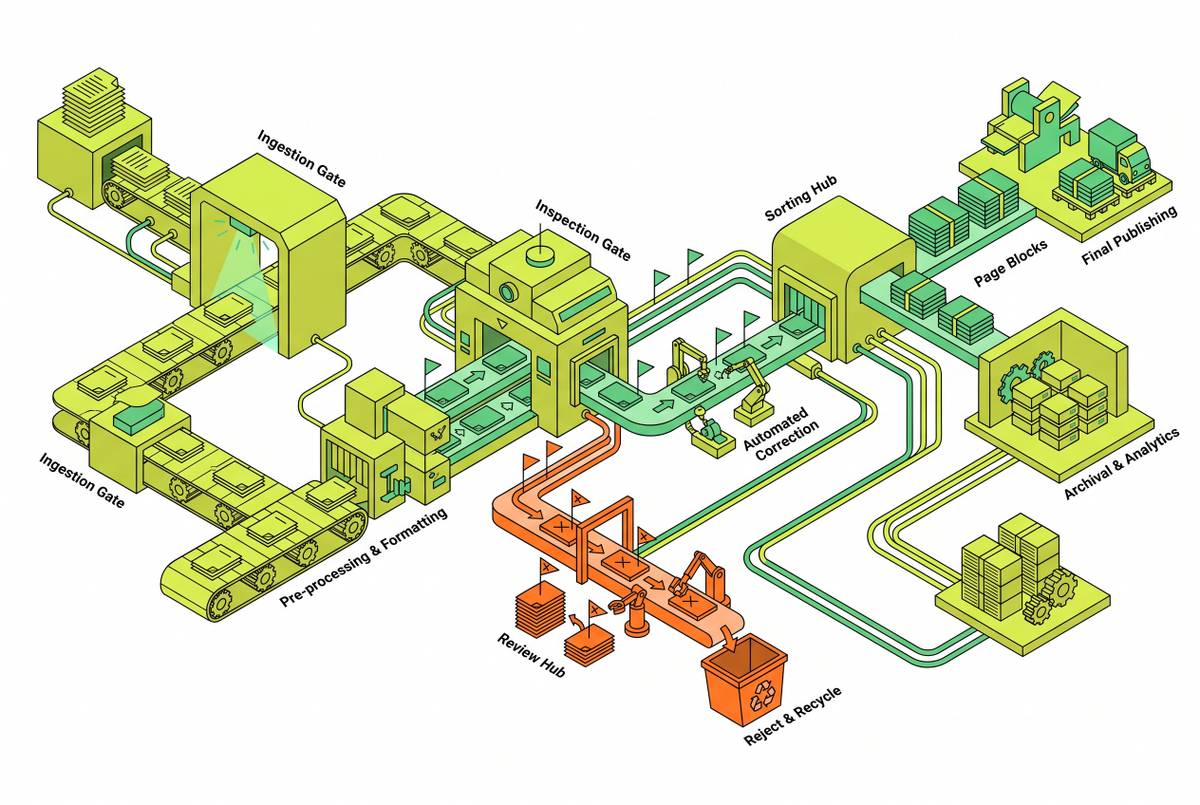
The loop begins with intent capture and specification framing, which turn the request into bounded instructions, constraints, and acceptance criteria. Each generation call gets an excerpt from the brand corpus because an earlier reference may lose influence. Orchestration then preserves context through the Drafter, Destabilizer, Compressor, and Authenticator. The classifier evaluates the resulting draft against the voice threshold.
Below-threshold output returns with the classifier’s failure signal as input to the next pass. This is the essential feedback connection. Verification redirects construction before the system accepts the artifact, rather than recording a score after the workflow has already ended. Exhausting a pass count cannot qualify an off-voice draft for delivery, because resource exhaustion and voice acceptance are different outcomes.
The voice specification also needs executable enforcement at pass boundaries. Scorer functions and linter-equivalent style guards let orchestration check constraints, so enforcement does not depend on prose instructions alone. Webflow’s marketing harness architecture distinguishes binary code tests from content constraints that depend on audience, channel, and intent. The system still uses a quality gate, but what counts as a pass must fit those editorial contexts.
What breaks when the classifier is the wrong shape for the loop
The first failure is feedback at a scope the available actions cannot repair. A scalar score can establish rejection without explaining which structural property failed or where revision is needed. The next pass then has little direction. Generating the draft again may repeat the same flaw because the loop has been told it failed without being told how to fix it.
A second failure comes from classifier-generator alignment. The artifact creation survey identifies the limited independence of learned judges that share a generator’s preferences or blind spots. Testing against deliberately off-voice drafts exposes whether the classifier can discriminate beyond the drafter’s own habits. Agreement is not automatically evidence of correctness, especially when both components were trained to favor the same patterns.
Threshold calibration creates a different tradeoff. A threshold set too high prevents convergence, while one set too low admits off-voice drafts. Approved and rejected examples provide a basis for choosing between those errors. As the brand evolves, however, an old corpus can make a previously useful threshold enforce an outdated standard, so retraining has to remain possible.
Independent reviewers can also disagree during revision, and that disagreement is useful evidence. The loop’s available editorial actions may or may not be sufficient to resolve the disagreement. A faster acceptance decision is not an improvement if it comes from weakening the test.
What implementing this architecture requires from the team that builds it
Voice enforcement needs an owner, a versioned specification, and a workflow set out before generation starts. Humans set the acceptance criteria, choose the data used to train the classifier, and decide what each pass does, so the system does not depend on people reviewing every finished output. Editorial judgment governs the work through the system’s design.
The resulting components belong in the developer stack as callable quality gates. A CLI, an API, or an MCP server lets existing pipelines invoke the classifier and editorial chain without requiring a separate web application. Voice rules scattered across Docs, Notion, and email cannot provide that enforcement on their own. The operative specification must be available to the orchestration that generates, evaluates, and routes drafts.
The corpus also needs continuous ownership. Versioning and ingesting approved output keeps the classifier tied to the brand’s current standard, while a one-time fine-tuning run preserves only a snapshot. Teams can show that few-shot approaches work before spending on fine-tuning for production scale. The first implementation need not include every component at full scale, but it must preserve the decisive workflow rule from the start. A draft is ready because it passes the voice gate.