AI Writing Platforms With API Access Built for Developers
Production writing APIs need routing, revision loops, and voice checks.
AI writing tools for developers need more than access to a capable model. For documentation, code comments, technical blogs, and project overview files, production writing infrastructure needs model routing, recursive revision, measurable voice fidelity, and quality gates. The gap between a foundation-model API and a writing-specific API is an engineering problem.
Why foundation-model APIs are not writing APIs
Making the first API call is straightforward. Making the hundredth call produce writing with the same voice and quality as the first is a different problem. Foundation-model APIs from OpenAI, Anthropic, Google Gemini, and others provide raw model access, accepting a prompt and returning a completion. That exchange does not show whether the text meets a publication standard. The caller is still responsible for quality, consistency, and voice.
At scale, that responsibility becomes a layer of infrastructure. It includes routing decisions, recursion depth, model selection for each task, voice enforcement, and checks between generation and publication. Endpoint access alone solves none of those concerns. Because foundation APIs are well documented and easy to call, however, they can appear to be complete writing systems. The absence of that layer becomes evident only when the text produced falls short of what was expected.
This is a category error. A foundation endpoint can generate text, while a writing API must control how it does so to produce a document that meets the standard. The distinction determines which problems belong in a prompt and which require a system around it.
What single-model output converges toward, and why switching models does not fix it
Writing from a single model tends to fall near the statistical center of its training distribution. Standardized training data and reinforcement learning from human feedback favor language that most people will accept, including the familiar patterns of generic marketing prose. Those preferences sit below the prompt layer. Instructions can change an individual response without removing the tendency that shapes output across a large workload.
Switching models changes the center while preserving the underlying constraint. Each model family has its own habits in how it uses transitions, chooses words, and structures text. Relying exclusively on a different family therefore relocates the source of consistency without necessarily producing a distinctive voice. A model can perform well in isolation while producing a body of work whose patterns become increasingly recognizable.
Fine-tuning on a brand corpus is the strongest objection. It can shift output, but its value depends on whether the corpus contains a distinctive voice worth learning. If the training material is generic, fine-tuning can make that generic style more consistent. Corpus measurement must therefore precede ingestion rather than treating a collection of approved documents as sufficient evidence of differentiation.
Those recurring patterns also have a detection consequence. Semantic fingerprinting examines model-family habits, while stylometric analysis compares new text with an author’s historical output. A draft may meet its immediate instructions yet remain recognizably different from the person or organization it is supposed to represent.
How AI watermarking and model fingerprinting change the production calculus
Statistical watermarking adds a separate signal to those stylistic patterns. A watermark is embedded in word-choice patterns during generation, making it invisible to readers but detectable with the appropriate tool. Post-processing therefore cannot be treated as a reliable way to remove provenance signals from a writing pipeline.
Anthropic embeds a statistical watermark in text from models released on or after August 2, 2026. Its public detection tool had not shipped as of that date, so developers could not integrate that tool into production checks for watermark presence. This separates a provider’s ability to mark output from a caller’s ability to inspect the mark. An API integration does not necessarily expose both capabilities.
The EACL 2026 paper DITTO documents another complication. A model trained on watermarked output can inherit the watermark pattern, a phenomenon described as “watermark radioactivity.” DITTO uses knowledge distillation to forge a victim model’s watermark signal. Consequently, fine-tuning on watermarked upstream output can propagate a signal into a downstream stage without that being the intended result.
Detection still calls for care when making yes-or-no judgments. Entropy, burstiness, and stylometric patterns can also arise naturally in highly edited, technical, academic, or non-native writing. The European Commission’s Code of Practice on Transparency of AI-Generated Content also places provenance within a regulatory context. Architecturally, distributing generation and revision across models addresses dependence on one family’s signature, but it does not turn probabilistic detection into certainty or guarantee that watermarks disappear.
What multi-model architecture actually means at the API layer
Multi-model architecture assigns different models to different roles within one pipeline. It is not simply a menu for switching providers. The design assigns models to generation, critique, and voice checking and specifies how their outputs move through revision. Routing operates throughout the writing process.
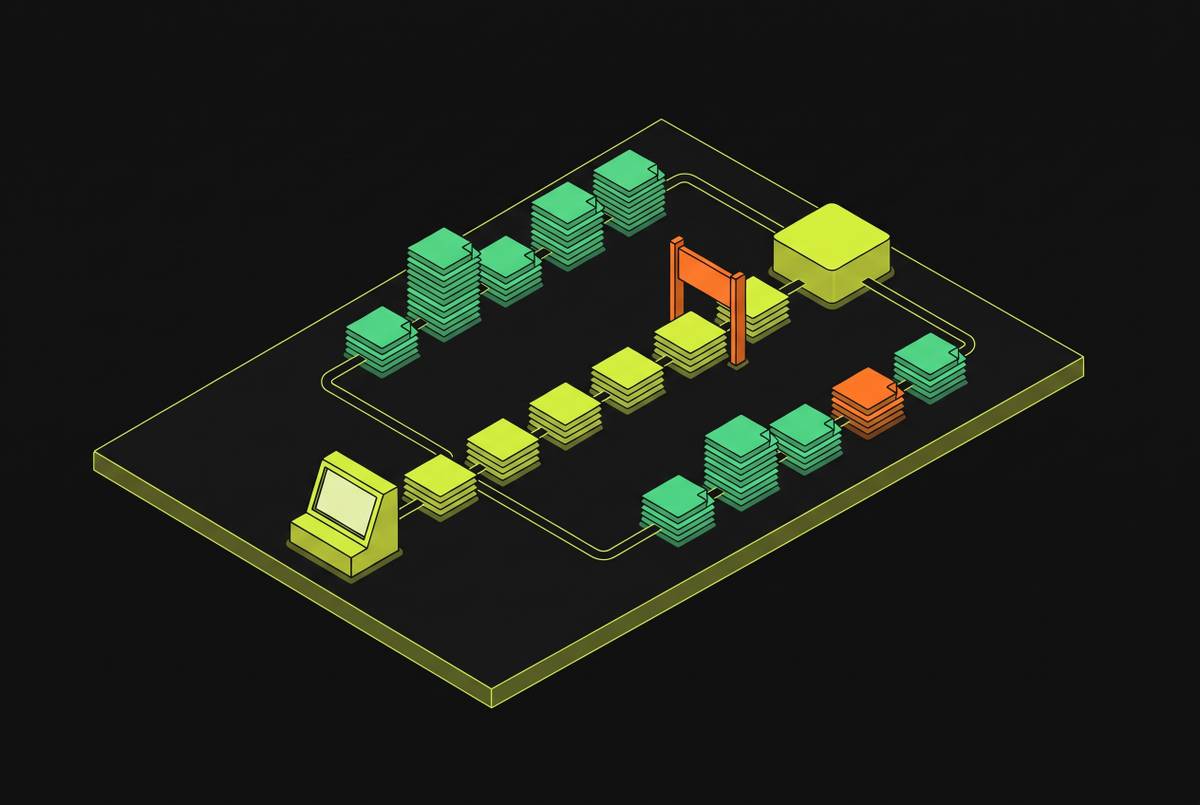
The evaluator-optimizer pattern provides the minimum viable adversarial structure. One model generates a draft, and a second grades or rewrites it, establishing a relationship similar to that between an author and an editor. Running that exchange once gives the draft one review pass. Running it recursively until the output meets a quality threshold makes convergence an explicit system behavior. Engineers then choose the recursion depth instead of letting it be set by how many calls happen to repeat.
Prompt chaining provides a more fixed sequence. Each call works on the previous step’s output, and gate checks between steps decide whether the document is ready to move on. Parallel agent spawning runs tasks that do not depend on each other at the same time. A documented site-audit pattern uses four agents for design consistency, content gaps, broken links, and SEO metadata, then merges their reports.
Cost also shapes the assignment of roles. As of July 15, 2026, pricing ranged from sub-dollar-per-million-token options to premium models at multiples of that level. OpenRouter provides managed access to 500-plus models through one endpoint, with quality-aware routing and automatic fallback. LiteLLM provides an open-source routing alternative covering 140-plus providers across native and OpenAI-compatible APIs. These tools supply routing infrastructure, but access to multiple models is not itself a writing architecture.
Voice fidelity as an engineering constraint, not a prompt instruction
Once several models participate in a document, voice becomes a shared output constraint. An instruction given at generation does not automatically control what later critique and revision stages produce. The pipeline needs a reference against which voice can be evaluated. Without that reference, recursive improvement may change the style as it improves another part of the text.
Prompt-level context injection is the simplest tier to put in place. Prepending excerpts from a brand corpus gives each generation call a contextual baseline, but its reliability declines as task content fills the context window. It is quick to implement, but the excerpts provide examples of the target with limited enforcement.
Fine-tuning moves that target into training. The initial size target is a few hundred pieces of content, with smaller collections supplemented by annotated examples written and reviewed against the brand. The model is trained on JSONL prompt-completion pairs, with a training-validation split. Success means the tuned model wins a majority of blind comparisons and a majority of brand-team pieces publish without significant edits.
The prerequisite is a measured corpus. Sentence-length distribution, lexicon, and hedging patterns need to be extracted, with distinctiveness tested through blind discrimination before the corpus becomes training signal. Post-trainable, corpus-ingested writing systems then use recursive self-correction against that measured reference. This is the tier at which voice can become a verifiable output property. With limited or undifferentiated material, however, training can still revert toward the same statistical center the system was intended to escape.
Quality gates for writing output, and why most pipelines have none
Software pipelines accept tests and adversarial review as normal production controls. Writing pipelines often move directly from generation to publication, without an automated check that the result meets their intended standard. A writing system without quality gates is exposed in the same way as a codebase without a test suite.
Fact-claim extraction and verification address factual reliability, while originality scanning evaluates output against a differentiation threshold. Structure validation checks readability and heading hierarchy, and entity coverage checks whether the text includes the subjects it needs to cover. Human expertise supplies lived examples and contrarian insights, while readability scoring and factual verification each serve distinct purposes.
Voice enforcement also has different implementation costs. A language-model classifier trained on branded content is more precise but takes weeks to build. Few-shot classification uses 5–10 exemplary brand samples to score new content, providing a lower-precision starting point that can be operational in hours. The practical progression is to establish that initial check before building the classifier.
The self-healing loop connects evaluation to revision. An automated auditor scores drafts against SEO and readability metrics before human review. If a draft falls below threshold, it returns to the generation agent with specific improvement instructions. That is the writing equivalent of a failing test triggering another build, making quality control part of execution.
What developer-native writing infrastructure looks like in practice
CLI-first, API-native writing tools bring these controls into the developer’s existing environment. They differ from browser-centered editors because the writing workflow can live in the terminal with build systems, test runners, and deployment scripts. The interface is only part of the distinction. The deeper change is that generation, checking, and publication can be treated as an engineering workflow.
Wonda covers the marketing pipeline from content generation through publishing and analytics in a single binary with no runtime dependencies. n8n is a workflow automation platform with a CLI interface and 500-plus native integrations connecting marketing tools, CRMs, email platforms, and databases. These examples occupy different roles in the workflow. One packages a marketing pipeline, while the other connects tools and data into automated processes.
Claude Code illustrates the convergence from the software side. It is gaining adoption as a terminal-resident agent that reads an entire codebase, writes and edits files, runs tests, and commits. Voice fidelity and publication quality still depend on the routing, reference material, and gates built around generation.
What should developers evaluate when choosing an AI writing API?
Foundation-model comparisons usually emphasize benchmark quality, latency, token pricing, context window size, and multimodal support. Those criteria are still needed to judge the raw capability, but they do not describe the writing system. Evaluate whether the platform merely returns text or governs its progress toward an explicit standard.
For teams choosing a platform, the evaluation should begin with role assignment and convergence. Does routing give different models the jobs of generation, critique, and voice checking, or does one model do them all? Does the system revise until it reaches a quality threshold, or return a first draft? A single external endpoint can still front a multi-model system. What counts is the architecture behind that interface.
The distinction is between a measured, corpus-ingested, blind-tested voice system and an instruction that can weaken as context fills. Quality gates should send text back for revision when it fails a check. Good developer ergonomics then let the API and CLI fit the terminal workflow, while provider portability allows underlying models to change without rebuilding the pipeline.
The practical test is to run the same five tasks on each candidate platform. Those tasks are the hardest prompt, the cheapest high-volume prompt, one safety-sensitive case, one long-context case, and one failure-handling case. This tests the team’s workload rather than substituting published benchmarks for production requirements. The strongest writing API is the one whose architecture produces acceptable work under those conditions.