The Statistical Patterns Beneath AI Text That Human Readers Sense Before They Can Name
Readers sense AI prose through flat rhythm, not just predictability.
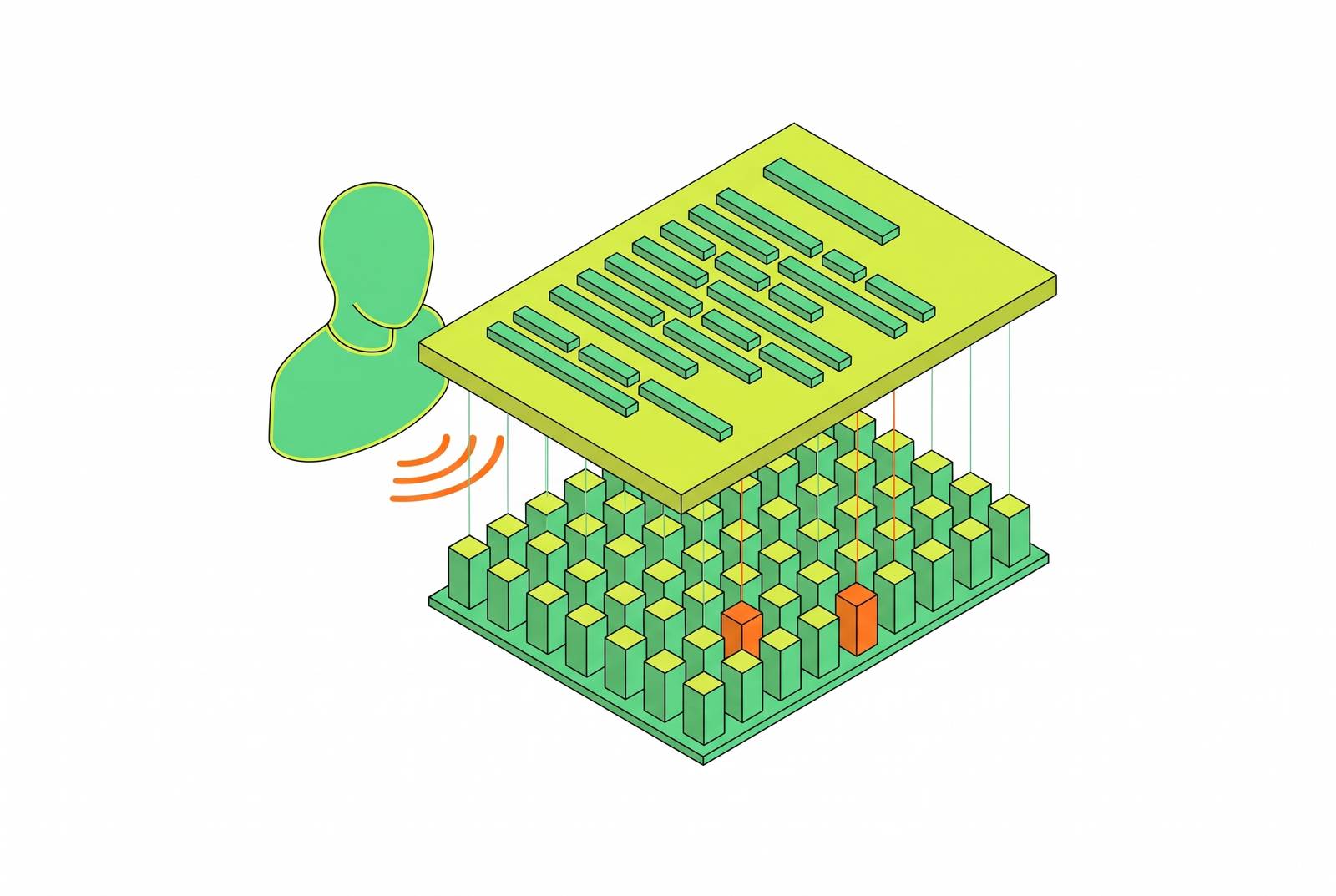
AI writing sounds like AI because next-token prediction favors words that are likely to come next, so the prose has too little change in rhythm and too few surprises. Post-training can reinforce that smoothness.
What readers notice before they can describe it
Three paragraphs into a blog post, a reader senses that something is off. Every sentence is clear, but the passage feels oddly the same throughout. A hiring manager may have the same reaction to a polished cover letter. Readers can have either reaction even when the spelling and facts are right. The trigger is often the absence of surprise.
Wang et al.’s multilingual study, Is Human-Like Text Liked by Humans? Multilingual Human Detection and Preference Against AI, found that trained annotators could distinguish AI text well above chance. The reported gaps centered on concreteness, cultural nuance, and diversity. Yet readers did not always like human writing better when they were not told who wrote it. Detection and preference are therefore different judgments, even when they arise from the same passage.
How LLMs generate text, and why that process biases toward smoothness
LLMs generate text by sampling tokens one after another from a probability distribution shaped by the data they were trained on. Likely continuations have an advantage, which biases the result toward familiar sequences of language. That pressure can still lead to good prose. It produces the aggregate of acceptable prose, where many individually reasonable choices accumulate into an undistinguished whole.
A person writing can reject an obvious word because its sound, precision, or implication is wrong for the passage. The model’s immediate operation is different, selecting a continuation from learned probabilities. Next-token prediction makes smoothness a structural tendency across products. This tendency is especially clear in brand writing, where voice depends on rules and on what the brand chooses to leave out. A plausible approximation of a voice is not the same as applying its boundaries.
The three measurable signals that make AI prose statistically distinct
Perplexity, burstiness, and surprisal variance describe different parts of this pattern. Perplexity measures how predictable a sequence is to a model. When perplexity is lower, the words are usually less surprising. AI prose tends toward this end because probable continuations dominate, while human writing more often reaches for an unexpected but precise expression. Judgments of literary merit or authorship, however, require evidence beyond perplexity.
Burstiness concerns variation in sentence length and structure. A long, complex sentence may give way to several short declarations in human writing, with that pattern changing as the argument develops. AI output often maintains a narrower range. This is a separate signal from word choice. A passage can use unexpected words while its sentences keep an almost metronomic beat.
Surprisal variance measures how unevenly unpredictability is distributed through the text. DivEye’s framework, published in Transactions on Machine Learning Research in 2026, uses surprisal-based features to capture these fluctuations. Human text has a wider spread and heavier tails in surprisal mean and variance, while the values for generated text fall closer together. The distinction is “rhythmic unpredictability,” whose second-order features include variance-of-variance, entropy, and autocorrelation of second-order surprisal differences, which describe how the pattern of variation itself changes.
DivEye outperformed existing zero-shot detectors by up to 33.2% and improved fine-tuned baselines when used as an auxiliary signal. That result gives the distinction practical weight. Average predictability leaves useful information unmeasured, because two passages can have similar overall surprise while distributing it very differently.
Why surprisal variance, not just perplexity, is what readers actually sense
Perplexity helps explain smoothness, but surprisal variance offers a closer account of rhythmic flatness. A human paragraph may move from a mundane connector to a precise detail, then a surprising analogy, then a plain declaration. The surprise arrives unevenly, in response to the thought. Its local pattern changes as the paragraph unfolds. This is what non-stationary texture means in ordinary reading.
Generated prose tends to distribute that texture more evenly. Every sentence may be competent while the passage maintains the same register and pace throughout. Surprisal variance is therefore a stronger explanation of the uncanny feeling than average predictability alone, although a detector’s success does not establish exactly what a reader’s brain measures.
Increasing temperature illustrates the distinction. Less probable word choices can raise average surprise without creating purposeful changes in rhythm. More unusual language is not automatically more expressive. The missing element is the relationship between surprise and the developing thought.
What post-training does to the variance problem — narrative flattening as a documented phenomenon
Post-training alignment can add another layer of homogenization to the tendency established during generation. Preference optimization rewards responses that raters find acceptable, adding pressure to write in ways they agree are good. A CHI 2026 paper notes, citing prior work, that AI writing often becomes homogeneous. It contrasts that tendency with creative writing instruction, which emphasizes developing a distinctive voice.
Acceptability and distinctiveness are not the same objective. A passage can become more polished while losing the unevenness that gives it character. In the statistical account developed here, preference optimization can compress the range of choices that survive into the finished response. Improvements in capability and alignment do not, by themselves, make writing distinctive and can reinforce the smoothness readers notice.
Why human detection is unreliable as a quality gate, even though the instinct is real
A genuine statistical tendency does not make every reader a reliable detector. Human accuracy varies with expertise, context, and text length. Earlier research using older language models frequently placed evaluators at or near chance, while research involving newer models has found higher accuracy. Greater model capability therefore does not guarantee that people will find its writing harder to identify.
Predictable prose also has many human authors. An often-cited 2023 Stanford study found that major automated detectors flagged most essays by non-native English speakers, even though humans had written every one. That finding concerns automated tools and exposes the risk of treating predictable language as proof of origin. Simpler vocabulary and more regular structure can resemble the signals used to identify generated text.
For editorial teams, the distinction is operational. An editor’s discomfort is a reason to investigate a passage. A quality gate that turns suspicion into a verdict confuses an informative pattern with a dependable classification.
What automated detection actually measures, and what it cannot
Automated detectors turn patterns of predictability and variation into classification signals. Neural classifiers fine-tuned on large collections of human and generated text can outperform raw perplexity checks. They still face overlapping distributions. A detector that catches a lot of AI text will also flag some human writing, so its score cannot prove who wrote a passage.
Editing further complicates classification because it can shift generated text toward more human-like surprisal distributions. DivEye tested robustness to paraphrasing and adversarial attacks, reporting stronger generalization than existing zero-shot detectors and competitive performance with fine-tuned baselines. Team DACTYL’s PAN 2026 results likewise show that careful dataset curation and Bayesian data mixing can support strong out-of-distribution performance. Neither result eliminates the underlying challenge of spurious correlations. A classifier may learn dataset-specific features that are unreliable indicators of source.
Text length imposes another constraint. Radvand et al.’s University of Michigan framework proves exponential decay in false-positive and false-negative rates with text length under its attribution setting. Short passages provide less evidence for distinguishing sources, rather than merely presenting an inconvenient edge case. Institutions should use detection scores to initiate review. Publishers and universities adopting that position distinguish a screening signal from an authorship judgment.
Watermarking as a provenance solution, not a quality solution
Watermarking addresses origin through a different mechanism. Instead of inferring authorship from incidental stylistic features, it nudges word choices during generation into a pattern recognizable by a detector holding the right key. The signal is deliberately embedded in the selected words. It is not an editorial assessment of the passage. Watermarking can therefore support provenance without resolving whether the writing sounds generic.
The EU AI Act’s Article 50(2) mandate took partial force in August 2026, with requirements for text output by AI systems newly placed on the market from that date. Systems already on the market before 2 August 2026 fall under the requirements from December 2, 2026. OpenAI announced its EU watermarking strategy, textGrain, on October 5, 2026, with detector access to be made available to approved researchers and expert organizations. Anthropic announced in August 2026 that Claude would watermark all its output and released a detection API in private preview in September 2026 to designated regulatory, research, media, educational, civil society, and enterprise audiences.
These developments concern compliance and accountability. Watermark distillation can also embed a statistical signal into model weights, allowing owners to identify their models behind black-box APIs. Neither approach supplies the structured surprise missing from a flat paragraph. A valid provenance signal and a poor reading experience can coexist without contradiction.
Why the statistical problem cannot be fixed at the prompt level
A more detailed prompt can influence output, but it does not replace the generative process that produces it. Instructions to vary sentences or avoid generic phrasing operate within that process. They do not establish an independent judgment of whether the result succeeds. Likewise, increasing temperature changes sampling, but it may still leave out the non-stationary rhythm that readers link to writing with a purpose.
Fine-tuning on a brand corpus can narrow the gap by teaching patterns from approved work. Past examples still cannot fully specify future direction or constraints that remain unstated. The model can interpolate toward what sounds like the brand’s voice while missing a boundary the team sees as essential. This is the limit of treating voice as resemblance alone.
A single prompt is only one part of a complete writing system. Whether smoothness reaches publication depends on what happens after generation, including how the draft is reviewed, challenged, and revised.
What structural writing infrastructure does that prompting cannot
A structural response separates drafting from acceptance. Adversarial multi-model review gives independent models roles in drafting, critiquing, and voting on output rather than allowing one generation to stand as the finished product. Disagreement becomes evidence for further examination. Repeated review toward convergence is intended to expose flat passages that a single pass would ship.
Prose linting in CI/CD pipelines can check each commit against predefined rules before publication, catching repeated openers, overused transitions, and uniform paragraph closers. The open-source package agent-style ships 21 curated English style rules, with 12 derived from canonical writing authorities and 9 from field observation of LLM output from 2022 to 2026. Its benchmarks showed that several models broke the AI-tell rules much less often. These checks address only the visible habits within the statistical structure of voice.
Brand corpus ingestion supplies the system with approved examples of vocabulary, rhythm, and demonstrated refusals. Those examples are richer than a descriptive instruction to imitate a brand. However, a corpus records choices already made, so review still has to address new situations and unstated boundaries. The useful architecture combines that reference material with constraint enforcement and independent critique. None of those components alone establishes that the writing has become distinctive.
What the uncanny feeling is actually telling you
The reader’s discomfort is best understood as a quality signal. It can point to flattened rhythmic unpredictability even when the prose is fluent, accurate, and properly attributed. That distinction changes what an editorial team needs to resolve. Establishing that a model was involved does not explain whether a passage deserves publication, while proving human authorship does not make flat writing effective.
The practical response is to give the signal somewhere to go before publication, through review that can challenge a draft. A writing system should treat the first version as the start of that process, with explicit constraints and a specific body of approved work informing revision. The reader’s reaction then becomes a test of the production system.