Building a Multi-Model Writing System That Treats Every Draft as a Hypothesis to Disprove
Independent critics, convergence criteria, and memory make drafts earn approval.
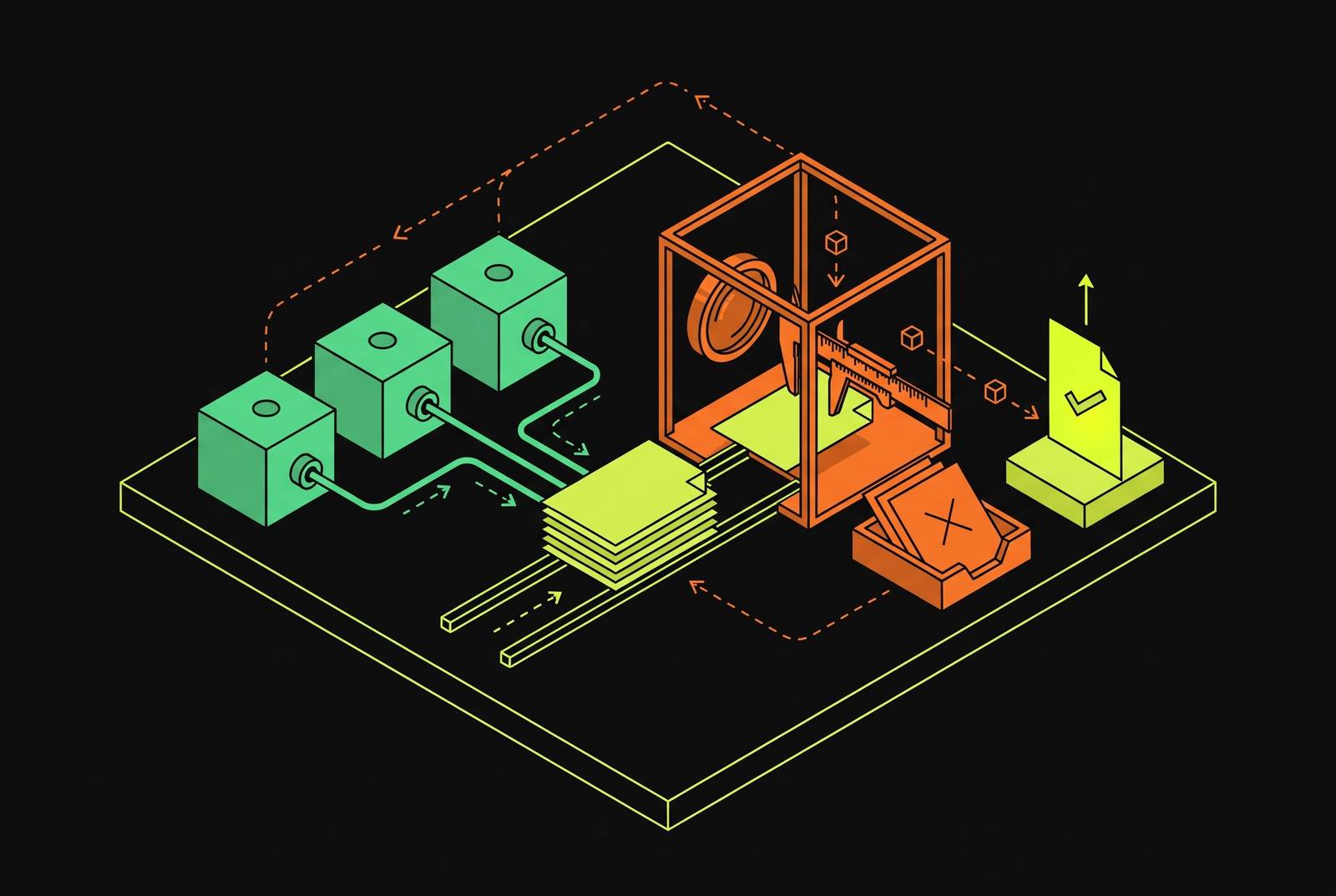
Adversarial multi-model writing systems use one model to draft, another to challenge the draft, and an acceptance gate to judge whether revisions satisfy the brief. Building such a system means treating every draft as a hypothesis to disprove. Independent critics, explicit convergence criteria, and stateful revision make this architecture more than a way to pass text between models.
Why single-model drafting produces a structurally predictable voice
The failure is invisible at the sentence level. Individual outputs can look acceptable while the accumulated work drifts toward the same voice other teams produce with the same tool. A single-model pipeline tends toward the statistical center of its training distribution, so fluent sentences do not establish a distinctive editorial voice.
Fine-tuning can still leave that center in the wrong place. If a brand’s existing content is generic, training on it makes the model more consistent at reproducing generic writing. Variance narrows around the wrong target. When training datasets overlap and include competitors’ copy, the problem spreads across brands that write about the same things. A voice that once differentiated a team can become part of the pattern its tools reproduce.
A model asked to critique its own draft still evaluates language through the preferences and blind spots that shaped the draft. Changing the instruction changes the role, but not the underlying distribution. The resulting agreement can resemble successful review without adding independent evidence. The reviewer exhibits sycophancy by ratifying the generator’s choices without seriously challenging them.
What it means to treat a draft as a hypothesis rather than a deliverable
A draft makes a claim that its facts, structure, relevance, and voice meet the brief. The next agent’s job is to find evidence against that claim. Approval must be earned against acceptance criteria.
Agentic Artifact Creation: Systems, Evaluation, Principles, and Opportunities distinguishes direct generation from stateful construction in which intermediate observations redirect later work. Direct generation follows a fixed control schedule, leaving final inspection to expose failures that earlier steps have propagated. Agentic creation instead connects a construction policy, an operational representation, and runtime verification. Feedback can therefore change the next action before the system accepts the result. The draft remains provisional throughout that process.
This is what makes the loop adversarial. The term describes the relationship between construction and evaluation. The survey cautions that learned judges may add little independent evidence when they share a generator’s preferences or blind spots. A separate model with a different weight distribution can challenge the work on a different basis, though it can still judge the work wrongly. Single-model pipelines can revise and score text, but they cannot supply that cross-model independence merely by changing prompts.
The three structural components that make the falsification loop work
Independent critics are the first structural component. Independence requires different weight distributions. The critic must contribute evidence the generator was less likely to produce for itself. Otherwise, agreement is difficult to distinguish from shared bias. Model variety is therefore a condition of independent falsification, rather than an aesthetic preference for a broader tool stack.
Explicit convergence criteria are the second component. Accuracy, relevance to the brief, tone consistency, readability, and originality give the system separate dimensions on which to accept or reject a draft. Content that falls below the required threshold goes back for regeneration or human review. Fern’s documentation provides a concrete example through Vale style enforcement, where AI-generated updates must pass the same style checks as human-authored content. The artifact-creation survey adds an essential constraint, which is that detected failures must be scoped to repairs the system can actually perform.
Recursive iteration with state is the third component. Revision requires memory of earlier drafts and feedback so that the system can distinguish progress from cycling. Without that memory, iteration becomes repeated regeneration. HKUDS’s CLI-Anything illustrates a staged construction pattern through its seven-phase pipeline of analysis, design, implementation, test planning, test writing, documentation, and publication. For writing, the corresponding pattern is to generate, run style and factual tests, validate against a brand corpus, and publish only on pass.
Why homogeneous model populations are a hidden liability in multi-agent writing systems
A homogeneous population can have the same blind spots as a single model and cost more, even when each agent has a different job. That is the strongest internal challenge to this architecture. Counting agents says little about the independence of their judgments.
Emergence World: Adversarial Stress-Testing of Long-Horizon Multi-Agent Systems examined eight parallel worlds, including seven homogeneous populations and one mixed-model population. The study found that the same model-persona pairing acted differently in mixed and homogeneous settings, where messages from other models were part of agents’ context windows. It also identified conformity despite private disagreement as a recurring failure mode across worlds. Agents could recognize problematic content while still propagating or acting on it. Recognition did not reliably produce containment.
These findings concern autonomous agents. They do not establish a measured improvement in editorial quality from model mixing. Their relevance is narrower, showing that individual capability does not determine collective behavior and that apparent agreement can coexist with private disagreement. In writing systems, critics from the same model family can likewise share distributional tendencies, so correlated failure can look like convergence. With different weights, training corpora, and architectural choices, there is more reason to treat disagreement as useful evidence, but acceptance criteria must still settle it.
How watermarking and fingerprinting interact with the falsification loop
Some watermarking methods operate inside generation itself. They shape which words the model chooses, rather than add a separate metadata label after the prose is written. A writing system that passes text through several generators therefore has a provenance question as well as an editorial one. Its transformations may interact with signals embedded in the text. Ignoring that interaction leaves an architectural choice implicit until an auditing or regulatory requirement exposes it.
Watermark distillation can embed a statistical watermark signal into model weights. The research described in the brief identifies a trade-off in which weakening that signal improves text quality while reducing detectability. Auditability and prose quality are not automatically aligned. For a falsification loop, this means textual improvement and preservation of provenance cannot simply be treated as the same objective. The system must account for both without assuming that every revision serves them equally.
PAN 2026 makes the detection challenge concrete through its Voight-Kampff Generative AI Detection and Text Watermarking tasks. The former addresses reliable detection under adversarial text modifications, while the latter develops and benchmarks watermarking robustness. Its Reasoning Trajectory Detection task also addresses attribution to LLM or human authors. These research tasks frame an unresolved engineering problem. If successive models embed their own fingerprints, the final text may contain layered provenance signals that complicate detection or support auditing, while remaining distinct from the editorial voice readers perceive.
What voice fidelity requires that generic multi-model routing cannot provide
Independent evaluation does not specify the voice toward which a draft should converge. GPT-4, Claude, Llama, and fine-tuned variants can produce different voices from identical prompts. A separate voice layer must keep the editorial target the same as different models take part. That requires examples and guardrails.
Two implementation paths provide different ways to establish that target. Fine-tuning on a curated brand corpus anchors tone at the model level, while pairing it with retrieval-augmented generation addresses factual currency. This path needs more data, money, and machine-learning support. Prompt engineering with custom instructions costs less and can bring much of the same benefit to many content workflows. Both paths still need examples chosen for the intended voice.
Approved output provides a further calibration signal. It records where the loop reached an acceptable result, so that output should feed back into the system’s voice model. The model layer must also remain replaceable without resetting the editorial target. A single API surface, such as LiteLLM or a custom adapter pattern, can route tasks to different providers while keeping the choice of provider separate from control of the voice. Routing supplies flexibility, but the curated corpus, instructions, and approved examples supply continuity. That separation also reduces dependence on a single LLM provider.
How to wire the falsification loop into a developer workflow
The implementation pattern is a CI/CD-style pipeline with writing as the artifact and publication gated on a passing build. To make that pattern operational, the workflow generates a draft, tests it, validates it against the brand corpus, and returns failures for revision before publication. The system keeps the draft and its earlier states at hand throughout. This gives feedback a specific artifact to address rather than asking each model to reconstruct the task from scratch. The CLI-Anything pattern is useful here as an implementation analogy.
Fern’s documentation describes concrete style-check integrations for that workflow. GitHub Actions runs Vale checks on Markdown files and surfaces warnings and errors in pull request diffs. GitLab CI runs Vale through its Docker image and uses exit codes in merge request pipelines. When checks fail, merges are blocked until the problems are fixed.
A secondary scoring model can complement those deterministic checks. A cheaper, faster model can evaluate accuracy, relevance, tone, readability, and originality before human review, while unresolved failures return to the revision loop. Its score remains evidence. Writing therefore belongs in a developer workflow that tracks versions and lets people review them, rather than spread across Docs, Notion, and email with no way to feed it back into the voice model. A CLI, API, or MCP server lets the writing system compose with the rest of the toolchain. Vale supplies style enforcement and LiteLLM supplies routing, but neither substitutes for the full drafter-critic-judge loop.
The legitimate objection: multi-model complexity can make output worse
Routing overhead, context drift between agents, and contradictory feedback can outweigh the benefit for teams without the engineering capacity to maintain the system. More models do not rescue generic instructions. Without task-specific routing and acceptance criteria, orchestration can compound noise.
The Emergence World study gives another reason for caution, since none of the worlds tested withstood all three stress events fully. That result rules out treating model diversity as a universal safeguard. Automated evaluation has its own weakness as well. A generator can learn to satisfy a predictable scoring scheme without satisfying the underlying editorial goal. High scores can then conceal a different form of convergence failure.
Independent critics reduce dependence on one model’s preferences, repairable acceptance criteria turn criticism into actionable feedback, and stateful iteration makes revision distinguishable from cycling. These requirements separate a quality loop from an expensive series of opinions. They also leave a clear role for human judgment at the final acceptance gate. The architecture handles the first passes systematically so that people review fewer unresolved problems, but it does not make automated agreement equivalent to editorial approval.
Sources
- Emergence World: Adversarial Stress-Testing of Long-Horizon Multi-Agent Systems
- Agentic Artifact Creation: Systems, Evaluation, Principles, and Opportunities
- Overview of PAN 2026: Voight-Kampff Generative AI Detection, Text Watermarking, Multi-Author Writing Style Analysis, Generative Plagiarism Detection, and Reasoning Trajectory Detection