Which Professional Writing Workflows Rely on Model-vs-Model Critique Loops
Drafting, critiquing, and judging work best as separate jobs.
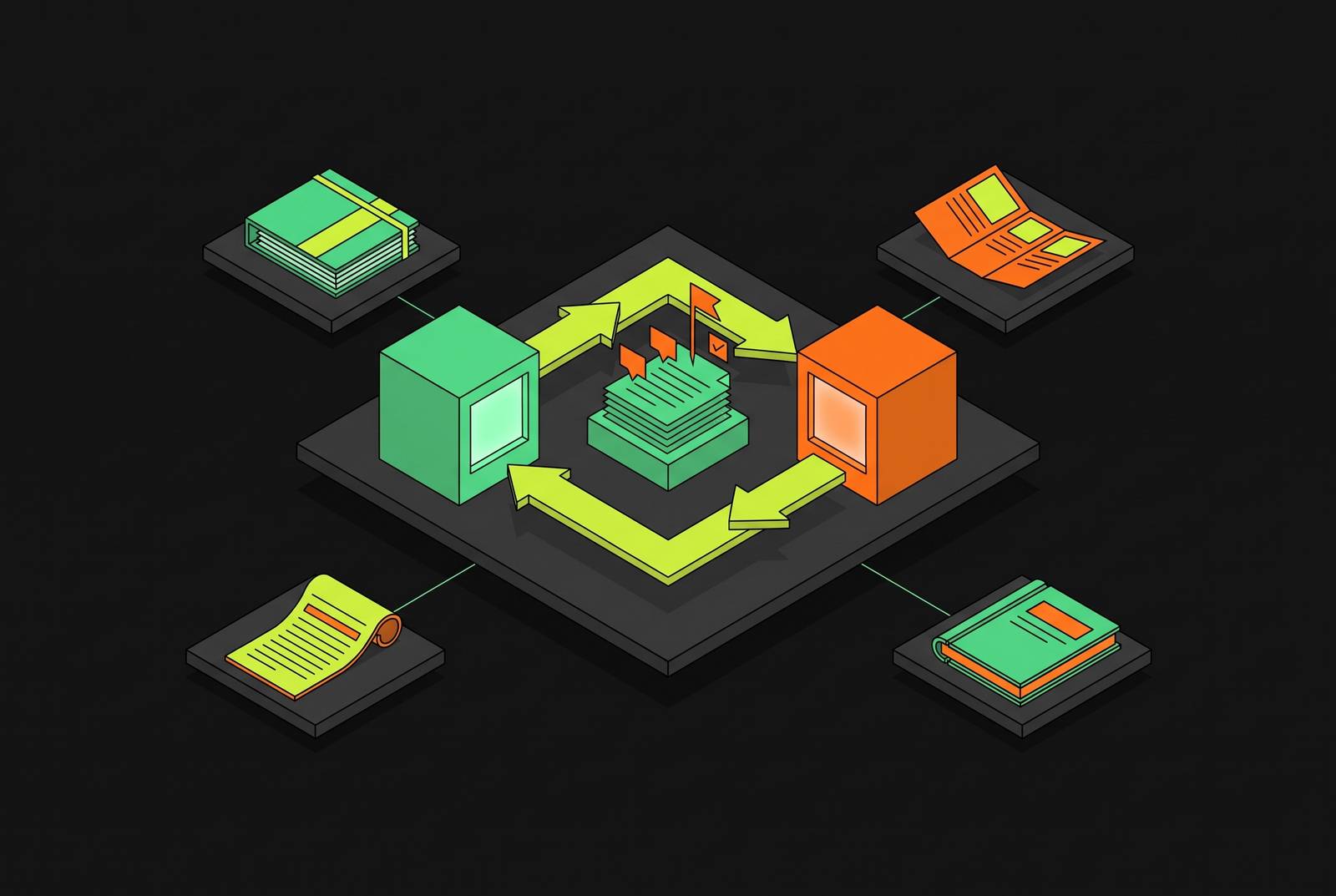
Adversarial multi-model writing systems use one model to draft, another to challenge the draft, and a judge or reconciliation pass to resolve criticism before revision. Scientific publishing, technical documentation, academic drafting, and content marketing need this split because a draft that reads well may still be unfit to publish. The decisive feature is not the number of models, but whether the pipeline tests the draft against criteria the generator does not adjudicate for itself.
Why do AI writing systems use one model to challenge another model’s drafts?
Drafting and evaluation are different tasks with different objectives. A generator must plan, synthesize, and express an argument, while an evaluator must find unsupported claims, missing coverage, or departures from an external standard. Combining those responsibilities in one pass leaves the output coherent but unchallenged. Fluency is not evidence that the challenge occurred. A model’s agreement with its own draft cannot establish that it has found the assumptions responsible for the draft’s weaknesses.
The critique loop separates these responsibilities into an architecture. The loop treats disagreement as evidence to look into. The logic resembles adversarial testing in software, where a function that has never faced bad input has not been tested against failure. A stronger generator does not eliminate the need for that test, because generating a plausible answer and exposing its defects remain distinct jobs.
This separation also changes what counts as useful feedback. Praise adds little unless the evaluator has applied a relevant standard, while a specific objection can expose a weakness that fluent prose conceals. In professional contexts where correctness, coverage, or fidelity must be assessed independently, external critique is a necessary part of the writing architecture.
What makes scientific publishing structurally dependent on external critique
Related work generation, review generation, paper revision, and novelty assessment require different judgments, even when they concern the same research. A useful review comment must support revision, while a novelty assessment must reason about a contribution in its domain. One general rubric cannot settle both questions. Scientific evaluation must combine subject knowledge with the requirements of the particular writing task.
UKP Lab’s Reward Modeling for Scientific Writing Evaluation demonstrates how general-purpose LLM judges can fail at that combination. A vanilla judge describes a review comment as non-actionable in one sentence, then implies the opposite in the next. The contradiction is more revealing than an isolated wrong score because the evaluator has not applied its criterion consistently. A critique loop built around that evaluator could return confident feedback without providing a dependable basis for revision.
The paper’s purpose-trained reward model, SCIRM, addresses this gap through training that first optimizes scientific evaluation preferences and then refines reasoning. The evaluator must learn what an actionable scientific comment is before judging whether a particular comment qualifies. Its multi-aspect evaluation design and joint training across diverse scientific tasks support generalization to unseen tasks without task-specific retraining. That makes the evaluator reusable infrastructure rather than a separate scoring tool for every assignment.
Asking the drafting model to act as a reviewer does not by itself give it different evaluation preferences. In this setting, the critic needs purpose-built training that grounds its judgments in scientific criteria. Human peer review separates authorship from assessment for the same structural reason.
How the TriAdReview architecture formalizes multi-model critique for technical documentation
Technical documentation adds a problem because reviewers can have sound reasons to disagree. An engineering reviewer and a security reviewer may find different defects in an architecture, while neither perspective alone establishes that requirements are fully covered. Review must both elicit different objections and decide what happens when those objections disagree.
Zhiqiang Zhou, Junliang Dai, and Xu Ling’s 2026 TriAdReview paper formalizes that decision through a triangular adversarial review architecture. Two independent reviewer models attack the generator’s output from distinct positions, one focused on engineering and the other on boundaries and security. When they disagree, a third-party judge resolves the dispute. Neither reviewer may adjudicate its own contested judgment. The authors describe this triangular mechanism as the first formal dispute resolution protocol for multi-model review that prevents self-adjudication.
This arrangement gives disagreement an explicit place in the system. An informal workflow can collect several opinions without defining which objection should control the revision. TriAdReview instead separates the production of criticism from the authority to settle contested criticism. Its structural advantage over single-model review is therefore not simply an additional reading of the document. It provides distinct review objectives and a resolution mechanism that does not belong to either disputant.
Tests of TriAdReview across five benchmark tasks and 75 experiments found that it did meaningfully better overall than the single-model baseline, but the gains were uneven across task types. Adversarial review harmed completeness-oriented tasks and was redundant for review-type tasks. More challenge was not always more useful. The lesson for technical documentation is to distinguish completeness checks from adversarial security review and route tasks to suitable reviewer configurations, rather than apply the same pressure to every document.
Adversarial co-thinking as a live practice in academic writing, and what it reveals about the skill at stake
Pia Tukkinen’s Adversarial Co-Thinking paper identifies sycophantic feedback as a central obstacle to serious academic use of generative tools. Tools that default to praise can help put an argument into words without testing whether it holds up. Agreement can make a weak argument feel settled. Tukkinen’s account, presented at a CHIWork 2026 workshop, describes drafting an academic paper from its first sentence in parallel with Claude, ChatGPT, and Gemini to surface disagreement.
The practice combines calibration with triangulation. Calibration uses past peer reviews to show the tools what substantive criticism looks like, giving them an external standard they did not generate themselves. Triangulation then sets their responses against one another and against the researcher’s intended contribution. Divergence is the productive result. Unlike triangulation that seeks convergent validation, this practice looks for points in an argument that are still in dispute.
That comparison also exposes what the paper calls “articulation capture,” a phrase coined by ChatGPT. A tool’s confident formulation can substitute for the researcher’s thinking without that substitution becoming apparent. A competing response interrupts the apparent finality of the first formulation by making another interpretation available for assessment. The researcher must then decide which criticism is sound. The presence of several models does not make that decision automatic.
Tukkinen’s account consequently places evaluative judgment above prompting skill. The loop can amplify expertise when the researcher can distinguish a substantive objection from confident noise, but it can mask the absence of expertise when every polished response appears persuasive. This is a practitioner account of a demanding writing practice.
Why content marketing is where single-model failure is most commercially visible
In content marketing, these failures appear in writing that customers read directly. A scientific draft may go through formal peer review, while a made-up claim in a published blog post can reach readers before anyone challenges it. Voice drift and stylistic homogenization are just as visible, because the writing itself stands for the brand. In this context, a draft’s apparent fluency can conceal defects until they become public commercial liabilities.
A model may preserve the intended voice early in a long draft, then lengthen sentences, formalize vocabulary, and reintroduce filler. As the team produces more documents, its writing can start to sound more like the model’s default style and less like the brand. The pipeline needs a check against approved writing throughout the document.
A queryable brand corpus supplies that reference. Approved content stored as vector embeddings can be retrieved during critique so that the evaluator checks the draft against examples that supplement a static style guide. The critic’s job is to flag specific departures and return actionable feedback. The generator then revises against those findings. This preserves the distinction between producing fluent prose and assessing fidelity to an external corpus.
The same gate can also check factual claims and recurring stylistic anti-patterns before the draft is published. That gives these checks a defined place in every generation cycle. The architectural connection to SCIRM and TriAdReview is precise. The evaluator has a different objective from the generator, and publication depends on responding to that evaluation.
What watermarking and model fingerprinting add to critique-loop pipelines
Multi-model revision also introduces an attribution constraint beyond writing quality. Where AI watermarking becomes a compliance requirement in regulated markets, the content owner needs to understand which models processed the published text. A final document alone may not reveal that history. A pipeline that mixes generation, critique, partial rewriting, and human editing must therefore account for provenance as well as the quality of its revisions.
Token-based watermarking nudges word choices during generation into a pattern detectable by a party holding the appropriate key. The signal is invisible to readers but recoverable by a detection system. If different models generate or rewrite portions of a document, the result may contain layered or competing marks. Merely reviewing a draft is distinct from changing its tokens. Attribution therefore depends on what each model did during its pass.
A detected mark also needs careful interpretation. Evidence that a model processed text is not equivalent to evidence that it authored the entire document. That distinction becomes especially important when human editing and AI rewriting are interleaved. Attribution must track who contributed what and in what order, rather than assign the finished document to a single source. Watermarking is consequently a design constraint to accommodate.
For teams building these pipelines, the lesson is to record which model handled each pass and preserve the corresponding versions. CLI and API-native workflows make each model call a discrete, loggable event, giving the pipeline a recoverable execution history. Versioning then serves a second purpose beyond rollback. It connects changes in the text to the process that produced them, turning provenance into part of the writing infrastructure.
How developer tooling makes critique loops composable and production-ready
A production critique loop can be expressed through three primitives, namely a voice file, a critique gate, and a CLI or API harness. The voice file contains approved examples, extracted patterns, and explicit anti-patterns. The gate evaluates output against that artifact and returns structured, actionable feedback under an objective distinct from generation. The harness chains the calls and manages recursion. Together, these components let routine drafting and revision proceed without manually coordinating every pass.
Treating the voice file as code makes those rules maintainable. A git repository can version the artifact, project configuration can reference it, and a rollback can restore an earlier version when output quality degrades. Templates delivered through API, CLI, or MCP integration can make brand rules available from the start of an automated workflow. Automation makes the agreed criteria repeatable without requiring a human review pass on every output.
Open-source tools illustrate components of this pattern rather than interchangeable end-to-end adversarial systems. dannybosie/slop-lint lints marketing copy for AI tells, buzzwords, and em dashes through a CLI, GitHub Action, and browser playground. Kunci-Tech/voicepack compiles a token-budgeted voice pack from a JSON persona store and lints drafts against it, with zero dependencies for Node >= 18. Their writing fit is specific and bounded. Neither capability alone establishes a drafter–critic–judge loop, but each addresses rules that a larger pipeline can apply.
SCIRM supplies specialized scientific evaluation, TriAdReview formalizes reviewer disagreement, and Tukkinen’s practice demonstrates human-led calibration and triangulation. Developer tooling can encode the relevant criteria, automate iteration, and version the artifacts those checks depend on. The resulting system is defined by the harness that makes drafts answerable to independent standards before they become published writing.