Designing the Handoff Between LLM Passes as an Editorial Brief
Typed briefs and acceptance gates stop AI pipelines from silently losing caveats.

Recursive AI writing pipelines refine content through repeated generation, evaluation, and rework. Their reliability depends on structured editorial briefs between passes. Each brief must preserve intent, evidence, scope, and voice, while an acceptance gate blocks the next stage until those requirements are met.
Why the boundary between LLM passes is an editorial problem, not a plumbing one
A research model returns a careful finding limited to a particular population and task. The writing model receives a compressed summary without those limits and turns it into a confident general claim. The JSON payload parses, the next stage runs, and the prose reads well. Nothing in the transfer reports a failure. Yet the sentence now claims more than the evidence supports.
That handoff is an editorial decision. A protocol can establish that a payload arrived in the expected format, but it cannot establish that the payload preserved the grounds for a claim. The missing qualifier determines what the next model is entitled to say. Removing it changes what the sentence means even when every word left in it is accurate.
This makes the boundary between research and writing an interface for editorial judgment. It must distinguish evidence from interpretation, retain the limits of each finding, and communicate which transformations are permitted. Otherwise, the receiving model must reconstruct those decisions from prose that may no longer contain them. Fluency then conceals the loss. Pipeline reliability therefore depends on how the architecture separates drafting from judgment.
How information degrades across model boundaries without anyone making a mistake
Information can degrade without a model inventing anything. A data gap occurs when a necessary fact or caveat never crosses the boundary. Signal corruption occurs when a number, qualifier, or citation changes during transfer. Referential drift occurs when “this study” or “they” points away from the intended source, a structural transfer loss that, like the others, can leave a readable sentence behind.
Scope inflation and verification theater stem from how the system around that transfer is built. Scope inflation turns a narrow observation into a general claim because the receiving stage lacks, or does not enforce, its limits. Verification theater substitutes downstream checks of fluency or format for evidence alignment.
Adding another model does not repair that relationship automatically. A relay working from the same information can reorganize evidence, but it cannot add facts unless new external signals enter the process. A further rewrite may compress away another distinction while appearing to improve the argument.
These failure modes also provide a practical diagnostic. A handoff can be inspected for missing caveats, altered qualifiers, broken references, expanded scope, and checks that never consult evidence. Each defect shows what a boundary contract must keep or check. The failures are auditable, which makes them suitable for acceptance gates.
What a structured handoff brief must encode to prevent silent degradation
A structured handoff starts with a content object. The object holds the audience, problem, main claim, supporting evidence, voice, and things that must not be said. The article is a rendered view of that object. This distinction protects intent across revisions. A later pass can change the prose without being allowed to redefine the underlying assignment.
A minimal JSON object can make the discipline concrete. Its fields can represent audience, problem, main claim, supporting evidence, tone, and visual_direction, with prohibited statements retained as explicit constraints. The structure can stay simple. Its purpose is to stop each stage from inventing a different brief from the text it receives. Where prose leaves relationships implicit, named fields make them available for inspection.
Factual claims need a more exact transfer contract. Each claim travels with a source URL and exact support, its applicable population, task, model, jurisdiction, and date, and an uncertainty classification of fact, estimate, interpretation, or prediction. These fields constrain the language available to the receiving model. A claim labeled “interpretation” cannot legitimately emerge as “studies show” unless new evidence supports that change.
Voice requirements belong in the same artifact. Banned terms, rules for structure, tone markers, and examples of output that meets the brief give the next stage clear guidance to follow. Provenance must also travel with every artifact, including the content object version, model, prompt template, and timestamp. That record connects an output to its source and build configuration. Without it, identifying a faulty sentence does not establish which handoff lost the constraint that should have prevented it.
How typed role contracts build an AI writing system that refines its own output
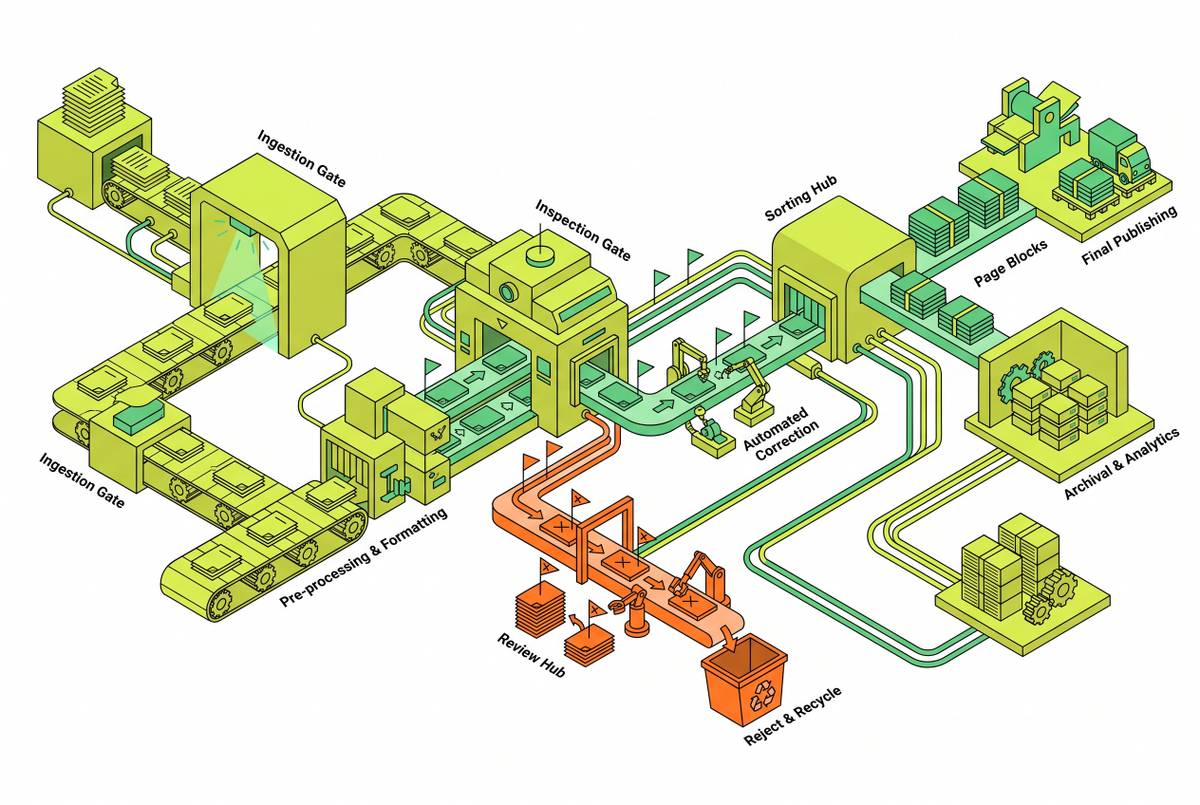
The Editorial Mesh organizes a multi-model operation around specialized roles that communicate through typed handoff artifacts. Each role has a scoped job, a specialized prompt, and an evaluation rubric. The architectural unit is the contract between roles. This turns the brief from a useful input into a requirement that governs how work moves through the system.
At each boundary, the upstream role produces a typed artifact and the downstream role accepts it against a rubric. A failed artifact returns through a typed rework-request payload that identifies what is missing. “Please redo this” asks a model to guess at the defect, while a request tied to a missing evidence field or unsupported claim directs revision toward the actual failure.
Independent evaluations keep those contracts meaningful. Research accuracy, writing voice adherence, editorial argument tightness, SEO keyword coverage, and QA fact-check pass rate are separate scorecards because they measure different obligations. One final judgment of quality can hide which role failed. Where possible, QA should use a different model family from the writing stage, since a model that checks its own work tends to judge it too kindly.
Typed artifacts also permit parallel work where the dependencies allow it. Research and SEO work can run concurrently and feed the writing stage through one shared Content Brief. Parallelism makes a shared contract more valuable, because inputs made separately must still meet the same editorial brief.
How voice configuration travels across passes without drifting toward generic output
Voice erosion can go unnoticed in a pipeline that otherwise works well. The output remains grammatical and readable while moving toward a generic, slightly corporate tone. An editor reviewing one item at a time may not see the cumulative change. A long-time reader may notice it first. Across hundreds of entries processed in bulk, the publication starts to sound different without a technical error.
Versioned configuration should include a glossary, banned terms, structural requirements, and annotated examples in every handoff artifact. A separate tone-of-voice document that the model never receives cannot constrain a revision. Broad adjectives also fail to pin down what makes a voice its own. The receiving stage needs actual linguistic patterns and sentence-level examples of approved and rejected output.
Explicit failure-state labels make those examples useful for evaluation. They identify what has gone wrong. This gives the acceptance rubric a basis for rejecting voice drift even when the prose is otherwise polished. It also keeps successive passes accountable to the same configuration.
Fine-tuning can embed voice in model weights rather than relying only on prompt instructions, but it requires a substantial, highly curated corpus and maintenance as the voice evolves. It is not a substitute for specificity. If the approved material is generic, fine-tuning reproduces that generic voice more consistently. Approved published pieces, supplemented where needed by written and reviewed annotated examples, provide the basis for a useful corpus. The system still needs the brief, because each role or model must be able to see the constraints when it receives the content.
Why the handoff brief must include an acceptance gate, not just acceptance criteria
Acceptance criteria state what an artifact must have to pass. An acceptance gate blocks the pipeline until the artifact passes. A brief that asks for evidence, scope, and voice adherence remains advisory if the next stage runs regardless of whether those requirements are met.
The engineering parallel is a test harness. A test harness checks code against defined expectations rather than accepting a claim that the code should work. A writing harness applies that discipline to editorial artifacts before the next role begins. Format validation establishes whether the expected fields exist, while the acceptance rubric addresses whether their contents satisfy the brief. A parseable object is necessary for a typed handoff, but it is not evidence that the claims are supported.
When an artifact fails, the rework request must name the field or claim type that failed. The corrected artifact then faces the same gate. This is the basis of useful recursion. Seven passes to convergence can be useful when the gate checks that the defect has actually been resolved. Rewriting over and over gives no such rule for when to stop.
The gate also creates an audit trail. Compliance teams in regulated industries ask who reviewed AI-assisted content and against which criteria, and a prompt instruction cannot establish that a review occurred. Approval must therefore remain non-bypassable through delivery. A composition layer that serves content without checking approval status breaks that control even if earlier stages did their checks. Approved content and delivered content are distinct states, and the pipeline must preserve that distinction.
What pipeline designers get wrong when they optimize the model and ignore the boundary
Model selection and prompt refinement are attractive investments because they produce visible changes in individual outputs. Boundary design is less visible until a qualifier disappears, a citation drifts, or a revision flattens the voice. Yet those are failures a stronger drafting model does not inherently prevent. AI-assisted drafting is a basic capability that, on its own, cannot set one content operation apart from another for long.
Long contexts further weaken reliance on prompt refinement alone. Liu et al.’s 2024 study, “Lost in the Middle,” found that models were most reliable with relevant information at the beginning and end of a context, while performance degraded for information in the middle. A structured brief gives the pipeline explicit requirements that a gate can test.
Rather than asking only which model is best for a stage, pipeline designers should ask what minimum information the receiving model needs to honor what the previous pass built. That includes the handoff artifact, acceptance rubric, voice configuration, and claim-level transfer contract. These elements define what revision may change and what it must preserve. They also make failures specific enough to repair.
A schema-validated, versioned, model-agnostic brief becomes durable infrastructure when those contracts govern every handoff. A replacement model still has to satisfy the same requirements, and its output cannot proceed merely because it is fluent. The durable asset is not a particular sequence of models, but an enforceable definition of what each pass must leave intact.