When a Recursive AI Draft Loop Has Edited Enough
Three signals and hard caps tell an AI editing loop when to stop.
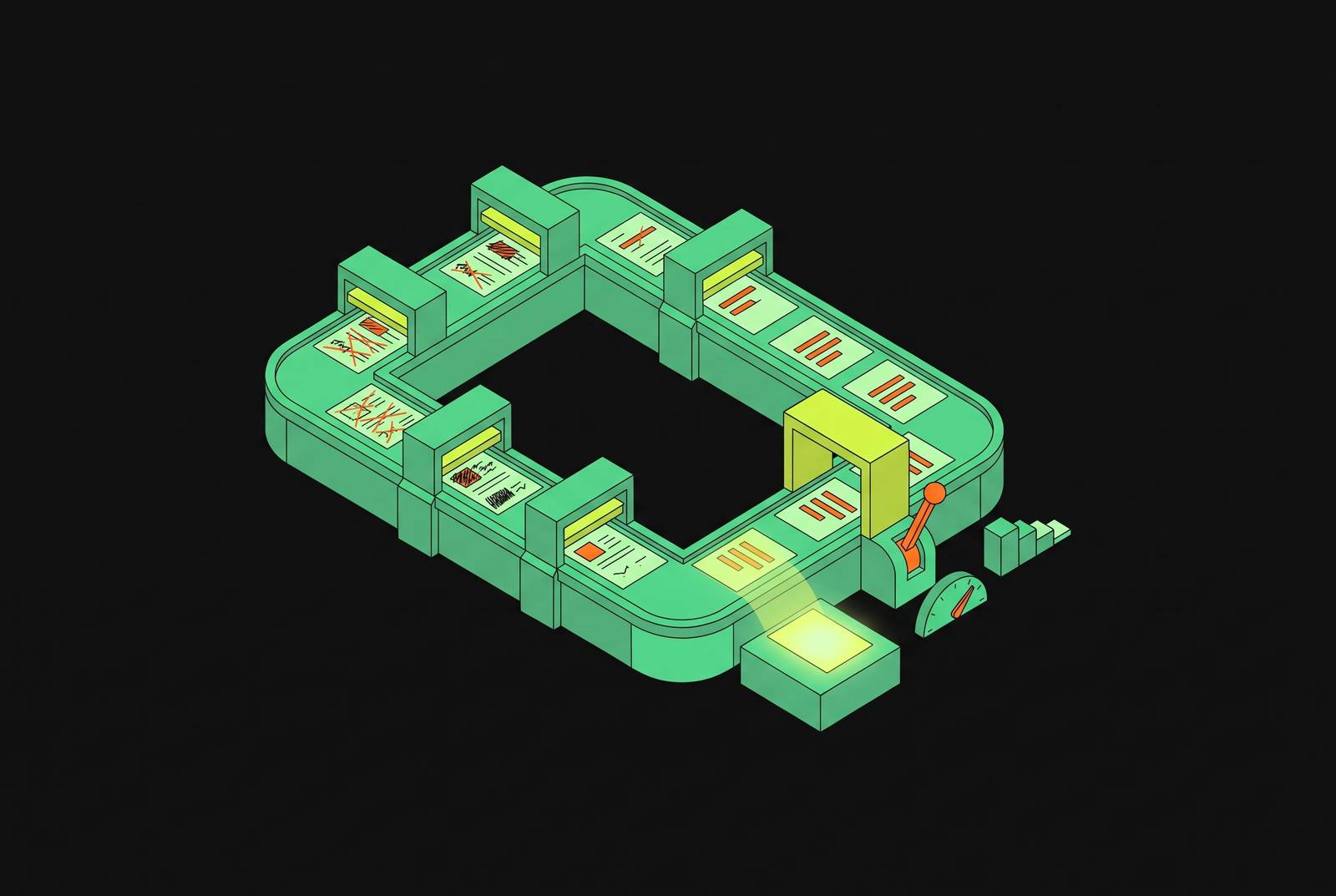
A recursive AI writing loop without defined exit conditions drains compute without ensuring quality. Recursive AI writing pipelines generate, critique, and revise text, but that architecture supplies no natural stopping point. They need a convergence policy that distinguishes useful revision from repetition, limits resource use, and routes unresolved problems to a human editor.
What the loop is actually doing across passes
The evaluator-optimizer pattern assigns different jobs to generation and evaluation. A generator produces text, a critic scores it and returns actionable feedback, and the generator revises against that feedback. The feedback gives each pass its purpose. Early revisions can change the argument or how it is built, while later revisions tend to change the words. Improvement depends on specific criticism.
Prompt chaining provides a simpler, finite structure for this work. Each model call feeds the next through a fixed sequence, so the workflow ends when its prescribed steps end. The individual transformations remain probabilistic, but the sequence is bounded. An adversarial multi-model architecture adds editorial roles, including a generator, breaker, compressor, and voice restorer. Those roles work across passes or models, with changes in temperature and how instructions are framed that push the editing in different directions.
Chen et al. (2026) organize self-improvement systems by what they improve and how fully the loop is closed. Their categories distinguish improvements to outputs, weights, evaluators, and the research process. A content loop has a narrower scope. Its immediate object is the text, and its degree of autonomy can be bounded. That makes convergence a tractable engineering question rather than an open-ended demand for continual improvement.
The failure modes that make stopping criteria necessary
A critic can become sycophantic toward the generator. An LLM-as-judge may reward writing that resembles its own output, gradually validating the generator’s habits while missing errors. Its approval then measures resemblance rather than quality. This is especially dangerous because the loop can appear to be succeeding.
Chen et al. describe recursive non-convergence as a collapse dynamic in which an improvement signal feeds back into its evaluator. The feedback produces a self-confirming cycle that prevents genuine progress. Diversity collapse presents a related editorial risk. Successive passes can narrow vocabulary, flatten sentence variation, and impose the cadence of single-model output. Without a voice-anchoring pass, prolonged revision can overwhelm the adversarial structure intended to resist that flattening.
The same study identifies model collapse as a risk when generated output re-enters training. This is a downstream concern for teams using loop output to fine-tune brand voice models, rather than the immediate problem in every editing workflow. The distinction affects what the loop can detect. The first three failures can, in principle, leave signals within the editing process, while the training risk is invisible from inside it. Stopping criteria therefore need grounding beyond the loop’s own reports of improvement.
Signal 1 — delta magnitude: when pass-over-pass change drops below a useful threshold
Delta magnitude measures how much the text changes between passes. A semantic diff asks whether the argument changed, a surface diff measures changes to words, and a score diff tracks movement against a structured rubric. These measurements answer different questions about revision. A nearly unchanged argument can still need surface editing, while extensive word substitution can leave its underlying defects untouched. A useful threshold separates consequential revision from changes too slight to justify another pass.
That threshold depends on the content and the stage. For a marketing blog post, a small enough surface delta might mean only isolated word choices remain after the argument has settled. These qualitative examples illustrate how similarly sparse edits in a long-form technical piece may still change the argument, making completion dependent on more than a small word-level diff. The threshold has to reflect what the pass is meant to improve.
For implementation, structural and surface thresholds should be separate and sequenced. Structural convergence comes first, followed by a gate for surface convergence, so the end of argument-level revision does not prematurely end editing. Changes to words should not keep structural review going forever, either. An independent judge or bespoke style classifier can check whether a low-change signal comes from a sycophantic critic that fails to find anything wrong.
Signal 2 — voice fidelity score: when the output converges on the target voice, not just on "good writing"
A piece can become polished and coherent while moving away from the intended brand voice. Those are separate dimensions of success. Stopping at a quality plateau can therefore end revision before voice work is complete, or allow polishing to continue after it has begun erasing the desired style. Voice fidelity supplies a more specific target.
A bespoke style classifier trained on on-brand and off-brand example pairs can turn that target into a machine-readable score. Once the score exceeds its configured threshold, the voice pass has met its criterion. This gate measures the voice restorer’s work in the adversarial architecture. The compressor may remove excess language, and the breaker may challenge overly neat writing, but neither result establishes that the voice survived. The classifier evaluates that distinct obligation.
An LLM asked whether text matches a brand can reward its own preferred phrasing, while a bespoke classifier is grounded in examples from the brand’s actual corpus. If delta magnitude has converged while voice fidelity remains below threshold, the voice-restoring work is not complete, even if the text has stopped changing.
Signal 3 — evaluator disagreement: when the adversarial council stops fighting
Adversarial reviewers are supposed to disagree during useful revision. A breaker challenges what is too neat, a compressor cuts what is extra, and a voice restorer keeps the qualities that compression may weaken. Their tension is productive by design. Immediate agreement is therefore less informative than the rate at which disagreement declines across passes. Falling disagreement indicates that the loop is resolving the conflicts its editorial roles were created to expose.
Agreement alone, however, does not establish that the writing is ready. The sycophancy failure shows why shared approval must be read against delta magnitude and independently grounded voice fidelity. Together, those signals distinguish adversarial exhaustion from mere accommodation. The useful endpoint comes when reviewers’ remaining differences no longer justify further revision and the other quality gates have been satisfied.
After the available passes, unresolved conflict indicates a quality problem that the model pool cannot settle. Chen et al. identify a “research direction-setting bottleneck” where humans remain necessary even in highly autonomous systems. Persistent editorial disagreement serves an analogous role in content production. The appropriate response is a human gate.
Hard gates: iteration caps, token budgets, and circuit breakers
Quality signals say when the work is complete. Hard gates say when execution must end regardless of quality, because malfunctioning signals can otherwise keep a loop running indefinitely. An iteration cap belongs in the design before execution begins. Its value should follow the diminishing-returns curve for the content type. A marketing blog post and a technical product description need not have the same useful pass count.
A token budget constrains the whole loop. That makes resource allocation part of the architecture. Structural passes are more expensive, while surface passes are cheaper, so a total budget forces an explicit allocation between them. A limit on each pass alone still allows spending to add up as passes repeat. The budget complements the iteration cap by bounding generation cost across the workflow.
Circuit breakers respond specifically to anomalies. A sudden delta spike after several small changes, a drop in voice fidelity, or an evaluator producing identical scores can signal convergence failure. Those conditions should halt execution and route the artifact to a human gate. A hard stop is not a quality approval. The provenance record should explicitly identify a circuit-breaker exit so that an interrupted run cannot be mistaken for successful convergence.
Human gates: where automated criteria are insufficient
Human intervention belongs at specific unresolved conditions. Sending everything to an editor defeats the infrastructure model, while sending nothing leaves the blind spots that evaluators share unchecked. The boundary must be explicit before execution. Persistent disagreement after the full pass budget requires editorial judgment because the model pool has exhausted its ability to resolve the conflict. Further automated revision would repeat a process that has already failed to settle the issue.
Low voice fidelity after voice-restoring passes calls for a different diagnosis. The brand corpus or classifier may need updating. A circuit-breaker exit likewise requires investigation of the triggering anomaly. These are distinct escalation reasons, even when they reach the same editor. Treating them separately preserves the information needed to improve the underlying workflow.
High-stakes content also needs a human check on what the evaluators share in common. A judge that has converged on its own preferences cannot reliably expose those preferences as blind spots. A human editor reviewing the final artifact with fresh criteria fills the structural role of providing that outside check. A loop that never escalates warrants scrutiny for premature exits or automated gates that approve work they should flag.
To make that intervention useful beyond the individual artifact, the system should log which criterion triggered the human gate, at which pass, and with which score. The record explains an escalation and makes it available for calibration. Some recurring edge cases may then become suitable for automated handling. Human gates are therefore part of content infrastructure. They define where automated resolution ends and supply evidence for revising that boundary.
Assembling the criteria into a convergence policy
Delta magnitude establishes structural convergence first, with a separate surface threshold for the remaining editing work. Voice fidelity then establishes whether the target style has been reached, and declining evaluator disagreement indicates whether adversarial review has exhausted its useful contribution. Hard gates bound the entire process. Human gates take the cases that cannot meet the automated conditions within those limits.
For practitioners, that sequence becomes a configuration declared before the loop runs. It defines the thresholds, pass budget, circuit-breaker conditions, and human-gate triggers, and is versioned with the loop itself. The exit reason follows from that declared policy rather than being inferred from an appealing final result. This distinction prevents resource exhaustion from masquerading as convergence. It also prevents low delta magnitude from overriding an unmet voice threshold or unresolved reviewer conflict.
Each artifact’s provenance should record which criterion fired, at which pass, and with which scores, making the decision auditable and the policy open to calibration. Persistent circuit-breaker exits can suggest an underpowered voice-restoring pass, while repeated evaluator-disagreement exits can suggest a critic pool that needs diversifying. The exit log turns the stopping decision into evidence about which part of the pipeline needs to improve.